
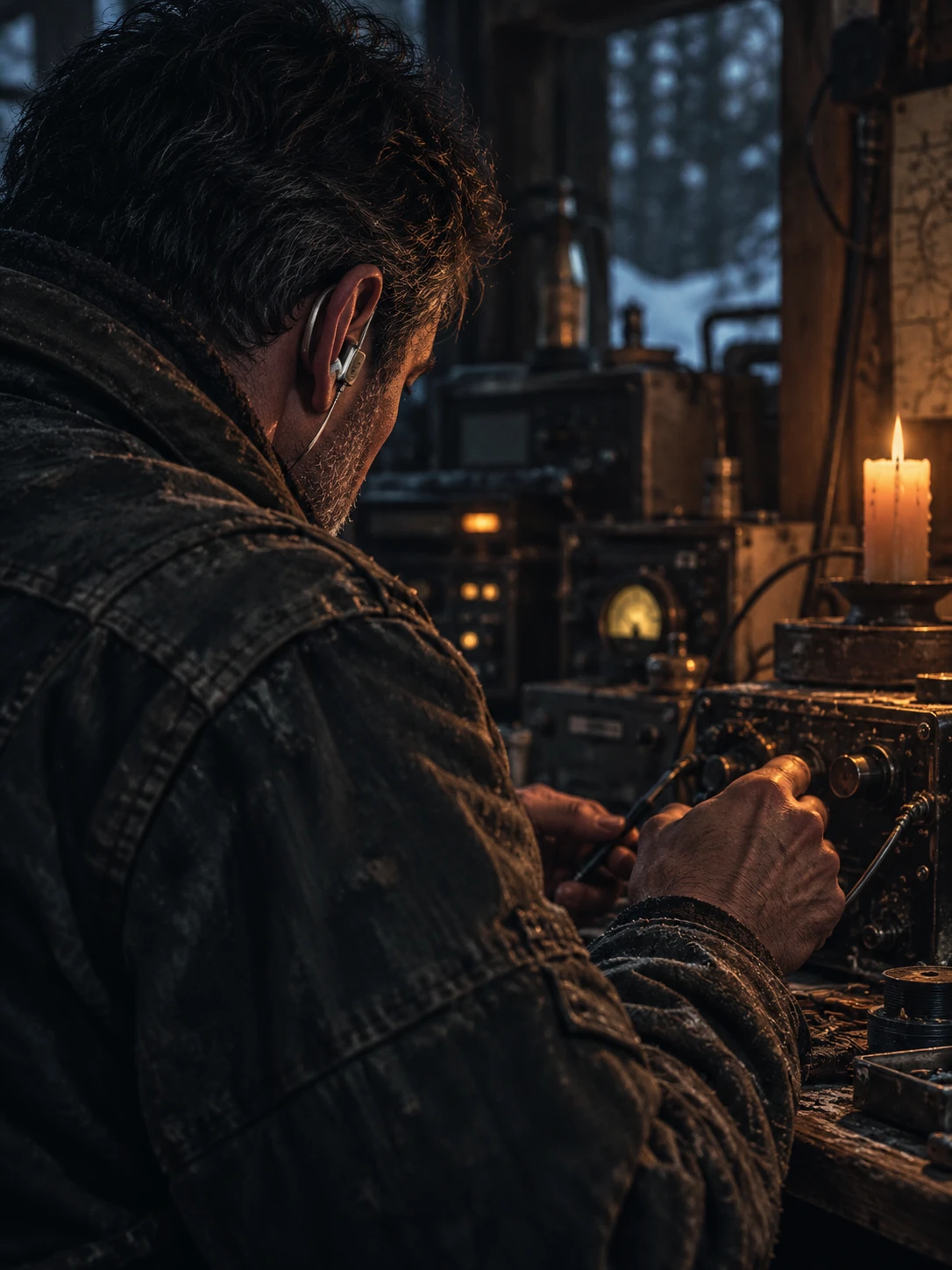
I was not a member of the Government. I remember well. I was friends with Captain Arsalan Rinchinov. He was retired from another era and worked as our electronics technician; behind his back swirled the hushed stillness of thirty jumps into the Absolute Not… But on his protective jacket the half-effaced number “nine” could still be seen. On his left earlobe he wore a silver radio earclip—a mark of particular reliability. He usually listened to cello music on it.
I remember well, I remember several times, that death flew past—it hit the “nine.” Who could have known why the captain had that half-effaced serial number stamped on the back of his protective jacket? How can a protective jacket protect you if it is numbered, as though expressly for someone, with a scrap of target, and in stark black and yellow at that? It flew past—made the flames of our candles and smiles waver: someone’s light bulbs and instruments burnt out, someone’s best shots with their mother-in-law were fogged, zippers broke on travelling bags, coffee boiled too long, there were premature births, or perhaps someone merely closed a little window blown open by a stray draught… It was among us—whether we spoke in half-whispers or laughed convulsively in cafés, lighting endless cigarettes, mumbled declarations of love to the autumn hats of chance female travelling companions in the midnight of thundering trains, or snapped matches a hundred times over as we lit every candle in the Temple of Falling Candles (near the everlasting fever of Rocket Park-1). Tape recorders set to “record” caught the faint, slender-throated song of the everlasting flower at that time; one synth-saxophonist told me that just then four of his synth-saxes had burnt out before he managed something remotely resembling Ch. Marker’s “Straztiz.” Everything, everything was out of joint with us! One big-jumper, the Blue Protest—what a jump it took! drifted, veered off course, shrivelled up in space…
Two Cosmoses lay before me, two Cosmoses: white and blue. And if the white one is a silent jogger running from a heart attack… (gladly I let the first snow deceive me)—then the blue?—…that is when there is nothing between her and August, she swims through the August water… But I understood their purpose: my past and future—I squeezed zinc white and ultramarine from the tubes, scattered geographical maps with the varying vastnesses of seas and the bridal whiteness of the sheets of unidentified continents, reread the blank verse in the blue cover of night, shook from the cigarettes of great snowy plains that closed my throat with longing the snow-white ash of seagulls into the azure majolica of the ocean…—and entwined it all with the all-mysterious Möbius strip, using it to tie my hair into a Chinese queue as well, so that, in accordance with safety regulations, it would not stray from beneath my thermal helmet.
…you say I tortured space, went beyond the horizon after the grey briefcase of the State Insurance agent—the Pied Piper drawing forth the slender-throated song of the everlasting flower? that I trudged by heart thirty kilometres from the tractor, from all those alarmizations—hurried, that only a day later a helicopter search party found me delirious and vomiting?—yes, into the black vein of the desert, into the ridged stomach of the sands… and do you know that I developed a dreadful vomiting, I puked up whole chunks of Time? cursed spaces erupted from me, events, eras… well, then, all those little hooks, little squares, little wheels, little springs, little minutes, little seconds, little blades of grass, little ants… this is—a Time to puke, is it? you reach your hands out to me across the marble estrangement of a morning café table, but you need not… know that there was nothing there but dirty soapsuds, and from everywhere, whirling spellbound, shaved seagulls and used Korean bicycles were falling, only seagulls and bicycles…—no, darling, it isn’t all so simple! it’s an orbital dream, what?! an orbital dream, I’m telling you: D!—R!—E!—A!—M!… eh? yes, yes, I can hear, Speak up, hell-o?!.. give me a room with a grey ceiling from west to north, hell-o!—well then, I suppose I’ll be going, darling, leaving you in this stone café… cheers! here I end my letter, give my regards to all our family and friends, all the very best to you… kisses, of course!
Yes, that was how it was, the age of all Accomplishments, we were forcing our way into the very depths of the Khuramchir Plateau. We were making a road, we were the first, we were swallowing space, simply drunk on it… Behind us, dwindling parabolically to nothing at the horizon, the highway of steel and concrete smoked milkily. Somewhere back there, a hundred abreast, cars hummed and strained, raced and burst. Beautiful women sobbed with happiness, choked on tears and died. Causeless children grew. The Government shovelled out the cash. I loved our tractor very much. Life did not sadden me. Ahead there was only insatiable heat and red-lead mountains. The Khuramchir Plateau. I worked dispensing and loading in the automatic canteen. At other times I wandered the dark passageways, raced up and down in the lift, swam in the little pool of cool water, or listened to little human stories if anyone felt like talking. Actually, I devised all sorts of little tricks to keep people, so long away from home, from going berserk on automatic food. I always loaded two or three extra little bottles of Captain Arsalan’s favourite sauced beer for him. I would have liked to live his walk and his glances, his hands, especially the way he held his head. Perhaps that is the clue to what is there—in the Absolute Not..? After all, they don’t say, or write about it in textbooks. In fact, no one knows. Jumps into the Absolute Not… had been discontinued. I would have liked to paint his portrait. Our school assignment for the summer—“a character in an interior.” That would be Captain Arsalan sitting in his habitual deckchair in the interior of the Khuramchir Plateau, wearing his distinguished old jacket, an optical long-ranger on his knees, looking into the distance at the red-lead mountains. “He Who Has Comprehended Silence”—that is what I would have called it.
Once I asked him to let me try on his radio earclip: silence lived there, a little Datsan of silence… Prayerful grasses bowed beneath the secret communion of the wind, a guard of feather grass held the Moon in silver, the everlasting flower sang its slender-throated song. Horses lived there too: ox-eyed, mists streamed from their manes, a scree of little stones spoke in crunches beneath their worn hooves, harness rings splashed with copper. And birds: the deep-pool mass of night creaked and rubbed against the roughness of their wings. There… a crooked Wall slashed with the scab of a lashing blow at the very heart of Asia’s depth; beneath it a grass-man lived face down, with pain and a humming all through his spine—from it grew a straight, hard arrow, yellow Buddhist ribbons rustling in the eternal draught of the pecked-open Asian heart… That was what I learnt. And I gave back the radio earclip with regret.
Usually I painted landscapes, little cardboard landscapes, settled beside the monumental caterpillar track of our tractor: an awning, an easel, a little chair, boxes of paints, a table with magazines and albums—I like to draw, and while thinking things over, to leaf through literature, look at the masters’ work or old photographs. I also like sipping lingonberry fruit drink from the planet Kapel—little fancies of mine… Everyone had flown home for the weekend, it was quiet, Captain Arsalan was on watch, and I had stayed with him. As usual, he was dozing, spread all over his biosensory deckchair; instead of the envisaged long-ranger, he cradled a little bottle of his favourite Market beer in his palms, and was not looking at the red-lead mountains. I looked and painted sunsets, and they were dense, somehow swooning sunsets: a bacchanalia of murderously crimson and crimson colour. Nothing else. Troubling. The mountains became mustardish then.
I worked peacefully and briskly, catching sidelong fragments of the captain’s sleep, marking them down in pencil for my all-summer painting. I took particular pleasure in sipping the fruit drink, since it came from the planet Kapel, where, they say, the lingonberry bushes grow chest-high and singing girls with colourful Indian headbands in their hair gather ripe armfuls of berries. A good acquaintance of mine had transformed herself to that very place, just when I had been meaning to make friends with her, artist to artist… Perhaps in this soul-warming drink there was the warmth and tenderness of her faithful hands as well? I seemed to have conveyed quite creditably that whole mass of oppressive space and the fact that only the devil knew when we would reach all that boundlessness. But it seemed too pompous, so spacious and gone wild: the flung-open desolation, the steep-browed faces of mountains, the heavy tides of sunset… On one of the hunching hills I added a small, fierce, tense figure of a rider on a shaggy little horse. Clamped like an iron staple into the windy distances, he watched worlds: a scout, a lookout, a messenger… It became simple and stern, like chess—he filled, as destined, the square of space in a combination decided long ago. Leaning back like the most imposing of masters, I casually leafed through my favourite magazines. Tart and moist, the fruit drink misted my memories with the promise of hands yet to come true… It was all that stupid painting driving me out of my mind, by some anciently distinguished artist: “The Lingonberry Harvest on the Planet Kapel,” whose unforgettable pomposity had supposedly adorned the vestibule of our school since time immemorial, that is why it all keeps seeming so to me, that is why I keep remembering…
Something broke in the evening, clicked, some switch… fell apart. A drilling trill ate thinly into the air and broke off, a startled murmur… a tremor—…a groan? I turned—the captain’s deckchair had crumpled, been flung backwards—he himself had twisted free, wrung himself out onto the sand, but had sprung up onto his knees, his fierce, dark face like the sight of an optical long-ranger with a dull play of sunset reflections, searching for something, tracking it through the ruled lines of the chessboard horizon… What?!—bewildered, I lived through this photographic collage shuffled in an instant by an angry hand. He rose straight from his knees, it seemed to me: ritually kissing the edge of the sunset banner, but wiped the long-range bitterness from his face, the grains of sand from his lips—or? I thought I heard… some ventriloquial spell, a prayer, a curse..?—Eh?!—again I failed to understand, but the captain was walking towards the entrance hatch with the frightening unsteadiness of a novice tightrope walker, or as though his path had been carefully mined and an explosion was to be expected at any second. And I understood nothing of his fate, but my evening had been frightened. Gathering my things, I thought about that gibberish phrase, some devilry or other?—“The shadow of the Father’s arrow”…—that was what he had said. I moved the deckchair he had left behind as well; the silver fish of the radio earclip flashed in the sand, it must have fallen out when he fell. I could not resist, I put my ear to the keyhole of the Universe. I seemed to hear instruments in different voices, the way an orchestra tunes up before playing; musicians talked at cross-purposes—their voices rustled like stiff, crumpled paper—or was it the wind turning the sheets of music? Someone’s fingers ran in secret communion over prayerful strings… an indistinct little pipe sang slender-throated… cymbals and little bells splashed out copper… a pianola rustled with ribbons in the wind… It could be heard, tangibly, really—someone came up, tapped the microphone, said: “in the gatehouse, in the park, in the black safe…,” and the reverberating echo took it up, carried it away, gave it voice—“…in the gatehouse, in the park… in the gatehouse…” Where was that from? What had lashed so across my heart? Was it not the white and blue Cosmos that had caught up with me and called me back?—it had happened, it had… But what was there, how did it go on? Why could I not remember…—or?—no, I shall entwine it anew and straighten out as a mysterious ribbon the blue-and-white band for my Chinese queue…
Laden with all my belongings, I caught up with the captain in the hall, held out the wondrous bright pupil on my palm. He remembered me painfully, patted my shoulder, went off in the lift. He did not have supper, shut himself in his cabin, sent word over the intercom that he was feeling unwell. Well, all right.
—And then something broke in our life, clicked, some switch…: Captain Arsalan grew thin and haggard, light bulbs and instruments burnt out, an alarmization-special-siren ate into us with a drilling trill, somebody was forever missing either breakfast or lunch… Coffee boiled too long, everyone wore a diligently angry face, at the pool I would notice only a wet towel just thrown down or a damp dressing gown belonging to no one knew whom. I even asked the shift supervisor: how many crew members were aboard?—Seven, as always…—he answered, evidently deciding that the latest of my tricks as a designer of unexpected joy was to ask idiotic questions. But I am not such a scoundrel and dunce that I should have to keep correcting some absurd mistake, and after thinking it all through carefully, I sent out eight portions and nine portions…—and the delivery robot delivered them all.
He came to me.
I recognized him at once. It was the grass-man: a small, withered Mongol in a shiny leather robe, a shaggy hat with ties, the toes of his soft boots looking up into our linoleum sky.
I was alone just then, in our tiny little bar, polishing my old but faithful shaker, hanging up coloured lanterns.
“Who are you?” I asked, spellbound.
“I am Geser Khan.”
“What do you want?”
“Give me vodka.”
I splashed some into a hefty shot glass that came to hand, but he pushed it aside with his elbow, accepted only a full goblet and drank it in one brief, serene draught. He stood swaying, sniffing his grassy, minty sleeve.
“Do you like little oatmeal pancakes?” I asked next.
“Yes…” He swayed blearily, pulled something out of the depths of his leather abode, laid it on the polished counter. It was a dark and ancient little broad spoon with a long handle.
“What is it?”
“It’s a little spatula for turning pancakes,” he answered, giving a broad, unrestrained snort. “My grandmother’s…” he added still more quietly, and went off, embracing with the arch of his horseman’s legs the far and the near, wildly fragrant with the honey of hoof-trodden grasses and spicy dust, the time of signal fires and nomad camps.
Batkhitkhvan Chumpura, a performer on traditional Indian instruments, had just flown in to visit us (hence the general tidying-up), and everyone began coming in and taking seats in the bar. He spent a long time tuning his sitar, he sang and played his music, kindled the enchantment of incense sticks, sweated all over, his face grew grey and gaunt as he rocked the pendulum of his cast, sun-through body.—…seagulls over the sea, you are white seagulls over the blue sea,—he said, or shouted?—to us from somewhere far below,—you have nothing to fear, relax, easy, everything is calm…—and we all became still more seagulls over the sea and flew, flew…—was it the music flying, his words, some ventriloquial spell?—was it the grass-man singing? prayerful fingers on the strings of the night’s secret communion, the slender-throated tidings of the everlasting flower, the rough tremor of mists streaming from manes, the rustling of Asian ribbons, the splash of little copper rings…—or was it the ringing of little bells—bracelets on the dusky bend of a wrist arcing evenly out of the August water as she swam from my orbital dream towards the region of the shore, irretrievable merely because I could not remember a phrase, its ending clear: “…in the gatehouse, in the park, in the black safe.” That was how the white and blue Cosmos caught up with me, took me into itself: …between her and August—there is nothing, she swims through the August water, not hearing how softly the bracelet rings—a cosmonaut weeps in an orbital dream…, in orbital flight, the cosmonaut is me, and she is that time, that song which I cannot, or dare not?—bring back, for I remember, I want to remember—and am afraid, and dare not, dare and am afraid from that world swimming away from me through the August water, running away like a silent jogger from a heart attack… (—why did he go running today?—with a thick line of footprints, like a cobbler’s waxed thread, he sewed the first snow down till spring). Or is all of this—HAYMAKING TIME?
you go away to the village,
and when you return—
women are wearing different shoes:
a golden one on one foot,
on the other—a purple one…
No, how can I think it through to the end, am I to blame for forgetting? And the music flew, drew us into itself, vibrated—and came in heavy tides of sunset, the whistle of an arrow, a rattling ventriloquial spell… and ended quickly, broke off, shuddered and died, drifted, veered off course, shrivelled up in space… A deep blow shook our tractor’s innards, some labour pains of the engine, the howl of the siren’s echo spreading in circles… The lights went out. We had certainly stopped, butting against the pressure of an invisible limit. Everyone scattered into the anxious gloom to their stations along the guiding threads of the emergency light conduit.
I had nowhere to run; with the great enchanter of seagulls over the sea I drank tea in the dim flicker of the emergency lights.
“A bad place, unaccountable…” he gurgled after all those cups. Some sort of energy absorber, the whole melody of the Cosmos drained into it like water into sand. “I’m very tired, very… I’ve never played so badly.” He fell silent, absorbing his tea, and added: “As though there were someone else here… Walking there, wandering…”
“What a bang that was! An accident, something’s happened,” I said, coming out of the spell of cigar incense
“That’s not what I mean…” The magician and sorcerer of traditional Indian instruments waved his hand.
“The helicopter will be here soon, it’ll take you away.”
“I meant to say…”
And so the white and blue Cosmos girdled me with two snakes: whitened and ultramarined me from the squeezing tubes of the Universe, wrapped me in the bridal sheets of unidentified geographical continents and the blue scarves of the varying vastness of seas, bewitched me with birds of blank verse from the blue cover of night, shook the snow-white ash of seagulls from the cigarettes of great snowy plains onto my majolica head… Thus the orbital dream foretold me, moving the white and blue little figures of events as destined in the chessboard squares of crimson horizons in a combination decided long ago
And the next morning we were still standing. The diligent anger of faces had closed in on some pre-birth contractions. Progress shuffled its feet in bewilderment behind our backs. Special teams swooped down. The devil brought the competent authorities too. One specialist summoned me to the library, where they had set up their office. His beard curled triumphantly in black, stiff paragraphs.
“Were you aware,” he began after the attendant half-statements and circumlocutions, “that there was also an eighth person on the tractor, not a member of the crew?”
I went slightly cross-eyed. Yes, there was no imagining yourself a stupid seagull over a stupid sea here; they could have deciphered the computer records.
“Correct!” He seemed to hook the timid whisper of my thoughts with his finger. “We have examined the computer records, even the robot’s food-delivery routes! Which means…” now he fished out his own little fish of conjecture, “you were in criminal collusion with video navigator Izya Faibushevich, who illegally brought aboard and maintained, in violation of the personnel regulations, his er-er-er… mistress! A certain, a certain…” He began catching some skinny scraps of paper on the desk, scattered by the fan. “But that is immaterial, we haven’t got to the bottom of it ourselves yet… What is it they say, ‘a woman aboard ship brings bad luck’?” He gave a slight chuckle, without, of course, violating the personnel regulations in the process, and I realized I was in for it! Izya Faibushevich…—what the devil had got into him?!
“But that is not all,” the pettifogging specialist beard continued, “look at this projection.” He handed me a sheet of graph paper. “The engine stopped because a certain foreign object penetrated the rotor. The local computer could determine neither the composition, nor the origin, nor the purpose of it, this er-um… object. It was split into atomic particles before the safety interlock engaged. Here is its graphic decoding.” He began poking and scurrying with his ubiquitous finger through the tangle and chaos of coloured lines and numbers. All manner of formulae and diagrams had made me sick since childhood, but here I could indeed make out a sort of elongated, onion-like thing with a long neck.
“Do you see, do you feel it..?!” the specialist busybody whispered reverently, spraying saliva and hooks, “more than anything it resembles a spacecraft, clearly of an origin alien to us! Possibly… an extraterrestrial invasion?—what do you think?”
I went back to my compartment, locked myself in and lay down. I thought nothing, it was simply funny: …extraterrestrials! an invasion! More than anything that er-um… object reminded me of a little spatula for turning pancakes! I took out that black, dried-up little bone of centuries, so remote from our life, and compared it by eye with the streamlined outlines of the graphic drawing. There could be no doubt!—exactly the same, but why had it been necessary to launch this strange message into our engine? I tied the unknown gift to a bit of wire and hung it on my chest beneath my jacket.
All the newly arrived people and our own gathered at midday to fly to the factory—or wherever else?—on their business. Either I was asked to stand watch (perhaps ordered?), or, on the contrary, forgotten in the confusion, or perhaps there were not enough seats, as sometimes happens—in short, I remained on this giant, cooling down from the roar and heat of work. I saw them off as they boarded the special team’s orange whirlybird. There was a woman with them too, but the devil take me if she was not the most ordinary, straightforward, very own wife of Izya! I had visited them once or twice, and now she gave me a faded smile, waved sadly. What sort of tricks were these!
And whatever I did, my time would not come right. Mechanically I leafed through little magazines, got wet under the shower’s little rain, wandered the colourless corridors, chirped with a pencil on cardboard, devised some food or other, but it was all dreary and worthless, all empty… Evening fell on me like a cardboard parachutist, sealing up and surrounding my lonely pastime with the shifting folds of taut, billowing night. I stood on the very top deck—and my life swirled around me, flew in the hushed stillness. With a frightening sweetness I loved my time, which I came to know as an unbroken tangle of events and happenings, omens and secret signs that so very many people did not live through, merely crushed beneath a heavy tractor or raced—where?—who knows!—in a bursting car. But the wondrous keyhole of the Universe flashed at me—a signal fire?! Who was it for? Who could be there?—ahead there was only inclement heat and red-lead mountains. Nothing. The Khuramchir Plateau.
There it was, stuck in my head, chattering like a camera for filming extraimportant events with a freshly loaded cassette; I took what was happening into myself as through an optical viewfinder, a film of sounds and voices revolved inside me. An answering signal fire lit up on the watchtower of an old foreboding—or expectation?—so that I could not fail to answer it, I walked, walked crunching through the sand, pressing down all that feather grass and other grasses, the cries of ancient nomad camps—tangled in the starry silk of the parachute night, with wondrous eyes I wanted to make out, with a dry throat—to drink this mirage… And after thirty years and three years of that night I reached it—a living, real fire; people were sitting there: my old acquaintance the grass-man and one other, I did not know him—crucified by the sun and the black wind on the cross of all the dusty roads leading to the holiest places, to the lost golden Mecca of all-forgiveness, so it seemed to me… They were roasting fish on a spit… Why do I know it was a spit?—why was it a fire, and they warming themselves beside it, passing the night, cooking food? Perhaps it was a stupid painting driving me out of my mind, by some anciently distinguished artist… some artist…—there it stands before my eyes, that is why it all keeps seeming so to me, why I keep remembering… They split it open on a stone, they deciphered the silvery signs of underwater life, opened its pink breathing over the fire, over the gemlike gleams of the exhausted coals—and all this on whittled forked sticks, ancient as instruments of torture, sprinkling coarse salt on the gaping slices—their movements were like a dance, some communication between mutes—understandable and familiar in some way, forgotten…—forgotten deep colours, smells, sound…
“Have you brought us vodka?” my grassy Mongol comrade asked me gutturally over the steppe, licking his greasy fingers and rearranging the sticks for their fiery comfort.
“Yes…” I said, delighted at the usefulness of the question, actually producing from my Aeroflot bag a timeless bottle that dazzled everyone with mercury.
He offered a drop to all the spirits in the four directions and poured for us into heavy little copper mortars for grinding mineral paints. They gave me a place by the fire, gave me vodka—and a sooty stick with a heavy piece impaled on it, swirling with fat—and I ate it like the endless fragrant space of that night, of memory, of the past…
“This, you know,” the Mongol said, “this is Baikal omul, fresh as they come! And this,” he pointed to the silent crucified one, black, strange, “this is… that, what’s his name? Ah, the vagabond, the man from the song, he wants to swim across Baikal.”
“But how, Baikal?”
“What, don’t you know Baikal?”
“No…”
“Well, you..!” They both looked at me at once with heart failure and went on sinking their teeth into smoky chunks of spaces, eras and events.
Baikal used to be here. An enormous sea. Sacred. Bright. Once, long ago. The wavering memory of centuries. No remembering it now. A thousand centuries. The genes and blood of humanity. The amniotic waters of civilization. The liquid convolutions of waves. Gloom. An icy swing. Home. A song, do you remember words like those? Yes, the hard little balls of words from the twilight Cosmos jostle one another as they run through your blood. The planet Baikal. The star Vagabond. A star cluster. Nerchinsky Zavod Well?! Across the wild steppes beyond Baikal, where they dig for gold in the hills… Steppe. Eve. Big-jumpers. Laughing bombs. The Time of Troubles. Raskolnikov with a rocket axe. Eh?!—I remember, I remember… yes! There he is—the vagabond. He comes to Baikal, takes a fisherman’s boat, strikes up a mournful song, sings of his dear homeland… Like he-ell you will! And what’s it to me… Look at that Silence… Baikal was shot like the Tsar (in the cellar of befuddled times, pelted with grenades, doused in acid). Yes, exactly, I remember: a stinking pit, a testing ground, a stony plateau, a road…—it all passed before my eyes, and still I wander, with no place to rest. The song’s remained, though, yes. What plateau, Khuramchir? what tractor? Highway, autodrome, rocket park, big-port, air-road, alumochromesilicatophosphate, thedevilknowswhere… It began to snow. What?! Bright snow began to fall, I said. Baikal ought to be here, gold, mountains, fishermen’s boats… But it was snowing heavily, and dead seagulls and used Korean bicycles fell, whirling spellbound. Soapsuds, dirty soapsuds up to the knees. They sucked you in, absorbed you, it was hard to walk. Mangled police megaphones lay everywhere, but they worked. I picked one up, shouted: “What are you doing? Come to your senses!” He paid no attention, caught some of the seagulls by a wing, shaved them bald with a cut-throat razor, flung them aside. They fluttered, squirmed—he struck them on the head with the heavy grip of a Makarov pistol; he kept the pistol ready, but also had to fend off falling bicycles, typewriters, hula hoops. I saw him as clearly, directly, close at hand—as I see you. He was sweaty, in a greasy little lilac vest, but then the September-telephone rang
…yes, you’re dreaming all of it, it’s an orbital dream, you flew a long time, heard faint cries, rustlings, crackling, voices… and the twittering of the sea, the heavy sighs of birds, the whispering of women, prayers the tinkling of a teaspoon in a glass, of little copper cymbals, bells, bracelets—we unwound whole kilometres of tape from you with all that rattling, you were like a tape recorder set to “record”… and you were vomiting whole chunks of Time, you spewed up spaces, cursed eras, timeless events… yes, exactly!—you hung in the air in the middle of a tall, bright Temple, smiling, worried people came up, looked, laughed lightly and cried, talked to one another; somewhere far below Batkhitkhvan Chumpura played a slender sitar and lit incense sticks… a helicopter search party found you in the very heart of the sands—where were you making your way? towards what? I reach my hands out to you across this stone café, I transformed myself from the planet Kapel—and at the very height of the lingonberry harvest!—which is invariably gathered by singing girls—all unkissed, virgins—and that’s definite, with colourful Indian headbands in their hair… and you had a worn travelling bag with a broken zipper, full of bottles..! hollow, empty-clanging bottles of every shape, size, age and nation—where did that come from? what are you trying to say?
Yes, yes! the September-telephone had rung, I picked up the receiver—just so, they were looking for me, for the cast blue and white little figures of events moved easily in the destined game, and, reasoning slyly, the players had bent solicitously over me as well. It was the very chairman of the Council of Veteran Jumpers into the Absolute Not…—and a meeting with him had been arranged for me. And death had already flown over us… We had been prepared for it so long, but everything had already happened, I felt it, I saw burnt-out light bulbs and instruments, overboiled coffee, the charred and shrivelled little corpses of synth-saxes… They broadcast cello music, confused and incoherent news—and the main thing was ready to tumble from the befuddled announcers’ lips in causeless grey little wheels, little squares, little needles, little blades of grass. Slowly I came to myself out of despair, slowly I grew accustomed to cafés and laughed in the streets, wrapped my ears in the thunder of midnight trains, lit a cigarette or candles in the Temple… That was all. Death hit the “nine”!
I found him with difficulty; he lived beneath the concrete bridge of an air-road interchange in a bus that had rusted through and burnt out long ago. Was I surprised when I saw the romantic sail of a shirt, the many-complex sitar, the sticks of smoking incense and Batkhitkhvan Chumpura’s face, spacious as a sky with seagulls of smiling light? So this was who he was—the chairman of the Council of mythical veterans..! Inside the bus’s belly it was warm, rusted, half-dark—the tree beneath which the Buddha attained enlightenment was quietly growing there. No, there was a soapy grey plain, which tilted like a table—and the foam began to engulf me, slippery, nothing to hold on to… He turned, saw me, threw me the end of an alpine accessory cord. Somehow I caught hold of it, hung there, sliding about in foam, scraps of feathers, bicycles… He tied the rope to a desk; there was a desk there too, a very clerical, official desk: several telephones, a writing set, a telefax, papers. He put on a perfectly respectable fine-striped shirt, a tie, smoothed his hair, tucked the pistol into his belt, sat down at the desk, switched on the lamp. And it was impossible to understand how he was sitting there?—everything was so very askew, listing so badly.
“Well,” he said to me, “surprised that I have to deal with all this? What else, I’ve been wandering about without kin or tribe for a thousand years of your prosperity, eh? You’re trying to remember just one single line, to return in time—and you can’t, so how do you think it is for me? Do you know that endlessly mournful tune, that exhalation that tears the soul, a groan-is-it? a spell?—a prayer, a curse…—you know, we sat by the fire that night, sang a song. Well, what Time was it, what song? Back then friends came to see you, lots of friends, you worked as a freelance decorative artist in the park… In the ramshackle gatehouse you drank wine, warm wine with blades of grass stuck to it, little leaves, ants. And in the corner of the gatehouse, for no clear reason, an enormous black safe stuck out… well?—‘in the gatehouse, in the park, in the black safe—I shall keep the bottles I drank this summer…’ wasn’t that it? Exactly?”
…it was a vision granted you, a Bright vision, an orbital dream does not happen for no reason; people have built Temples in such places since ancient times—there the twilight Cosmos enters a person quite easily… you know already, everything has happened, death has flown over us, Captain Arsalan did not wear that jacket with the half-effaced number “nine” stamped on it for nothing, he is dead… he turned the tractor round when he was left alone, he turned your cursed tractor round and headed back, he ate that space of night, that road—sealed off the Khuramchir Plateau, now the Absolute Not… has descended there—no one will be able to get in, learn, change anything… that was what was appointed him, it is the final privilege of a Jumper Into the Absolute Not… but before he died he ordered that his radio earclip be passed on to you—here it is, it is the mark of a special super-initiation! and it’s strange that it should be you—hm… a designer of unexpected joy… they say you were painting some picture, “He Who Has Comprehended Silence,” yes? interesting… but now you can be in the Absolute Not… you can use the teleportation channel “To all! to all! to all!” if you need it, of course, if you know why? and when the white and blue Cosmos catches up with you, the unidentified continents and blue scarves of the varying vastness of seas strangle you, blank verse bewitches you, the cigarettes of great snowy plains rise with longing in your throat you will know what to do, you will know…
I brought my worries and affairs to a close, repaid my debts, wrote my death letters. From the radio earclip, cutting blades of seagulls raced through my head, the surf creaked and scraped, the glass wind gasped in anguish.
That was how I found myself in the Absolute Not…
Nothing, really, had happened: inclement sunsets hovered, there was crimson heat, and our tractor stood at the very beginning of the plateau, from where we had set out on our apocalyptic journey. the crooked scab of a lashing blow slashed the very heart of deep Asia, the sun sank like a red-hot bathyscaphe into a copper machine mountain. I wandered the innards of corridors already growing over with grass—Silence reigned everywhere, tendrils of plants had broken through the walls, instruments and consoles curled with moss, a flowering twilight filled everything around. The pool spread into a lake of green water, with a small murmuring waterfall; the lower engine room was turning marshy, growing with mournful little birches; here and there robots lay scattered like grey boulders… And we had prayed to these idols stuffed with electronics, to this linoleum sky, these plastic thoughts..!—just look, as soon as we withdrew our all-pervading influence they became precisely nothing!—zero, decay, a spell.
But that was not what occupied me, I was thinking of something else, had almost grown accustomed to it and prepared myself…
Yes, on the upper deck of the helicopter pad—there only the sky leaned on the steel guard rails… You could already have failed to notice him, so thoroughly had withered northern grass grown through him—had it not been for that sinister jacket of his. He had folded into the strange and pitiful posture of a child drawing in, contracting into a little ball, a spring of life not yet set going, and caught unawares just so—a straight, hard arrow had precisely pierced the crossing of chessboard lines between his shoulder blades, splitting the stupid numeral, affixed for who knows what—or for whom?—at the point of plunging Silence.
Everything shut its eyes: the sky, the region, the tractor, the sunset… I sat and thought of him. The already faded ribbons rustled barely, tied with such Tibetan tenderness right beside the frayed fletching, or was it the leaves of the cherished tree beneath which the Buddha attained enlightenment rustling so..!—in a rusted bus, under a bridge, in the mortal knot of air-roads… Barely, barely, dawnlike, from top to bottom in old Mongolian script, snow began to fall; it fell only in the column of Silence spreading from the dark blood-spot where the arrow began. I opened the worn travelling bag I had dragged tirelessly behind me ever since; I knew this had to be done in a certain place, in this very chessboard square, and here it was just right. I took out those many-voiced bottle-envelopes and, like the last survivor of a shipwreck, sent them into the ocean maw of the silently grinning Cosmos with warm greetings from a farewell summer: dried blades of grass, little twigs, the tiny corpses of ants at the very bottom—let visible and invisible friends living on the planets of the Former Limit remember, let other captains of big-jumpers and interstellar Suncars fish them out, and perhaps even a good girl from the lingonberry planet will shed a tear, spilling an armful of the precious harvest… Television news, radio orders, intercom conversations, specialist chatter will stop; everyone will press close to the remaining light bulbs and instruments, set their tape recorders to “record”—I shall transmit to them on the “To all! to all! to all!” channel: Hey, can you hear me?! If you have anything most precious to you, send it to me sealed in a bottle. Please: a crumb of tears or silver frost from the planet Moroz, spray from the surf and flower dew from the planet Tropikal, lingonberry blood-drops from the planet Kapel, hey, anything at all! Where are you out there?—Rose, Cyclone, Blue, Mirage, One Hundred Years of Solitude, Forest, Charlie Parker, Baikal, Vagabond, Nerchinsky Zavod, Rain Is Falling on Warsaw…—where have you all gone?!
I had calculated everything exactly: in the very column of Silence, under the action of the Absolute Not… my bottles floated safely upwards, into the Universe. Snow covered the helicopter deck. Sleep peacefully, grow into grass, respected Captain Arsalan, I shall drink some lingonberry fruit drink in remembrance of your soul, and set out your little glass too, brimful of that unforgettable sauced beer. And I myself shall go.
I was not a member of the government. I remember well. I found the place thirty kilometres from the tractor, guided only by the hard twilight balls rushing through my blood. I drove in marker pegs, stretched twine from memory, yes, that was how it all ought to have been. I tied my hair more tightly at the back of my head, crossed myself towards North, West, South, East, spat on my palms and began to dig Baikal.
I particularly liked my shovel: a clear engraving across its unknown cosmic blade—“To Him Who Has Comprehended Silence, from the Council of Veteran Jumpers into the Absolute Not…”
@nevsky_alexander
On Instagram: Dubai beyond the postcard — family, the city, discoveries and life between projects. On Threads: thinking out loud about design and AI. On YouTube: videos that need more room than a story. Follow me wherever you feel at home, and let’s keep in touch