Contents
In the magazine, the fragments are separated by asterisks and have no titles. The labels below are taken from the opening lines of the text.
- The famous American heart surgeon, Dr. Mehmed Oz, has opened thousands of precious caskets with his scalpel:…
- When the last bell at graduation rang out for my classmates as a signal to storm…
- At the request of a firm where I worked on the side for a while, I once had to “draw” a portrait…
- When the Lord painted Baikal (and He is undoubtedly an Artist), He used a thick,…
- In Soviet times, the artists from the technical aesthetics department of the PolymerDetal factory, on…
- At the end of the eighties, in my native Ulan-Ude, in the fitted-out basement of an apartment building,…
- My journeys to Baikal could hardly be called ‘health trips’. Perhaps some people…
- In former times the PolymerDetal factory, on the outskirts of Sotsgorod near Moscow, was very rich.…
- ‘There’s something strange about you. You’re not like everyone else,’ the literature…
- In midsummer Marina and I travel through the boundless Oka floodplain, observing signs of the…
* * *
The famous American heart surgeon, Dr. Mehmed Oz, has opened thousands of precious caskets with his scalpel: the hearts of his patients. There is something mystical about what a heart surgeon does! Peering beyond the gaping bodily shell, into the open Cosmos of the human heart… is it possible to glimpse the Soul there? Or God? The Prince of Darkness? The tablets of the past? Portents of things to come?
All in all, there is no knowing what abysses opened up before this Mehmed. But he became a fiery preacher of a healthy way of life, won an enormous audience. His word is revered as a revelation granted from above. What, then, does he preach to his newly converted flock?
“Walk as much as possible,” the doctor implores.
This is strange, to say the least! The very development of civilization along a technocratic path, progressive engineering thought creating ever more comfortable cars, whose production grows each year, establish an immutable truth in the minds of the majority: one must walk as little as possible! Or not walk at all. Can you take away any car owner’s favourite toy—even if he drives a rusted-out wreck? And how do you persuade someone who works by the sweat of his brow, denies himself everything, gets into debt, takes out loans so that he can finally buy his coveted “little swallow”—not to waste his life on all sorts of nonsense?
It was Saint Sergius who “was in the habit of going on foot.” These days even a priest drives through the gates of the Lavra steering a luxurious Merc with his left hand and making the sign of the cross over himself with his right.
And the prams they have now—real lunar rovers! They wheel the little tot in one to a big supermarket—and there a special trolley awaits. They load the child into it, throw in a heap of tins and packages. Then wheel it back to the car park, tip the contents into a tin can on wheels. Time will pass, the darling will grow up, take the wheel. He’ll drive through life as through a big shop, picking one product after another off the shelves. (It is not hard to guess where he too will eventually be tipped from his tin box… Into a wooden one. Assigned a parking space for an unlimited term.)
Anyone who has made something of himself in life naturally has a car, more than one, even. What can one say of those who have railways, yachts and aeroplanes as well? Who would suddenly, out of the blue, start “walking as much as possible”?! (Unless—touch wood, of course!—under guard on walks around a prison yard?) His loved ones will not understand such a willing neophyte of the pedestrian way of life. Friends and acquaintances will turn away. Society will simply reject him, ostracize him.
Strange fancies this American doctor has! What are his appeals worth, whom are they addressed to? It is like a sandcastle on the seashore. The winds of time, the surf of implacable reality will leave no trace of his imaginings!
Take me, for example: I walk to work, from my railway platform at Starodachnaya to Stroyperlit. And back from work too. About ten kilometres altogether. But I work as a decorative artist at the Impuls Palace of Culture (on the outskirts of Sotsgorod near Moscow). My salary is pitiful. And if anyone is waiting for me at work, it is Olga Yuryevna Kulakova. For six months she watches for the staff to arrive by ten, recording the time in a logbook. And for the next six months everyone comes in whenever they please.
Every six months we have a new director. The Sotsgorod Department of Culture changes them according to a pattern: bad director—good director. During the corresponding periods the regime is tightened, followed by complete relaxation.
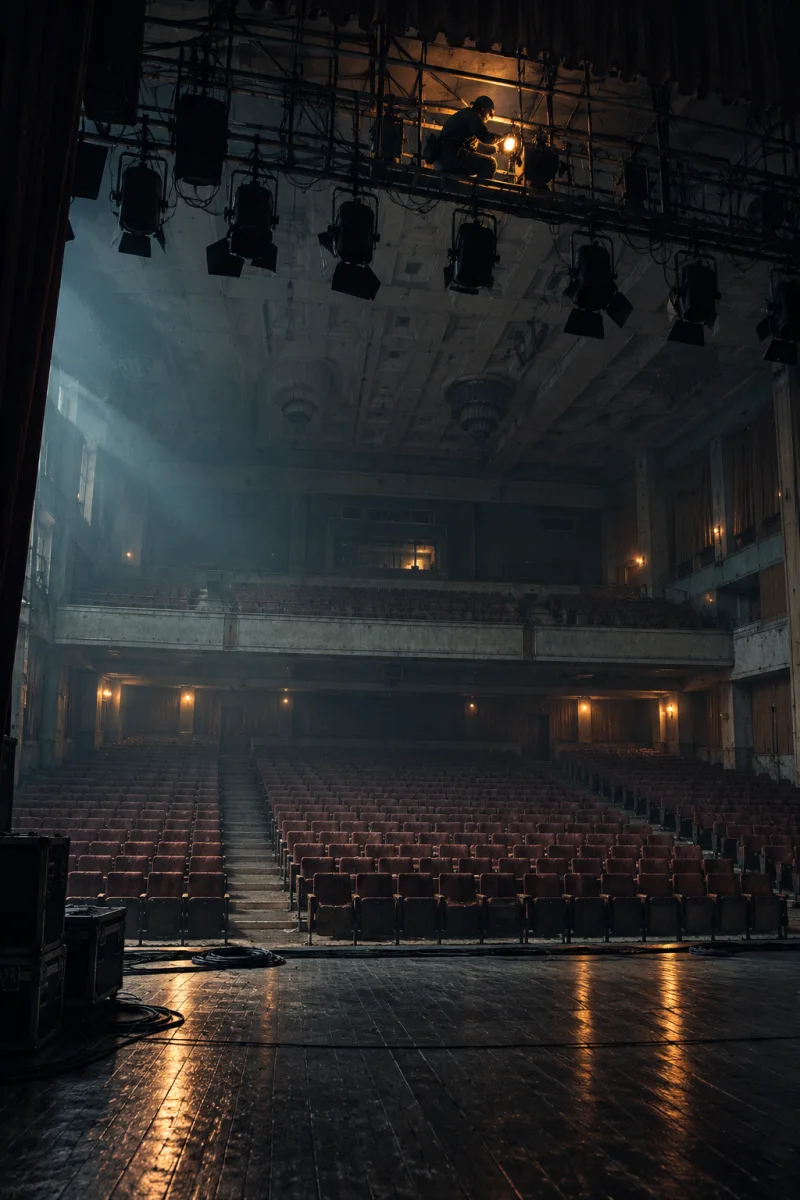
The auditorium at the Palace is splendidly equipped, seating 600. A stage with well-designed machinery and even a revolve! Extremely powerful lighting equipment, a modern sound system, film projection equipment. But nobody needs any of it, and it all stands idle.
Somewhere I read about wonderful musicians from a small town in Germany who make their instruments out of vegetables. Before each concert they carve “vegetable instruments” out of pumpkins, melons, courgettes, cucumbers… well, other things too… They play classical works on them. Bach, Mozart, Beethoven. They have toured the whole world, made a heap of money, their performances are booked years ahead. Amazing! Our musicians at the Palace cannot even play ordinary domras, balalaikas, accordions, any old tambourine. Nobody invites them anywhere, they look rather poor, audiences do not applaud their art.
During the lunch break I go to the shop, buy lettuce, cabbage, cucumbers—for my lunch, of course. (After all, the American doctor ranks healthy eating second only to walking. He literally implores us to chomp nothing but green tops, like a rabbit!) At the shop there is a special stand where you can pick up a free little newspaper, the Employment Herald. It has hundreds of job advertisements, the tempting salaries employers offer. And so, one might say,
The hum died down. I stepped onto the boards,
that is, I stepped onto the apron of our Palace’s stage. I had this little newspaper in my hands. Somewhere overhead, clinging to the ceiling structure that supports a mass of spotlights, someone was crawling about, spread out like a huge spider. Why, it was Oleg Kazanin, our sound technician! He was screwing a light bulb into a spotlight. How he had got up there was beyond comprehension!
“Well, I’ll be,” I thought, “screwing in a light bulb. And judging by the ads, you can make decent money at a cushy little job.”
“Hey, Oleg!” I shouted up to him. “Is that you, then?”
“Well, yes… who else…” the sound technician answered.
“Screwing in a light bulb?” I asked him.
“Yes… just try screwing one in up here…” He sneezed deafeningly from the dust.
What a state of affairs! And not so long ago the Palace had specialists on the staff responsible for the stage machinery, the lighting, the projection equipment. Now some have been made redundant, some fired, some left of their own accord. Oleg alone takes the rap (or the sneeze, in this case) for everyone. A wonderful thing that he knows English, can read the instructions for any piece of equipment at a glance, can connect and repair anything.
“Listen, you can rattle away in English all right, can’t you?” I continued my interrogation.
“Well, more or less… if something needs translating… But I haven’t practised speaking it for ages. Probably a bit rusty,” Oleg replied.
“That’s all right, you’ll soon brush it up! Look, see, it says in the job paper they need guide-interpreters on the island of Crete. Two grand in bucks, free meals, accommodation, flights.”
“I don’t want to go to any island of Crete! What would I do there?”
“He doesn’t want to go to the island of Crete!” I seethed inwardly. “Azure sea, orange sun, golden beach. Women tourists from all over the world.”
And I shouted up to him: “You’d be better off screwing your light bulb into… all those Scandinavian and Swedish girls!”
* * *
When the last bell at graduation rang out for my classmates as a signal to storm the heights of higher education, I suddenly announced to my parents that I was going to Kuibyshev, to my grandmother’s, and would apply to art school there. In truth, what Kuibyshev, what art school? I dreamed of finding myself in Moscow, breaking into the Literary Institute. Having written Wild Songs of My People by then, I imagined the doors of the literary sanctum would swing open before me and, stepping beneath its blessed vaults with these “Songs,” I would twang my lyre. Apparently this twanging (in my dreams) drowned out the compassionate warnings of my family, as well as my teachers and friends, that in the very near future the green gates with red stars of the District Military Commissariat awaited me. And those gates led nowhere near the bowers of PARADISE, quite the reverse! There was no getting round those gates, not even on a crooked goat. With a lyre or without.
And where were the two years of employment required for admission? Where were the recommendations from a creative union, publications in the press, letters of encouragement from senior comrades-in-letters, and a ticket to life from the city Komsomol committee? How petty and insignificant all this seemed to me.
And so my friend Oldrel (he was going to Anapa to visit relatives) and I are sitting in an empty carriage of the Ulan-Ude–Moscow train. Our former classmates—we had studied with them until the eighth form, then they had gone to railway technical college, where every summer they worked as carriage attendants in a student brigade—had just returned from the capital on this train. They had promised to take us to Moscow as a favour (and save us the money our parents had given us for tickets). This conversation had taken place about three weeks earlier, and then, in words, everything could not have worked out better! But since then the lads had been travelling without relief and were dreaming of being given a rest this time. “What difference does it make to you?” they said. “In a week we’ll definitely be going, we’ll take you with the greatest pleasure!”
The night was coloured with signal flashes, dispatchers broadcast from the heavens, repairmen tapped with little iron beaks on the distant branches of the spreading station-side crown to which the shunting engine had dragged the train. In the staff carriage, they said, the train chief was receiving urgent dispatches from Moscow. My fate depended on this! Would our friends be making the trip that night or not?! I put my faith in some external force… Let everything decide itself!
Meanwhile, alarming sparks from the staff carriage fanned the flames of conflicting rumours. The lads doused them with Moscow vodka, poured some for us too, treated us to Moscow sausage and Moscow bread.
The echo of clicking wheels wandered, beneath the floor the rail-strings kept humming, the curtains fluttered in the restless wind of the Trans-Siberian main lines, bringing change for the better, as one wanted to believe. Another messenger would come, announce something dreadful (and to me encouraging): “There’s nobody in reserve. Get ready, brothers, you’re going without relief!” We sang along with Maryla Rodowicz, popular at the time:
Board any train, be like the wind
and don’t you worry about a ticket,
clasp a green leaf in your palm,
the past will never catch you again.
And there’s your green leaf for you! It has long been morning—the clicking of wheels in our dreams is real! And the landscapes rushing past the window… Everything had happened unexpectedly. In the hour before dawn, the train had magically transformed from a provincial frog into a Moscow princess. Quite literally, the “hand of Moscow” was shaping my fate!
How many times afterwards, entangled in a knot of nagging, insoluble problems, I became convinced: somewhere in the depths of the Ministry of Railways—and now Russian Railways too, as its direct legal successor—there is… perhaps an old Gypsy woman in colourful shawls, shuffling a deck with brown fingers laden with massive rings? A Tibetan monk who has surrendered himself to the flow, turning the pages of the Book of Changes? Some travelling circus performer’s trained parrot, picking a rolled-up ticket from a hat among worn coins of unknown countries and vanished peoples? Someone, after all, was turning up the card of the journey ahead—whether it proved a happy one or not—but meanwhile a miraculous renewal took place, as soon as one reached out for salvation through the ticket-office window!
There was no time to sit around, for we had been taken into the brigade as “sons of the regiment.” Put on rations, issued uniforms. We strutted about in the regulation white jackets, carrying trays of tea in glasses with metal holders. Everything was filled with incredible vastness, with cosmic scope! Changing time zones, the flickering faces of constantly changing passengers, arrivals and departures, space stations and little halts along the great Milky Way of the Trans-Siberian. Even on the glass holders the raised silhouette of a satellite gleamed silver, having circled the Kremlin’s Spasskaya Tower and now soaring towards the stars. Rosy-cheeked waitresses from the dining car delivered shiny stacking food containers assembled into real “solar batteries”—with fiery borscht, mashed potatoes and cutlets for the main course. And Moscow mustard in tubes, “just like the cosmonauts have,” and a packet of Cosmos cigarettes in a mysterious dark blue? And if we met girls, we could spend the whole night listening to music recordings: the Lithuanian Zodiac, the French Space.
Komsomol pioneers were travelling back from the Baikal–Amur Mainline. This brought a spirit of conquering vast spaces, of unity with a mighty force that held sway over rivers and the expanses of taiga and, why think small, the far reaches of space! All the BAM men wore identical denim suits, Japanese ones for some reason (issued at the Eighteenth Congress of the All-Union Leninist Young Communist League, perhaps?). Indispensable attributes: a flare pistol, an Evenki hunting knife tucked into the belt, bushy reindeer antlers. All these lads drank a great deal. (There was some secret directive not to restrict the heroic youth in anything, so they were sold vodka by the crate and at three times the price.)
Sitting in the attendants’ compartment, we “took tea.” We poured two bottles of vodka and four bottles of Fanta, fashionable then and only just introduced, into a large enamel teapot. If anyone looked in, nothing out of the ordinary, the toilers of the steel main lines taking a rest. A teapot on the table, an amber drink in the glasses, teaspoons, slices of lemon.
Oldrel had long since heard of my “Songs”—word gets around!—and had asked several times to read them. I handed him the legendary manuscript. My friend immersed himself in reading. And now Novosibirsk, a stop of about 30 minutes. On the next track a train heading the other way, Moscow–Vladivostok. Suddenly I see Oldrel behaving strangely… He walked past, completely detached, with a blissful little smile, absurdly “conducting” with his hands, as though humming to himself a tune only he could hear. This put me on my guard. And when he calmly, as though it were perfectly natural, climbed into the Vladivostok carriage, I did not know what to think! And we were already pulling out!! Perhaps I had gone mad, and my friend was the one acting sensibly?! Not a bit of it! I darted back, saw “my” passengers, who had become like family by then… They were calmly finishing boarding our carriage, the right one!
The Moscow–Vladivostok is moving, about to carry Oldrel off to the ends of the earth!
I dashed over, jumped into the antipode carriage. And what did I find? There he was, sitting with the attendants there as though nothing were amiss! Exactly the same white jackets, a large enamel teapot on the table. His railway brothers had already served him “tea.” A glass in a metal holder, a teaspoon, a slice of lemon… Everything just like ours! Have you gone out of your mind or what?! I grabbed him by the scruff, dragged him towards the exit. We jumped off while it was moving, caught up with our train—to Moscow, thank God!—barely managed to leap onto the footboard of the last departing carriage.
Later I asked my friend: “Why did you get on the wrong train, Oldrel, decide to go back the other way? What past was catching up with you, what were you trying to escape?”
To which he replied simply: “Been reading all sorts of crap.”
A quarter of a century passed. I went through the stern school of army hardening, of course. Then, as in Vysotsky’s song about the “pure truth” (if one alters the words a little): “…wandered a long time, was ill, was short of money.” After agonizing attempts I got into the Higher Literary Courses (at the Gorky Literary Institute) and graduated. I wrote two books, published by the capital’s largest publishing house. But even now, after reading them, many people either disown me in the same way, run away, or do other things that are not always entirely rational.
Suddenly the winds of my homeland brought a call from Ulan-Ude!
The Ministry of Culture of Buryatia had responded, inviting me to the traditional Book Salon. (The fifteenth, incidentally. And this is the first I have heard of it. Just as I learn that in the past ten years I am the only person from Buryatia to have had books published in Moscow.) The Ministry’s invitation struck me straight in the heart! Until then the face of Mother Buryatia (her official face, of course, is what I mean) had never lit up with a tender smile towards me, her prodigal son, and
when my cart went hurtling downhill,
was I calm?
(I recalled a song by Dmitry Revyakin, leader of the band Kalinov Most.) At once I crammed 60 of my books into my rucksack, having bought them from an online shop. God willing, I would find 60 dear readers in my land “of taiga, lakes and steppe”!
I flew from Moscow over the snowbound expanses of Siberia, saw golden scatterings of lights in the swirling depths… Chelyabinsk, Novosibirsk, Krasnoyarsk, Irkutsk. “And what about the readers in these Siberian cities?” I thought. “There isn’t a single book of mine beyond the Urals. Not in the bookshops, not in the libraries. Only Internet monitors flicker in the night. Will
we burn on screens of blue ice,
as Bashlachev sang so prophetically?
Shouldn’t we consider the technical possibility of fitting aeroplanes with a hatch for ‘book-bombing’? So that parcels of books could be dropped from passing airliners to them, Siberian book lovers snowed in across endless spaces?
…And only the freezing wind howled in reply, tried to knock me down with its iron clawed paw early that morning at Ulan-Ude airport. But I stayed on my feet, was not carried away, did not vanish like a grain of sand in the stream of existence, thanks to my books in my enormously heavy rucksack.
I was met, driven in, warmed through. It all went off without stiff officialdom, “just like home.” My thanks to my friends, without whom this celebration would have been unthinkable!
And again the freezing wind, early morning, a plane to Moscow.
I gave away all the books, handed them out as gifts, signed them as keepsakes. But was my rucksack empty? I walk, hauling an enormously heavy quiver on my back beneath the icy gusts. In it—60 arrows. Their tips are sheathed in steel of a special Transbaikal temper, inside—the unwaning heat of my countrymen’s hearts… The murmur of the taiga, the singing of steppe grasses, the stern silence of mountains, the rumble of Baikal’s waves. I settle into my seat, cast a farewell glance through the porthole at the blue distances that call to me, give me no peace, promise new journeys and discoveries. For every summer I come to my homeland, to Buryatia, to Ulan-Ude; set off on a hike to where, beyond the Forest, the immense heart of Baikal stretches out. Its nerve connections are stellar rays piercing the depths for millions of years; it pulses with currents now hot, now icy; life and death are held in balance across the expanses of Eastern Siberia by its universal rhythm. Above it arise air vortices bringing changes in the weather, from it spread lines of energy creating a powerful field of attraction. The worldview of those born on its shores is shaped by its magnetic influence. The consciousness of the people of the Baikal region is fitted into the nesting doll of the Forest. The nesting doll of the Forest—into the steppe expanses. The nesting doll of the steppe expanses—into the mountain distances. The nesting doll of the mountain distances—into the sphere of the Sacred Sea. And further—into the shell of the sky. Into the Cosmos.
…The memory is still alive of the epic times when people understood the language of the Sacred Sea. In the quiet lapping of waves they discerned a warning of an approaching storm. They knew the life-giving arteries in the depths, where the silver blood of shoals of fish flows. They felt the ripening in the taiga of berries, nuts and other blessings. And the growing of animals’ young towards the time when, by the law of the hunt (which in those epic times was comparable to God’s law), they could be taken for food. In black, tarred grayling boats the lake folk rowed day and night; the taiga men broke ski trails through every hour of the short winter daylight, pursuing game in the wild barren heights; harvesters with sacks of nuts weighing many poods wore themselves out making their way towards human dwellings. And they thanked the Old Man for their catch, whispering ancient words… With the glimmer of a fire that saved and warmed them on a freezing night, with the stiffness of a cooling, freshly stripped hide, with the amber of roe beads in a fish’s slit belly, with the sourish breath from the smoky womb of a winter hut nestled somewhere against the flank of a hollow, sunk into the earth, weighed down with willowherb blossom on its split-shingle roof.
Where are they, those Words? Resin seals the cuts of blazes in the skin of trees, grasses heal the black burns of campfires, rampant undergrowth hides the brown scars of trails as though they had never been. The rawhide of snares thins to cobweb, nets rot away, rust eats the traps, fallen timber buries the crumbling pit traps. Parchment decays, the scroll disintegrates, the map with the confessional markings of those who survived a solitary flight through the cosmos of the Forest wears away to dust.
…But now you are alone. The rustle of the surf swells, the yellow lunar eye watches unblinking, the mountain sentinels stand frozen in silence, the taiga abyss has opened. The insistent chatter of a stream twists the thread of a funeral tale of those crushed beneath the fallen dead trees of fear, swept away by avalanches of disbelief, drowned in the icy rivers of weakness of will. And now those departed ones creep about as eternal wandering spirits. Sometimes they will even sit down by your fire to warm themselves. Then woe to you, solitary one spending the night in the forest!
…An unknown night bird flutters its wings restlessly, flying overhead all the while like a tossing black cloth—yet remaining invisible. And you feel The Doors creaking, opening a little, letting in the terror of the boundless night. And the Words come. Half-incoherent babble, a kind of prayer in the language of beasts and birds.
So can these really be anything but the “Wild Songs of My People”?
But the aeroplane’s turbines roared!
And Revyakin “roared” in my player’s headphones,
I return travelling light with a stock of arrows
back to the cellars.
* * *
At the request of a firm where I worked on the side for a while, I once had to “draw” a portrait of the statistically average Russian. The firm was researching the Russian household appliance market. I had to systematize a huge mass of information: deadly dull statistical reports and, on top of those, translated articles from foreign websites.
Having collated the information and done a little editing, I arrived at the conclusion that the statistically average Russian, on the basis of his average income, buys an averagely priced washing machine for 10 thousand roubles. (All prices are arbitrary, for round figures.) Now his average bed linen and equally average clothes are, on average, always clean. The happy owner of the washing appliance devotes so much of his newly freed time to such-and-such a leisure activity.
But after a while he suddenly notices he has begun to get fat. His blood pressure troubles him, he is short of breath, his heart gives him twinges and so forth. What has happened? The Russian consults doctors. Examinations, tests, consultations. One way or another, he will have to pay 5 thousand roubles, another 5 thousand for medicines, a total of 10 thousand. His health may improve, but then… Someone tells him (or he figures it out himself) that the trouble lies in a sedentary way of life, an unhealthy diet, a lack of physical exertion. Excellent! Our Russian goes and joins a fitness club. (Another 10 thousand gone.) He drives himself on exercise machines in a gym that is a plastic box filled with conditioned air and permeated with electromagnetic radiation. All in all, so far so good.
I went on analysing the translated foreign material… Astonishing things emerged! It turned out there was a man in the world responsible for all the world’s inventions, engineering and technical innovations in the field of washing machines, as well as their production and marketing. Through financial instruments, his influence and indirect presence in every washing machine manufactured in the world are beyond doubt. (Little is known about this guru of the washing-machine business. To avoid confusion, let him be Mr. Alfa.)
Well then, Mr. Alfa, one of the richest men on the planet, lives in a modest mountain chalet somewhere in a remote Swiss canton, and he has no washing machine. Usually at the end of the week Marta comes up from the valley, where the village is, bringing oats, vegetables, bread. And she will wash a change of linen too, for doing a bit of housework is no burden to the rosy-cheeked Alpine girl. (Whether they have any kind of relationship or not… All this is fodder for journalistic speculation. In any case, in the photographs taken by a journalist who visited Mr. Alfa—a short, brown-faced, smiling Japanese man whose age one might put at over forty but under eighty—he radiates masculine confidence and satisfaction with life.)
It is rather difficult to find out anything about him, not because everything is encrypted. He is of no interest to the media. He gives no interviews, has not been spotted in political or society circles, does not cultivate friendships with the powers that be. Here he is, in a ski suit, coming out into the yard with a shovel the morning after a snowfall, clearing a path. Here he is doing exercises. Cooking oatmeal. Sitting at a table in a little room, snowy slopes visible through the window, an ordinary accountant’s ledger before him, writing something. Going for a walk along mountain roads and paths with ski poles: the health-promoting style of so-called northern (or Nordic) walking. Returning. Peeling a couple of potatoes, an onion and a carrot for soup. Reading ancient Greek philosophers by lamplight.
As I worked further through the material, I came across information about a certain Mr. Beta too. He settles every question concerning the development of medicine in the world. His investments create lines of force linking a highbrow theorist in Silicon Valley—and a volunteer in the African backcountry vaccinating black children—and an exhausted district physician at a local Russian clinic. Everywhere they use either equipment made in factories and laboratories he owns to one degree or another, or equipment manufactured using technologies, patents and designs belonging to him. On an unknown island in the Pacific Ocean, the gentleman wanders along the edge of the surf, gathering wholesome sea creatures with the natives. Where would a washing machine come from in his palm hut? He himself has never consulted a doctor. Fresh air, the bounty of the sea, swimming and long walks allow him to remain vigorous and in excellent health.
And here is the third character I managed to learn about, = this is Mr. Gama. He bears responsibility for the production of all medicines in the world. As it turned out, he spends most of his time in a faraway settlement in Lapland. The local hunters and trappers sometimes take him along… Though he is no good at stalking game, his African-American appearance stands out too much against the snow-white background. His face can be smeared with something white, but how do you camouflage a two-metre frame? (The hunters speak disapprovingly: “Ooh, the great lanky beanpole! He ought to be playing basketball for the national team!”) Meanwhile, he handles skis quite well, covers tens of kilometres to check snares and traps, breaks trails through virgin snow from the early twilight until dark. And how wonderful it is to warm up in the sauna afterwards! He has no washing machine either, no doctor has ever made an attempt on his strong, muscular body, in his whole life he has never taken a single pill.
And how is Mr. Delta doing? His capital is invested in the global fitness industry. Through it he influences everything connected with advertising in this field, the manufacture of exercise machines, clothing and footwear, nutrition, the development of methods, the opening of new fitness centres. His identity and activities are hidden from outside attention on an old ranch somewhere in the boundless prairies of Wyoming. He has a few cows, makes his own homemade cheese and is very proud of it. Looking after the cows, carrying water, chopping wood, mowing grass—the best workout, in his opinion. In the mornings he does a light warm-up, jumps over the fence a few times, does pull-ups on the gate’s crossbar, pours a couple of buckets of icy well water over himself.
…If Mr. Alfa is perfectly happy with his Marta (which one can only guess at, of course), Mr. Beta has a giggling island girl for a friend. She tidies the hut, cooks the fish that has been caught, washes linen in the stream—pounding it on the stones with a wooden washing bat—and sings the songs of her people. When her white master goes away somewhere and then returns, he gives her glass beads or a hair clip, or a heap of colourful skirts. All the women in the village envy this girl.
And Gama does not sweat alone. In the company of a gorgeous Lapland woman he comes out of the sauna (with a bag of clean linen, incidentally, which the northerner washed in passing). Both wear fur parkas, sparkling frost has dusted the fur edging of their hoods, beautifully setting off the blackness of the man’s face, the rosiness of the woman’s. Ahead lies a wonderful evening by a blazing fireplace, mulled wine, recordings of classical operas.
At this same time the gentleman from Wyoming lies in the hayloft in a mound of fragrant grasses, gazing through cracks in the roof at the nearby stars. Her head resting on his shoulder, the black silk of her hair spread out, a free daughter of the prairies dreams happy dreams. And all is well with them, everything is washed, no need to go to doctors, take pills, do idiotic fitness exercises.
Marina and I have lived for many years in a House of Creativity near Moscow, we have no washing machine, there is simply nowhere to put one. Our activities are likewise little known to the general public, and so simple joys are available to us. Bread, wine, mushroom hunting, walks and ski outings, the bathhouse. The Pacific Ocean of our love will suddenly carry us from the tropical greenery of islands to sparkling Alpine peaks, or snowy expanses will breathe icy silence, or flowering prairies waft their fragrance…
Whether the lord of the washing business takes offence at us or not, we cannot give him even 10 thousand of our hard-earned little roubles. And since washing by hand provides physical exertion comparable to a couple of hours’ cycling or an hour’s swimming, the medicine man and the drug man go without 5 thousand each, the fitness organizer without 10. With the money saved we go to the Black Sea (near Sochi), spend a honey-half-moon at a holiday camp that has been dying since Soviet times—15 days of wonderful holiday.
…They say the roads in Russia are bad. And a good thing they are bad! This is the salvation of untouched corners of Russian nature—in general—and of secluded places near Moscow in particular. For its, nature’s, motorized “lovers” cannot get there. There are still, thank God, potholes and bumps, marshy lowlands, wind-thrown timber, impenetrable wilds… There is room for a pedestrian from the Moscow region to roam!
Before setting off anywhere, we study maps, look for accounts by like-minded wanderers, if anyone has visited those wonderful faraway places and left a description of the route on the Internet.
Recently we discovered a beautiful lake. To reach it, we took a suburban train, a scheduled bus, walked. The approaches to the lake are boggy, we kept coming up against mossy hummocks, shifting quagmire wastes. We wandered for several hours, finally made our way into the dark conifer thicket fringing the shores. It was a hot day, the silvery surface of the lake was both motionless and somehow breathing, giving off wavering pillars of light. A few fishermen sat frozen in black rubber boats, drawn into the landscape. Everywhere nearer the water were reeds and tall grasses. In the thicket the mosquitoes nearly ate us alive, but ahead appeared a cape thrusting far out into the water, and on it a bright little island of birches.
We made our way there through grasses as tall as a man, amid an unimaginable din, enough to deafen you! Unknown little birds pierced everything with their tinkling, frogs darted croaking from underfoot, escaping lizards rustled, an otter plopped off a snag, a duck quacked, calling her brood… Some lake monster with its tail—or perhaps these were bubbles rising from the bottom?—but something gave the water several resounding thwacks. The grasses vibrated like a whole forest of silvery aerials, a humming ball of mosquitoes rolled after us, the wind drove ripples across the lake. Grey herons fluttered their wings in the pillars of light, raising the earthly weight of sounds into the open expanse.
We simply collapsed among the pale birches, lay looking at the trunks rising upwards, at the tracery of swaying branches, the agitated foliage of crowns whirling in an endless round dance, trying on hats of cloud…
But it is absurd even to speak of this!
Once a little book called I Am an Amateur Filmmaker came into my hands, it had been published in 1969. It said that before working on a film, every amateur filmmaker must take an oath. First, never under any circumstances to film tree trunks from below, converging in perspective, with the sun shining through them, and all of it seeming to “spin before the eyes” of a romantically inclined hero. Second, the heroine running happily among birches (or other perennial plantings), with the hero chasing after her, and so on. Even then, back in distant ’69, this was considered the very model of a vulgar cliché!
As for me, I am no amateur filmmaker. And so I lay in the grass, my hands behind my head. But a strange feeling, as though someone inside me… (perhaps some “chronicler”? apparently he is in a hurry to fix the very best, most piercing moments of summer in memory for ever)… suddenly grabbed a “movie camera”—an imaginary one, of course—and started cranking away at those birches from below! But what about the oath, about its being vulgar, and all that?
And again, again that round dance of snow-white whirling trunks! And a grey heron takes flight, trailing a fringe of water falling from its wings. And we, happy, run among the birches in such a banal way. Chase each other, tumble into the grasses.
* * *
When the Lord painted Baikal (and He is undoubtedly an Artist), He used a thick, dense technique of painting (what is known as impasto).
It is astonishing that this is precisely the style in which Vladimir Nikolayevich paints his pictures. For almost forty years he has worked as a decorative artist at the Palace of Culture of the PolymerDetal factory (now “Impulse”) on the outskirts of Sotsgorod near Moscow, devoting his free time to creative work. Vladimir Nikolayevich does not stint on paint. Squeezes out practically a whole tube and one, two!—with the palette knife… This way and that! Another tube and another. Strontium, cadmium, cobalt, ultramarine, azure, Mars. Every stroke is so generous (like Vladimir Nikolayevich’s soul) that the paintings seem shaggy; the texture of the canvases is like bristling “fur,” the rough flanks of some fantastic unicorns endlessly racing… racing, apparently, through Vladimir Nikolayevich’s dreams. Strontium-yellow, cadmium-red, cobalt-violet.
Recently he painted a picture of me at Baikal: squatting at the edge of the surf, cleaning fish. Vladimir Nikolayevich himself has never been to Baikal, but painted it from my descriptions, and also by looking through ten thousand photographs I had taken, setting out on Baikal hiking trips every summer. To be honest, hardly anyone would guess it is actually me in the picture… Well, some shaggy fellow is sitting on the shore, smiling—and gutting a monster of the deep. (Vladimir Nikolayevich clearly went overboard with the size of the fish.)
If I have captured ten thousand frames, Vladimir Nikolayevich has probably painted several hundred thousand pictures. He has diplomas and certificates for taking part in exhibitions, his works appear in catalogues, articles about him in newspapers. He takes his freshly painted canvases to the local gallery, to the branch of the Union of Artists, puts them up for sale in an art salon… And sits in our studio (I work at the Palace too, the staffing schedule allows for two decorative artists), dozing, more or less asleep. But most of his works are kept in the “reserves” (in the bomb shelter beneath the Palace, in fact). Because of this it is impossible to get into the shelter (let alone for anyone to find refuge there if, God forbid, anything happens).
Mostly he depicts the countryside around Moscow… The riotous spring floods, the summer profusion of grasses, the crimson of autumn avenues, snow-covered groves and copses. (There are no “unicorns” in his paintings, of course. This is something latent, a sort of underlying basis of the creative work. It can only be noticed—and spoken of—through a very close and partial examination both of the artist’s works, naturally, and, as a whole, of all the circumstances of his fate, of that Cosmos which shaped the creative individual.) Having painted another picture, he sits down in front of it and peacefully falls asleep. Then suddenly wakes, takes a sharp look with one eye… grabs the palette knife… Touches something up, removes what is superfluous. Or paints over some spot—one, two!—changes something, renews the picture of the world.
One, two! This way and that!!—I think the Lord exclaimed, drawing a cadmium sunset across the whole heavenly canvas above Baikal, heightening the contrast with strontium yellow, saturating the water’s smooth surface with Prussian blue, the forests—with emerald green, and the cliffs and crags—with Mars brown. Seen for the first time, the picture of Baikal astounds… with its untidiness? its shagginess? As though everything has only just been painted, before your eyes. And the movement, the running of some unknown creatures has been arrested; they have frozen, held their breath, but any instant they will dart away, race off—change the picture of the world, the moment you look away.
Every holiday I set off for the shores of Baikal, go on another hike. And I notice… (you cannot simply close your eyes to it), how petty little humans, having switched to powerful off-road jeeps, superfast motorboats, armed themselves with repeating firearms, fine-meshed nets, electronic fishing rods, make their way ever further into places formerly inaccessible and therefore still pristine. I say “petty little humans”—for what can they create?
Dead, poisoned, scorched earth behind them. Mountains of rubbish, heavy fuel oil spilled from barrels, black fused tyres. A dump.
Sometimes I can just see the picture: having forced their way on powerful engines into the protected wilderness, a party spills out of an off-roader—crawls ashore from a motorboat. The people’s souls are enraptured by the beauties unfolding before them! It is hard to imagine all the shades revealed on the tablets of Sky, Sea, Forests. Yet, petty little humans… “Well, come on, bring it out! Let’s get started, shall we”… commands the ringleader, keeping a relentless eye on everything. And out come the sacks. The glass of vodka bottles, the plastic of large beer bottles, the tin of empty cans, scraps of paper, the vile mould of disposable tableware…
They scatter it around themselves. Burn out living things with the napalm of their campfires. Chop down trees.
And it is hard, so hard for them, as for any human soul, to do something so vile! But they carry on with the last of their strength, having stunned themselves with vodka so as to remember nothing at all of what they have done. Well, is that it, have we shat all over the place? We have. Phew… Wearily, hollowly, they climb into their vehicle. And now they have cleared off, evaporated, dissolved in the bluish petrol exhaust.
I know, one day the Artist, frowning and noticing something amiss in the picture, will smile wryly into His beard and—as Vladimir Nikolayevich does—brush away the orange speck of my tent somewhere on the shore, beneath a mountain, erase the little spark of the campfire beside it… Touch the spot lightly with pure strontium, renewing the sandy strip by the surf. And I shall disappear.
Or perhaps, taking a keen look… one, two!—He will paint over all humanity, spreading like grey, vile mould beneath the wondrous sunsets, beside the transparent waters, amid the murmuring forests.
Hm, Vladimir Nikolayevich… He will put the picture away in the basement beneath the Palace. And doze off again, snuffling peacefully.
Sometimes I look at him, and whisper hurriedly… “Lord, Lord! Save us, Vladimir Nikolayevich…”
* * *
In Soviet times, the artists from the technical aesthetics department of the PolymerDetal factory, on the outskirts of Sotsgorod near Moscow, liked to graze in the generous fields of the factory’s Palace of Culture. (Some thirty artists had crammed themselves into that department. The more large-scale the visual propaganda they produced for national holidays, the more they received, on top of their basic salaries, under separately signed-off work orders.) With the beginning of perestroika, never mind the artists—half the workers already had nothing to do at the collapsed production plant. And there was no money to maintain the Palace. It was handed over to Sotsgorod, renamed “Impulse.”
When I took a job there as a decorative artist, I was tasked with designing layouts for newfangled banners in graphics programs. The woman director had got it into her head to have these banners—enormous vinyl sheets—printed by an advertising agency. And to decorate the Palace façade with them. (While everything created over the long years by the “PolymerDetal” artists was “junk, it belongs on the rubbish heap.” Such was the general line.) But the old display boards were genuine works of decorative art. And what “outdated ideology” was there in them? Perfectly ordinary New Year, March 8, Victory Day, Children’s Day. Weighty, substantial, three-dimensional—they occupied the storeroom for large stage scenery.
And a banner layout?
This merely virtual phantom can be “sort of ordered” from the advertising people ten times under different names, and they will “sort of print” it. Then “sort of install” it, after which it is—quite genuinely, it must be said—written off. While the money allocated to this undertaking is deftly transformed into building materials. The director, people said, was finishing a house in a prestigious village near Moscow. After a while she received a signal “from above”; the “vinyl abyss” project was quietly shut down. The few sheets that actually were made are spread over the stage. In spring, when the snows melt, and in summer, during the rains. The roof leaks like a sieve!
i switched to laying out posters and leaflets about the celebrations and concerts taking place at the Palace. The entire neighbourhood is plastered with colourful dazibao, building entrances flooded with them, letterboxes stuffed. This creates the illusion that everything here is seething with vigorous mass-cultural activity. In reality there are scarcely enough events to fill a cat’s tear.
And my pay is just as small as a cat’s tears. I have to run around after clients, grab any work I can. And in the evenings and at weekends I sit at the computer in the studio, processing photographs… thousands of photographs… Which I bring back from the expeditions I set out on every summer to the shores of Baikal, to the harsh and inaccessible parts of the Baikal region. On the slopes of the Khamar-Daban range, in the spurs of the Eastern Sayan Mountains, at the foot of the Barguzin range, on the Svyatoy Nos peninsula—I search for “stone hieroglyphs.” I learned about them on my first solo hike to Svyatoy Nos. It would be more accurate to call this “hike”—without any plan or preparation—an escape from the problems in life that had driven me into a corner at the time. My route took shape out of fishermen’s tales about fantastic fishing waiting somewhere… Someone gave me a lift in a lorry, someone took me along in a motorboat. Rainy days set in, fishing was out of the question altogether! I found myself in the stone labyrinths of the lower part of the Svyatoy Nos range, descending towards the peninsula’s southern tip. And suddenly, under very strange circumstances, I picked up a distress signal: it so happened that I spoke over the radio with a Chinese hang-glider pilot who had crashed and was mortally wounded. He struggled to find Russian phrases, his voice was lost in a sea of interference. The area into which the unfortunate pilot had been carried—a sudden gust of wind had flung his hang-glider onto the rocks and smashed it—was wild high mountain country somewhere in the central part of the range. Bad weather raged; I had neither supplies, nor equipment, nor hiking experience. To speak of my rushing off in that situation to who knows where to rescue who knows whom—is simply pointless.
Who was this Chinese man, what was he doing there, how had he got there? Where could I turn?… To the Rescue Service? To the police? (And this, I should say, was the mid-nineties. Back then even our own people disappeared in broad daylight in the middle of town.) I told a friend of mine everything, he served in the Ministry of Internal Affairs. My friend advised me to put it out of my head, forget it as quickly as possible. The great detachment of the People’s Republic of China had apparently “failed to notice the loss” of one of its “fighters.” No reports of anyone missing in that area (still less a foreign national) had reached the authorities.
Throughout the following year something troubling would not let go of my soul, stirred the researcher’s imagination. It impelled me to action, to searching. I studied the literature about Baikal, about the peninsula—everything I could find—as well as maps and hikers’ reports. During my summer holiday I set off for the shores of Svyatoy Nos, climbed onto the range, crossed the deserted mountain country. Was what I managed to discover the crash site? I found something like a “black box”… In a black plastic bag, ten or so photographic diagrams showing the positions of the stone “hieroglyphs.” Flying over the stone “pages”—over the plateau of the Svyatoy Nos range—the Chinese man had taken photographs from a bird’s-eye view, hoping to capture ancient messages. Left by whom, for what purpose, addressed to whom—unknown?
And now, exploring the places marked on the diagrams, I photograph the mysterious “signs” from the surrounding heights, or by climbing tall trees, or by assembling a gigantic “tripod” out of poles, or using a helium balloon and an automatic camera.
Processing the Baikal photographs, I convert them into vector graphics. The result is something like a “contour drawing.” This is a “view from above” of the area where my stones lie: in scientific language, “ritual or navigational structures of the landscape type.” After the first stage of processing, the material is ready to be passed to an institute engaged in space research (in Korolyov near Moscow). Renting a powerful computing machine is a commercial service (it costs an incredible amount of money). Yet there is no other way to calculate and identify what does not belong to the random play of natural forces. But in which can be traced the creative activity of those who left a chronicle of a vanished civilisation—or a certain navigational system created for those (or by those) who visited / will visit Earth. The information received from the institute is not everything yet, it is, one might say, a guide to action. One must also make a proper description of the find—and, with regard to certain “signposts” hidden in the arrangement of the stones—plot a direction, make a preliminary study of a new area where the search is most likely to continue next season.
And there is my main job at the Palace as well. And outside clients too, laying out their financial tomes, their most tedious catalogues.
The work computer at the Palace is busy from morning till evening. And one day it could take no more, it broke down. The monitor black, the system unit dead, no signs of life. I reported this to Krasnova, the facilities manager. She warned me ten times not to touch anything, not to try breaking the seals, since it was under warranty, specialists would come and put it right. Well, by all means! At her instruction I hauled the equipment into the lecture room. Brought in my laptop, loaded the saved information, carried on working.
Of course, the computer had no warranty. But the facilities manager had an interest in transferring money for repairs to one thing or another through various ingenious schemes. As a result, everything here, from replacing plumbing to waterproofing the roof, was done by some shady “crack crews!” rounded up from the expanses of Great Spudistan. And the less, one must assume, they charged for their work, the more expensive, obviously, were the gold jewellery and fur coats that Izolda Krasnova kept changing. But whatever she got up to was no concern of mine. Meanwhile nobody was in any hurry to repair and return my equipment!
Several weeks passed. One day I came to work and the security guard said that “the fighters of the invisible front have arrived; maybe they’ll fix your computer.” There was bitter irony in his words.
I went about my business, but remembered the guard’s remark, something about it had caught me. When I was free, I decided to see what was happening there. Went up to the lecture room, looked in.
What I saw gave me a genuine culturological shock! On tables pushed together stood some “hyperboloid of Marshal Kim Chir Yn”… (I remembered a photograph from the news in which the North Korean leader was inspecting some “secret X-ray emitter.”) That is, a cardboard cylinder—about two metres long and a metre in diameter—wrapped in silver adhesive tape. Right there, two newly fledged “specialists” in blue uniform overalls with reflective patches were unwinding wires, pulling thick (half a metre in diameter) “pipes” of corrugated plastic. (If one tries to describe what they were doing, then, in technical terms, they were sort of “connecting” the wires and corrugated “pipes” to the “hyperboloid”… Which, one may suppose, contained certain “devices.”) Everywhere was cluttered with instruments resembling sound engineers’ mixing consoles; in the corner lay heaps of coiled rope, long poles with iron tips, toolboxes, extending ladders…
Perhaps something interesting was being prepared here? A performance by a complex technical show, a theatre of illusions, a motorcyclist racing inside an enormous transparent sphere?
This, of course, had nothing to do with me. I shrugged, was already turning back.
But why had they taken my system unit and monitor out of their boxes?
Meanwhile one of the workmen had removed the back panel of the system unit and, pulling up an immensely thick cable, was screwing it into place inside the case. He was working away with his screwdriver—what a racket! Right beside him, a corrugated “hose”—apparently ready to be connected too. Where, how? To the hard drive, or what?! The calm and confidence, the genuine professionalism of this master of the screwdriver’s art left no doubt that to him this was perfectly routine: nothing out of the ordinary, just as it should be.
They were mangling my computer before my very eyes! Whatever it might be like, I had worked on it, my files were saved in it!! Hey, brothers in electronics, what’s going on?!
Anyway, as it turned out, these “experts” were “computer tree-climbers.” Gleb was the older one, pushing fifty, and Ales was probably over thirty too. They themselves were from Belarus, worked for a firm in Moscow, had work permits and registration, everything legal.
But what “tree-climbers”?! I had never heard of such “computer specialists”!
Gleb and Ales—they bore any resemblance to the members of the ensemble Pesnyary, famous in the USSR (and not forgotten even now), only in their rather picturesque moustaches, but “pesnyars” is precisely what people call those who come from Belarus to earn money—well, these “pesnyars” had mistaken me for someone else… Probably thought I was a representative of the inspecting (and punishing) authorities. They would not answer directly, grew nervous, referred me to their firm, told me to ring there if I had questions. Kept referring to work orders, licences. “We’ve got a job order,” they repeated the same thing over and over. “And clearance, and a technical specification. Your side’s paid for everything by bank transfer. What’s all this about?”
That’s not what I mean, my brother Slavs! What “trees” are you going to “climb”? In the computer, or what? (There is, of course, such a thing as a “computer tree.” But that refers to the registry of system folders. How can you “climb” through “trees”? Whether it is in the hard drive, or in the registry, or who knows where else.) And how will you get in there? Squeeze through the USB port? With your ropes, poles, ladders? With a garden sprayer… (“Petrol-powered, backpack type,” as Ales began explaining in great detail for some reason.)
This time Izolda Krasnova herself had overdone it! Wherever had she found these last (or perhaps not) “Belarusian partisans”?!
Gleb stubbornly insisted that “…we’ll clean up in there, remove what’s unnecessary. If there’s some virus, we’ve got pesticides… but how will you get INSIDE the computer… we’ll get in all right. The usual way. Here’s the adapter.”
“This cardboard tube?!”
“How is that a tube?” the more technically advanced Ales joined the argument. “The magnetic field in the adapter, and the frequency of the accelerating field, are constant over time, but the resonance condition is maintained during acceleration by changing the acceleration multiplicity g.”
What was this?! Had Belarusian scientists discovered something that turned the scientific picture of the world upside down? Yet the internet community was unaware. The Nobel Committee remained in complacent ignorance. Silicon Valley dozed quietly. And why were we still not walking upside down on the earth?
“Looks like you’ve got an LHC here?” (I meant the Large Hadron Collider, of course. I was itching to be snide, to call it the Belarusian Hadron Collider.)
Ales drew himself up, coiled like a spring, the knuckles of his tightly clenched fists went white.
“Looks like you’re trying to give us trouble?”
Why would I “give you trouble,” lads?!
…I had only imagined them climbing into the computer. What would they do in there? Trample my files with their heavy boots, rummage through the photographs, open my emails? How was I supposed to (and was I supposed to at all?)… stand up to this? Argue that it was going beyond the bounds of reason? Fly at them with my fists? Which meant acknowledging what was happening? Taking part in this insane performance invented by who knows whom and for what purpose?!
And if one recalled the guard’s remark (accurate in this context)… Who are called “fighters of the invisible front”? Intelligence agents, saboteurs; anyone who fishes out secret information. What if someone had decided to put me under total surveillance? Turn my soul, files, photographs, mail inside out? No, what a thing to get into one’s head! Complete nonsense!! At any time when I am not in the studio, if someone comes in and turns on the computer—by all means, look and search out whatever you like.
As for checking my mail… Any hacker could do that. (No need to be a “tree-climber”!) But what is in it apart from the most ordinary, everyday things? Yes, I corresponded with the fellows from the Geopoisk club in Novosibirsk. They sent me methods for studying my “hieroglyphs.” In our correspondence I had to tell them about the “black bag” of photographic diagrams found at the place where the pilot was presumed to have crashed. His distant voice, breaking through the crackle and discharges of interference, had become the starting point of my journeys. More than ten years had passed already.
I am getting ready to go, packing my rucksack… What could stir one more than the anticipation of the road—dangerous adventures, unexpected encounters—this is conjured up by the smell of a campfire from smoke-steeped belongings. Early morning, enormous boulders, Baikal’s expanse, a float on a softly sighing wave. The trumpet voice of Baikal called me, a ray playing in the greenish crystal of the depths, organ pipes in the powerful breathing of winds, the fragrance of sun-warmed taiga gullies, the gleam of soaring peaks. This is the route of my life—and certain signs I try to make out so as not to lose the appointed direction. Turns, hard climbs, steep descents along this trail… A concurrence of circumstances brought me to “Impulse.” I process thousands of photographs, commission renderings of the “contour drawings”—and paste together, and spread across the stage, enormous “fields” of my stones. Sometimes, as though “floating” over them, I feel a mysterious connection… With some “projection” of clouds? With the sky above Baikal?
Gleb’s voice brought me back to reality from my involuntary reflections.
“Listen, do you live in Moscow?” he asked with deliberate “tenderness.”
“In the Moscow region,” I clarified.
“There! And if you lived in Belarus, Batka would give you such acceleration with an iron boot up your arse that without any of those cyclic accelerators,
you wouldn’t just climb into a computer through a cardboard tube,
you’d fly wherever you were supposed to, like a fly, understand?
We, for instance, can do anything you like! We’ve got inventions like you wouldn’t believe! Tell us to hack into the White House sewer system and connect to it—we’ll hack it! We’ll squeeze into the presidential toilet, climb up Barack Obama’s arse with torches! If it weren’t for your Montreal mental wankery, we’d have closed ranks into the iron fist of the Union. Any NATO or WTO, we’d spit on it and rub it out!
Well, all right, my friends! Let’s do without the geopolitical prattle! You were sent to fix the computer—and besides, our side has “paid for everything by bank transfer”—so get on with the repairs. And I went about my business, reflecting sadly that there was nothing either funny or strange about these Belarusians with their cardboard tube. How were we any better off… How to twist and turn, where to get money for expeditions, for research? Every summer, with the start of the holiday season, the parasitic oligarchs—their tentacles entangle both the steel arteries and the wings of our Motherland—raise train and plane fares. Like Viy—his iron eyelids! It is a special sort of mockery in Russia, where the expanses are vast and boundless, where the Russian—always searching for answers to the eternal questions—opens the great novels. War and Peace, The Brothers Karamazov, Leonov’s The Thief. And they were created precisely to be read unhurriedly, for four days, to tea and the clatter of wheels in an open sleeping carriage from Moscow to Baikal; to discuss pages, individual chapters, with one’s neighbours and fellow travellers; including those—of life, fate, Being. Must Russian people—descendants of great discoverers, carrying on the work of those who opened up Siberia and blazed a trail into Space—really sit at home, be left without journeys? (Surely what travel agencies offer cannot count as conquering the expanses: holidays in resort reservations, visits to fly-covered “sights”?) Where is a Russian to turn?! At the space research institute, at the computer firm where they install new programs, at the suppliers of aerial photography equipment—you have only just set off to see them, have not even got there yet—and the prices have already been rewritten! Everything has trebled in price. Anything to make money off you—now, this very minute!
I slog away from morning till night. Marina teaches in three places, gets back towards evening. But what can we afford? We pour the money we earn into some abyss.
And how do we spend our holiday together? Before I set off into the Baikal wilds, we go to the Black Sea coast, to a holiday camp not far from Sochi. Nothing has changed at the camp since before perestroika, time is almost motionless, in the honeyed viscosity of the days we spend a holiday that lasts twice as long. In the stormy foothills, above which hover the souls of the vanished highlanders, we dream of finding the abode of Sacred Bytkha. This sacred object—a stone eagle with eyes of precious stones, with gold on its beak, with wings and claws in silver—was worshipped by the Ubykhs who lived in these parts. Judging by the few legends that have survived to our day, in ancient times Sacred Bytkha would “rise” at the beginning of summer and “fly away” to the high mountain pastures. And in autumn return to its place in the sacred forest. Why, this is some sort of “flying object”! Where did it come from, by whom and for what purpose was it “programmed”? We explore the gorges of the Osokay, Khodzhibse, Beranda, Detlyazhka, Buu rivers. Sometimes we come across the healed scars of cattle tracks along which herds went up to the mountain pastures. At times blazes can be seen on mighty tree trunks….Something like marks—“beacons,” which, from one to another, set “directions,” yet lead nowhere, soon disappearing. There is sometimes a strange feeling that the dots and dashes of this cipher might suddenly reveal a message, drawing us deep into the forest towards some centre from which it was transmitted.
But the heart of Mountain Ubykhia is closed to us and keeps silent.
* * *
At the end of the eighties, in my native Ulan-Ude, in the fitted-out basement of an apartment building, I had—my studio. It really was on Lenin Street—and I practically lived in it without ever going out—and so, just like the lyrical hero of Fyodor Chistyakov’s well-known song (the band Nol), I too, accordingly, would get blitzed from time to time. But that is by the way.
The studio’s genuine realness is determined by three aspects (expressed in the principle of Analogia Trinitatis), just as the root, third and fifth form the “core” of all tonal structures. But, in this case, these are
clients,
friends
and girls.
A decorative artist establishes a spiritual equilibrium with the client. The client’s well-being depends on the Eternal Blue Sky in the artist’s soul. And vice versa. The ancient Chinese said that a work of art would endure through the ages if it remained unfinished. So, when carrying out a commission—making any sort of outdoor advertising—at the final stage I would leave a detail, as it were, masterfully unpainted. Not everyone, of course, could see in this a vector pointing towards the future. Some flatly refused to accept my concept—and paid nothing for the work done. Others… well, perhaps gave me half of what we had agreed.
Never mind! For friends come to support the artist. They always bring something that warms the blood and cheers the soul. “You’re doing the right thing, brother,” they say. “Everything in this world is transient. Art alone is eternal. Let’s have a drink.”
And girls come simply because winter is always followed by spring, the time of riotous flowering—by bright summer.
One girl asked me: “How many islands are there in this place where the countless channels of the Uda River, branching among deposits of silt, flow into the mighty trunk of the Selenga?” I did not know whether to laugh or cry! This question—among the large and small and utterly tiny islands, as though scattered from above, from the Buryat heavens, by a generous hand—reminded me of a passage from Sasha Sokolov’s Palisandria: “Nor must we forget the land of triumphant nirvana. There, a drop of rain, reaching the surface of a puddle, distinctly says not ‘plop’ but ‘zen.’ There—all ends and beginnings. There—grace. Only, in trying to partake of it, do not ask a passer-by:
what hour or century it is,
whether he has seen how the river flows
or Malevich’s square?”
“The islands were created by a landscape architect,” I said. “It was he who sent the dredger into the Uda delta, having drawn out for it a Path creating a large-scale model of Zen Buddhist esotericism, which in itself denies the existence of any path, prescribing that one follow one’s karmic destinies unconsciously and spontaneously.”
I told her how from heights detached from all worldly bustle, where untouched drawing paper gleams with absolute whiteness, where pencil leads are so black that they can be compared only with the blackness of the shadow cast by age-old rocks beneath the brilliance of icy azure—well, from these heights the landscape architect surveyed the “Plan of Ulan-Ude.” And he executed a drawing, enclosing the city’s outline with accentuating lines within the harmonious proportions of a heptagon; having determined the point of contemplation, he experienced a captivating consonance inaccessible to ordinary mortals, arising from the coordinated system with geometric perspectives extending beyond the bounds of limited space.
“Do you remember what our town beach used to be like?” I asked. “The semicircle of the embankment in the bed of the Uda formed something like a ‘strait,’ on whose right bank was a mooring for launches and motorboats delightfully puffing blue smoke. And further on the beach of our childhood was bright with the umbrellas of women selling ice cream, rang with children’s voices, pulsed with taut blows against a volleyball, clicked with pensioners’ domino tiles, barked in a bass voice through the lifeguards’ tin megaphones, urging enthusiasts of active recreation on the water not to swim beyond the buoys.”
“No, that was before my time,” the girl replied sadly.
“Yes, now it’s a rubbish-strewn wasteland, the ‘strait’ has turned into a swamp. I don’t know what happened… Did the swift current carry out masses of sand, did the river channels change? Then the islands were created. There are 35 altogether. Do you know why? The numbers 3 and 5 are fundamental to Chinese numerology, which Japan borrowed along with Buddhism.”
“What have Chinese numerology, Japan and Buddhism got to do with it?” she asked in surprise.
“They have to do with… In a word, wherever you look at the islands from, there are always 34. One island remains invisible, hidden behind the others. We happen to be on that very one, and so nobody around can see us!”
She looked at me in surprise.
“What, didn’t you read our international affairs writer Tsvetkov’s book The Fifteenth Stone of Ryoanji when you were a child?”
“No.”
Girls these days! They don’t read interesting books, don’t remember how truly wonderful the town beach was!
I had to make an instructive excursion into the rock garden at Ryoanji Temple, the chief attraction of the Japanese city of Kyoto. There, on a plot covered in white sand, 15 black, unworked fragments of rock are arranged in such a way that those contemplating them can see only 14 at once, whatever angle they look from. Zen Buddhists regarded this mysterious harmony as the unfathomable nature of being, while to anyone who attained enlightenment through prolonged meditation and the proper disposition of consciousness, the chronological regularity of time was revealed.
“For several years the dredger wandered like a bullet with a shifted centre of gravity through the blue arteries of the Uda,” I continued my tale. “It scooped megatonnes of stones and sand from the bottom, piled up sandy hills. Some flat, others shaped like volcanic cones, they rise above the river’s windings, surrounded here by the deep and there by the shallows of Creation—and seem to ‘float past,’ like clouds, in a calm and slow movement, drawing the townspeople’s consciousness into a state of peaceful repose… And certainly not into worldly reflections on how dredging up the ‘islands’ had allowed someone to raise a tidy sum from the town budget, dredge it up and launder it, send it off into the irretrievable blue distance.”
The girl and I lay on one such island. Somewhere beyond the limits of our solar system a distant tape recorder was winding out monotonous splashes. The river’s current and the wind carried silvery echoes… “ah!-ah!-ah!”….It was as though we had ended up inside a gigantic radio! The gleam of dagger waters sliding in the patterned scabbards of willow-lined banks, silvered with niello, the blinding sun that had reached its zenith and stayed there, nailed in place with nails of rays, created a play of reflections. The islands resonated, amplified the radio interference driven by the wind over the channels. And the endless “ah!-ah!-ah!” from the tape recorder floated past like a child’s rubber ball painted to look like a watermelon… Why, it was Tanya Bulanova asking some “ataman”… Saying, “tell me the truth! why do you need my love?!” Suddenly silence would fall, last a moment. And from some heights, into the neck of the transparent casing in which we were enclosed, from the upper chamber of an invisible hourglass above us—an avalanche came tumbling down of gulls’ flourishes, splashing streams, sizzling pebbles, the springily bouncing bark of dogs, children’s cries…
“If we’re ‘invisible’ on our island,” my companion remarked, “then why does that man over there, our neighbouring islander, keep gawping at us? And besides, he seems to be sunbathing there with no pants on at all!”
But this was too much… These girls are forever noticing all the wrong things! I raised myself up and spotted a hefty stone nearby, ready to lob into the garden of this devotee of air and sun baths a naturel, should he prove to be one.
The channel between our island and the next was about five metres wide. Why, I too had noticed some strange man flitting about on it. He appeared now above the sandy cone, now beside it. Tanned black as a charred log. What this Robinson was doing there (alone, without Friday) was anybody’s guess. Before long I saw him. He did have some sort of loincloth on after all. Squatting on his own bank, he called out, got a smoke, guys? We had cigarettes; I told him to wade across to us, no point throwing good tobacco, quite literally, to the wind.
The fellow was roasted by the sun, his hide tanned by winds and waters; he looked like a coarse, shrivelled shoe. About thirty, with the baked apple of his bald head covered by a silly little handkerchief knotted at the corners. Under his arm he clutched something like a canvas ‘reticule’, with something iron clanking inside. Assuming he was a seasoned local fisherman (which seemed quite natural), I asked him about the fishing… But he fobbed me off with generalities, knew nothing interesting. Then we got talking, and it turned out that here, on his island, there was a ‘nudist colony’. Some ten or fifteen of them, men and women, sunbathed here naked, preaching complete union with nature and rejection of the conventions of civilisation.
It was just then, in the eighties, that all manner of teachings, sects and preachers came pouring in. Some muttered mantras, some walked barefoot in the snow, some ate only raw food, some tied themselves in yogic knots, some grew kombucha and drank nothing but kombucha, seeing in it a panacea, salvation (or oblivion?) in times that had changed so strangely and suddenly. But nudists? Beneath Buryat skies, amid the currents of steppe rivers, in the bitterish wind bringing the smell of scorched grasses from the Mongolian plains… Well, it seemed somehow absurd. What was this, the French Riviera or something?! Yet what this disciple of some ‘new’ (and highly dubious) earthly Eden told us in his few words sounded harsh and bitter.
Yes, at first those who liked sunbathing and swimming in their natural state had a wonderful time on the distant island and bothered nobody. Their supporters grew in number. Meanwhile, the local thugs stepped forward as zealous champions of public morality! Their packs circled round, cackling from the gut and leering filthily. But that could still be tolerated. Then they began picking on them openly, or lying in wait for those walking back along the embankment in the evening. Naturally, after such a ‘working-over’ (if, thank God, it did not mean a spell in hospital), few remained devotees of such extreme recreation.
“They started coming at us on the island,” our new acquaintance told us. “We fought them off with whatever we could. Reinforcing rods, sticks, broken bottles, we used everything. Well, we fought and fought… What chance was there of sunbathing or swimming, or playing volleyball?”
“And the police didn’t protect you at all?” the girl asked.
“The police, like hell!” The nudist waved a hand in resignation. “Well, they come, have a look. Anyone lying there completely out of it gets loaded into the wagon, and off they all go together to the monkey cage. Then they say citizens without pants are none of their concern, they’re disturbing public order themselves.”
The heat was gradually subsiding, freshness drifted from the water, the sun slowly inclined towards sunset. I thought of how, when crimson reflections gilded the domes of the thirty-four islands in farewell, one, invisible, would remain in shadow—hidden, unmanifested in reality. A true hero would ascend its summit, and with a sweep of the reinforcing rod in his muscular hand mark out the boundaries of the Hellenic world. Fiends of darkness would come crawling at him from every side—into the circle of light.
“Two friends of mine were supposed to come…” The islander kept looking round anxiously. “But there’s no sign of them. Maybe the thugs roughed them up on the way.”
“So you’re here alone….going to sunbathe?” I asked in quite understandable bewilderment.
“I am. What else can I do.”
“You mean… you’ll stay like that, in your… nudist state?” the girl enquired. She really had a thing about this ‘nudist’ state!
“Hmph! Well!!” he confirmed firmly, making it clear that the question was out of place. “Unless the thugs finish me off today. They promised to do me in. But I’ve got something ready for them… Just let them try.” He pointed to the strange ‘reticule’ he was carrying. “I had a pistol made.”
“A pistol?!”
“Yes, converted from a starting pistol, to fire live rounds. Commissioned it from a handyman at the factory.”
“Going to fight them off with it?”
“I’ll have to.”
I handed him half a packet of cigarettes, all I had. “Here, some ‘ammunition’. It’s a bit nervy round here, by the look of it.” He trudged off to his island. What sort of conviction in his own rightness did this man possess? I wanted to shout after him: “Listen, what about putting some pants on? Is sunbathing in pants too much trouble?!” But I said nothing. It would be like trying to stop Giordano Bruno on his way up to the stake.
* * *
* * *
* * *
My journeys to Baikal could hardly be called ‘health trips’. Perhaps some people come back from their travels refreshed, tanned, having lost a sensible amount of weight. As for me, God grant I make it home—my face is red, swollen, overgrown with a wild beard; I am bitten all over by mosquitoes; and my eyes, as many people remark, have a half-crazed look about them. It is a good thing if there are no obvious, open, festering wounds. All in all, the only thing I want after such a ‘holiday’ is to sleep, sleep, sleep.
The following summer I am once again planning a route to the shores of Baikal. You wait a whole year, prepare, dream of it. And now, at last, you are packing. Suddenly it turns out that you are stringing on some thread what seem to be beads of things already familiar, things that have happened to you. Omens, signs, events. It is hard to understand how this happens, willingly or unwillingly? Well, you give yourself your word, for instance: that’s it, I’ll buy myself a modern, anatomically shaped, waterproof, energy-saving rucksack, and a cooking pot and a reel for the spinning rod besides. But there was nothing new before, and there is still nothing new! You look: the very same rucksack, the same pot, the same reel. And again, precisely so many tins of stewed meat, so many onions, such and such a chunk of pork fat (by weight). All these are recognisable landmarks, those blazes on trees—taiga signposts—which you follow, from one to another, so that afterwards you can return in exactly the same way. Not lose yourself, not vanish in the endless expanses surrounding you of forests, mountain spurs, deep river valleys.
Stanisław Lem put it very precisely in ‘The Patrol’, in Tales of Pirx the Pilot: “When you are surrounded by one and a half trillion cubic kilometres of emptiness in which you cannot find so much as a pinch of cigarette ash, the desire for something, anything, to happen, even a terrible catastrophe, becomes a veritable mania. Over his hundred and seventy-two patrol flights, Pilot Pirx had passed through various stages: he grew sleepy, turned gloomy, felt like an old man, took to eccentricities, came close to thoughts of some decidedly unquiet form of madness, and finally began, almost as in his cadet years, making up all sorts of stories, often so intricate that even an entire flight was not enough to finish them.”
As we know, Pilot Pirx, patrolling a region of Space where several spacemen had previously vanished without a trace, suddenly notices some mysterious ‘object’ and begins pursuing it. The mad chase brings Pirx, who has lost control and is close to madness that is no longer imaginary but quite real, to the verge of disappearing into the cosmic abysses. This ‘object’ turns out to be a reflection of light playing across the observation screen as a result of certain technical peculiarities.
In some wild regions around Baikal, still pristine because they are inaccessible, I investigate the so-called ‘stone circles’. One cannot speak, of course, of any ‘trillions of cubic kilometres of emptiness’, for the world of taiga, mountains and rivers—everything surrounding that greatest of seas, not called Sacred for nothing—is so thick… as thick as the fish soup you sometimes get to cook—with the tails of omul or grayling sticking upright out of the pot of fragrant broth. And yet, the devil knows, how does it happen?! For if you shake off all the beauties, tear through the many layers surrounding the very essence, what remains is… What remains? That same little ray, a glint, a spot of reflected sunlight, or ‘the desire for something, anything, to happen, even a terrible catastrophe’, as that wonderful science-fiction writer says.
And this little firefly, appearing from who knows where, may beckon, call you after it, drag you into such wilderness that… When the forest releases you from its claws, God willing—even with a wild red face, a dishevelled beard, mosquito-bitten, with inhuman eyes—traces, scars, will remain upon your heart. And in dreams, or even waking, you will be visited by that mysterious and inexplicable thing you touched, something you spied or overheard there, in the depths of the forest, from which this time you escaped alive.
To this day I cannot explain to myself one expedition… or, more precisely, several days of that expedition, on the Svyatoy Nos peninsula, when I wandered through the heavily marshy valley of the Ongokonka River, trying to break through to the Svyatoy Nos Range. What misled me then? Perhaps, after reading Hello, Baikal! by V. P. Bryansky, that wonderful Baikal scholar and promoter of hiking routes, I simply came to believe that well-trodden paths ran everywhere there, with groups of inquisitive tourists striding briskly along them. But I failed to take into account that all this—that is, the ‘hundreds of young people with rucksacks’, and the way they ‘force their way along the shore of Barguzin Bay over the dune’—had happened more than a quarter of a century earlier, when the book was written. Since then the forest had swallowed every trace, and not merely of tourists…
At the northern end of Ongokon Bay, in the years before the revolution—and during the establishment of Soviet power—there was a little village that lived by fishing and hunting. Part of Podlemorye, the novel trilogy by the fine Buryat writer Mikhail Zhigzhitov, is set there. On a topographical survey map of 1943 it is marked as ‘ruined buildings’. But I could not even find the waste ground where this village had stood. The forest had healed this wound in its body with sparse woodland, woven branches across it, entangled it in grasses.
My diary entries about that expedition might have broken off with the words: “Farewell, Baikal! And God’s world in general.”
There was nothing there… Here and there on the enormous trunks of pines and Siberian cedars were the healed scars of blazes, from one to the next of which a path—perhaps in some age of legend—had led towards the ridge, towards the pass. But if these commemorative notches could be made out at all, they were at some inhuman height, more than two metres up. Could the brave pioneers who had beaten this trail have been actual giants? No… Since the blazes had been made, the trees had grown, stretched upwards. Well, if only there were some reminder of the little village, while a path to the headwaters was a matter of life and death for me! Finding neither, I experienced a genuine geographical shock. Standing at a specific geographical point, I felt horror at having ended up here at all. But where was there to retreat… Dusk was thickening, the gusts of wind were laden with moisture, foretelling bad weather. Unknown creatures on soft rain paws filled everything round me with rustling and movement, as though darting from place to place… (Hiding from me? trying to draw me into some incomprehensible game?) As though the enormous radio station of the Forest had switched on, started working. I found myself amid unfamiliar noise, listening intently, trying to identify that unknown thing which seemed to threaten me.
…Next morning I woke to rain persistently drumming on the roof of the tent. Nothing pleasant about wandering all day through the undergrowth beneath an icy shower. But the murk had not dispersed by evening either; the rain settled in for the whole night. I lay amid the rain forest beneath silvery IV drips pouring in an acrid poison, paralysing the body, poisoning the brain with anguish at the boundlessness of the forest. The key to this anguish—the tapping of the drumming drops—is recorded somewhere in far, far memory. Into those far reaches sails a little life raft: a foam camping mat, a sleeping bag. And now you descend in the bathyscaphe of the tent to those depths where the consciousness of the forest—and yours—are one and inseparable. As it was in the beginning… The mad radio operator of the rain drums the same obsessive Morse code on the tent fabric. The temperature falls, drops of condensation swell on the underside right before your nose, since the ‘ceiling’ of a ‘burrow’-type tent is low. You watch the birth of these large anti-minutes, each of which (there can be no doubt about this down there, in the depths of the rain forest) will devour, swallow a real, living, full-fledged minute. A dangerous state! The pressure at those depths could easily flatten your bathyscaphe… And you will dissolve into the forest, become forest yourself.
The trunks that had fallen across the little river were rotten, overgrown with reindeer lichen, lingonberry bushes, wild rosemary. Windfall barred the way; looking for a way round, I strayed from the river, stumbled upon animal trails that offered hope for a little while only to vanish at once into thick tangles of impassable undergrowth. Would I never reach the scree, the foot of the ridge? The rocky crest seemed now quite close, then, by some extraordinary laws of perspective, receded; reaching it was beyond even dreaming of. Hordes of some particularly persistent mosquitoes gave me no respite. Then I wandered into a bog, into quaking tussocks; the riverbed vanished in these wastes oozing icy sweat. In some ghostly delusion the green disc with its recording of the forest spun monotonously… I had got caught somewhere in the grooves of this record, in a quarter-century gap in time.
But what if we actually looked into it?
After all, the village’s ‘ruined buildings’ had gone underwater because of the commissioning of the Irkutsk hydroelectric station in 1958, when Baikal’s level was artificially raised by more than a metre. The hunting trails had been abandoned after the National Park was established (1986) and hunting was prohibited on its territory. Weather on Baikal is hard to predict in general, while on the peninsula—the warm front from the shallower and therefore well-warmed Chivyrkuy Bay, the icy winds from the Barguzin Range, the mighty breath of northern Baikal, and the masses of air from the open sea on the Irkutsk side—all collide above the Svyatoy Nos Range in veritable ‘atmospheric mysteries’! Why had these simple explanations not occurred to me? What had got into me, piling up all these mystical horrors?! ‘The forest devoured the traces of man’, some ‘unknown creatures on soft rain paws’….But be that as it may, all my plans went to hell; I had to turn back. And straight away, early in the morning, I had only just woken—an enormous shining vault, the crystal palaces of Baikal.
There were still several wonderful days ahead, splendid places where the good fishing had already been tried.
On the path from Zmeyevaya Bay, already beyond Krestovskaya, I saw some tourists walking below, along the shore, while I was up on a bluff, on the path that climbs the slopes, runs into the forest, inland from the coast, cutting across the jutting capes. The elderly man and woman struck me as foreigners… Well, you could see they weren’t from our parts. (I also thought they were the first ‘earthlings’ I had met since my flight into the abysses of the rain forest.)
About two hours later I too came down this path to the shore—emerging at a cosy little bay where I made a halt. I cooked buckwheat porridge, added tinned stewed meat, ate lunch and began drinking tea. Just then this elderly foreign lady came past, carrying a very expensive camera with a powerful lens. I invited her to have some tea, but she said she needed ‘many many photo’. We exchanged a few phrases, the usual sort of Russian-English. I advised her to take the path straight uphill, it was only a short climb, and the best pictures would be from up there. She thanked me and went on.
After a while her companion came tramping along. I greeted him too, suggested he have a rest, here was some tea, please help yourself… They turned out to be a Swedish couple. The man looked over sixty, probably; short, somehow ‘solidly put together’ all over. A rather swarthy face, his head silvered with a crew cut, a checked ‘arafatka’ wrapped close round his throat. Splendidly equipped: rucksack, windcheater, boots, a sheathed knife on his belt, binoculars, some fancy watch—all from well-known makers of outdoor equipment—but the things were not showy, not straight from the shop, but well tried, imbued with the spirit of wandering. We struck up a conversation; he both understood and spoke enough Russian for us to communicate. I asked where he had learnt the language—he answered that it was connected with his service. (Not entirely clear: perhaps service in intelligence? But it would have been out of place to enquire.)
As I had supposed, they had taken a launch belonging to the tour company that had arranged their journey to visit the hot springs in Zmeyevaya Bay (the most popular local attraction). Then they had been taken to Krestovskaya Bay and put ashore, and were walking from there. We exchanged impressions, talked about the weather, fishing, bathing in the hot springs. The Swede took out a map, an ordinary tourist atlas of the reserve, and asked whether they could climb Vidovaya Peak: they had heard there was a breathtaking panorama from there… Oh, you must go to Vidovaya, you absolutely must! I began describing both the beauties and the difficulties awaiting them, how to get there and how long it would take. The Swede asked sensible questions, and knew his way round a map too.
He was about to leave, had swung his rucksack onto his shoulders. Thanks, and all that. Out of nowhere I suddenly asked: “And did you ever serve in the army, then?”
Why the army came into my head, I do not understand.
He paused to think, not expecting the question, searching for words: “Oh, yes. I served. Of course.”
Then I got carried away, as they say. “What sort of army could you possibly have? The Swedish army, or what?!”
“Yes, Swedish. Armed Forces. Försvarsmakten.”
I know perfectly well it is the Armed Forces! For some reason this made me very angry.
“Ha, some army! You could drive right across the whole of it in a day, this army of yours! Now our army, that’s an army… ho-ho!” I spread my arms wide, insisting there was no comparing our army with theirs, just spit and rub it out. “With us you spend a whole week grinding along on the train, grinding away to the furthest reaches. Or ten hours by plane from end to end, eh? How about that?! Why, Marshal Grechko himself signed my demob order!!”
It burst out against my will, just some sort of slip of the tongue! Perhaps because I had wolfed down all that grechka… Had buckwheat porridge with tinned stewed meat from an army cooking pot brought everything military to mind? Or had Andrei Antonovich Grechko, USSR Minister of Defence from 1967 to 1976, been firmly lodged in my memory since early childhood, since the days of TASS radio bulletins about the confrontation between the aggressive NATO bloc and the member countries of the Warsaw Treaty Organisation? Of course, during my army years it was Dmitry Fyodorovich Ustinov who gave the orders. Including the order to demobilise conscripts in 1982, which concerned me personally. My thanks to him for that, may his memory be eternal.
“Ah, Grechko, en rysk kosmonaut!” my companion exclaimed, and his eyes warmed.
He even knew our cosmonauts! I had to explain:
“No, not the cosmonaut Georgy Grechko… The Minister of Defence. But that doesn’t matter. You can’t imagine what serving in our army is like!” I laid into the Swede again. His face showed unmistakable bewilderment. But that only egged me on. “Why, when I was doing my stint, they sent us to Kazakhstan for the battle for the harvest… To help bring in the grain, that’s what they called it. Ours was a cadre unit; if anything happened, it would be brought up to strength with men from the reserve. Reservists, that is. ‘Partisans’, understand?”
“Ah, ryska partisaner!”
“Well, ‘partisans’ is just a figure of speech… Folklore. And do you know what the sky is like in Kazakhstan? A boundless sky, high, enormous, stretching the whole breadth. And the wide-open spaces! No wonder our cosmodrome is in Kazakhstan, Baikonur, the Universe’s first space harbour. The descent module of the woman cosmonaut Savitskaya landed there in the middle of the steppe, and our platoon was the first to come racing up in a truck. Then the helicopters come flying in… They’re bawling through loudspeakers for nobody to approach! But fat chance… We tore up the parachute for demob souvenirs, and somebody even got her slippers. On this capsule—it was all charred, scorched by streams of fire on entering the atmosphere—every man scratched his name with a nail or whatever he could, where he came from, and ‘DEMOB such-and-such year’. But that evening on the Vremya programme they showed it all differently. The helicopters circle so beautifully, technicians and doctors glide up to the sphere with their little cases. Savitskaya comes out looking sprightly, in a blue tracksuit top (like the USSR team’s), like Tsar Gvidon out of his barrel. And straight over to the Chairman of the State Commission. And there he is, proceeding so grandly along the red carpet. Why, it was all filmed beforehand on a Mosfilm soundstage, that’s obvious!”
From the torrent of words I unleashed upon him, the Swede registered the main, as they say, ‘cultural markers’: Kazakhstan—Baikonur—Savitskaya—Mosfilm.
He said he had seen Kazakhstan, it was an enormous country. That Baikonur was a great humanitarian and technological breakthrough in the history of mankind. That Svetlana Savitskaya was the first beautiful Russian woman to walk in space. That Mosfilm meant Eisenstein’s Ivan the Terrible and Kolotozov’s The Cranes Are Flying.
An encyclopaedist, just my luck! Or had he watched too many BBC documentaries?
“Where have you seen Kazakhstan… On television, or what?! You should have been there yourself in the eighties! No roads there, only directions. As though some mad bomb-dropping angel had flown over them… Everywhere the blackened hulks of overturned, smashed, burnt-out vehicles. In an alcoholic stupor the ‘captains of the grain expresses’ fell asleep at the wheel, tumbled into ditches, rammed anyone coming their way or crossing it. Perhaps invisible sentries standing at the roots of the grasses—the disturbed shades of nomads—bewitched them in the dusk before evening. The surrounding hills and ridges surfaced like the backbones of ancient fish out of long winding strips of mist. You could just see it: wild riders on furious horses would suddenly burst onto the jagged crest! The tanks of the tanker lorries flared up from the lightning-arrows loosed at them, blossomed into black roses with grotesquely serrated petals of twisted metal.
The locals caught the partisans with a special bait. An empty bucket left beside a village house. A truck would drive into the yard (and this was a proper bai’s homestead—nothing like what you were used to in Russia), and the grain was tipped into a pit prepared in advance. For feeding livestock and poultry, for moonshine. The driver was paid in ‘liquid currency’, a full bucket. Some of them, apparently, also arranged for some of the local narcotic dope.
Sometimes two fuel tankers would go chasing each other across the steppe! As though someone were rolling them like balls over a boundless billiard table… And suddenly they would head into a collision, head-on, ramming each other. All that remained of the incinerated racers were the steel inserts in their shoulder boards and their homemade boot irons.
I served at the operational duty officer’s headquarters; we had to go out to every accident. We travelled in a dust-choked, scorching-hot duty GAZ jeep. We lost our way, got ourselves into such steppe backwaters that you could not see the light of day! A wall of fire from the epicentre of the explosion burned out concentric circles; they seemed to converge towards the centre of a target, towards the mangled skeletons of two brontosaurus tankers locked in an incinerating embrace. We pulled on the muzzles of gas masks, donned the cumbersome armour of chemical protection, trudged through this soft sea of ash where footsteps made no sound. In the very place where the plasma substance had sucked in the souls, as in the bull’s-eye of a target pierced by a tight cluster of shots, emptiness gaped. Not even a light breeze reached there, having dried and scorched its wings. We gathered what remained into a zinc box. For some reason it was always shoulder-board inserts and boot irons.
“Stop-stop-stop.” The Swede looked at me intently and coldly. As though he had ‘scanned’ me with an X-ray machine built into his skull (or so it seemed to me). “Wait!” he stopped me…
I know what happened to you…
The steppe then rose gently like a convex lens, and it seemed someone was lying beneath it, seeing from below the soles of your overboots, which you forgot to take off. You went down into misty hollows filled with inky dusk. Disturbed ducks flew up towards you, shaking silvery threads from their wings. Two little lakes gleamed with the moonlike cataracts of a blind man. You flung yourselves into the motionless glass, revolved in rubber suits fused to your skin, arms spread crosswise. And even the zinc box floated beside you. The knobs of the respirators, the corrugated trunks of the hoses, were pointed at the little votive lamps of the stars hanging low. The tiny star of a space station crossed the round eye sockets of the gas masks. And the cosmonaut aboard it, through a special ear trumpet, a top-secret invention of military specialists, registered the quiet lapping of earthly lakes, some strange clanking of metal objects… It was the clanking of zinc boxes floating alongside, with a handful of ash from burnt partisan drivers, with steel shoulder-board inserts and boot irons.
“Yes…” I almost whispered. “How do you know?” My breath caught; I could barely speak.
“Well… I simply saw you.”
“You? saw me?! What are you talking about, God forgive me!!”
Anyway, he said he had been that cosmonaut, flying on a space station over the boundless expanses of Kazakhstan. Through a special device he had watched everything happening on our territory. But what ‘space stations’ could Sweden possibly have?—I was beside myself with indignation. He said it was a top-secret project; Sweden had had reconnaissance aircraft for ages and ages. And nobody was obliged to report every new development in weaponry to me, an ordinary citizen. And this Swede also said that our poet Tolya Poperechny had been a friend of his; in their day they had drunk a fair amount of Swedish Absolut together. And that was when he had given him the idea (that is, this Swede had suggested it) that ‘cosmonauts dream of something very close to home, something truly earthly’. And Poperechny had captured it wonderfully in the song ‘And we dream not of the cosmodrome’s roar, nor of this icy blue…’ It was performed by the group Zemlyane. A real hit of all times and peoples!
…Well, to hell with this Swede! He picked up his rucksack and went stamping up the path in his toothy mountain boots. Good riddance! For some reason I was very upset, troubled, with an oppressive feeling that something alien, from outside, had intruded, fastened itself to my life, and was even examining my most intimate secrets, perhaps through some telescopic tube. Everything slipped through my fingers, the fishing came to nothing, and the holiday had gone wrong. Towards evening I went over the mountain to the neighbouring fishing village, Katun. There, from one of the locals, in a very partisan sort of way too, under the counter, I bought a bottle of vodka. I returned to my bivouac and drank this bottle; to eat with it I made ‘Young Pioneer’ shashlik: threaded on a whittled stick, toasted rounds of the dry sausage I had left, onion rings, slices of pork fat, pieces of bread. Next morning I drank five mugs of tea, boiling water from Baikal. A storm was starting, though the sun was shining; the strong wind blew all sorts of nonsense out of my head.
* * *
* * *
* * *
In former times the PolymerDetal factory, on the outskirts of Sotsgorod near Moscow, was very rich. Polymer lakes boiled up in its depths, and rivers of linoleum and PVC tiles flowed from them, feeding the building sites of the national economy. The factory built a residential quarter, a kindergarten, a school, a clinic, a department store, a stadium, a swimming pool, the PolymerDetal Palace of Culture. They laid linoleum everywhere, covered everything with PVC tiles incorporating elements of the national ornamentation of the fraternal republics. But the storms of the newly begun perestroika battered the flagship of the chemical and construction industries, hurled it onto the rocky fangs on the shore of the market free (of all laws). Now its rusted hulk is rotting away, its enormous workshops have been turned into holding tanks for Chinese consumer goods, small tenant firms gnaw away at the last remnants of the giant.
The residential quarter with all its infrastructure passed from hand to hand as though in a protracted battle. Sometimes children playing in a sandpit, schoolchildren writing a dictation, patients taking their blood pressure, shoppers standing in a queue, footballers running, swimmers frolicking like dolphins—were transferred with a stroke of the pen from one ownership to another. A track athlete might start a 500-metre race on a stadium track belonging to one clan, and cross the finish line on the property of a rival faction.
The PolymerDetal Palace of Culture was handed over to Sotsgorod and renamed Impulse. The hearth of culture barely smouldered, but kept its little flame alive through the night of the nineties… Who didn’t try to get their hands on it! Wholesalers and Chinese traders dreamed of setting up a market, businessmen demanded an office centre, swindlers pushed casino schemes, and even a satanic sect intended to make its nest there… They all broke their teeth on its invisible, underground part. For this was a ‘dual-purpose facility’. In its foundations was a bomb shelter, unfurling the curls of its labyrinths like a concrete rose. The Ministry of Emergency Situations, which is responsible for it, allocates money to its facility, and the Sotsgorod administration has to maintain it (the shelter is intended for the top leadership; should anything happen, they will save themselves there and establish a Control Centre).
I know of this secret root system through Vladimir Nikolayevich. He had worked at the Palace as a decorative artist since the day it opened. When I took a job as the second artist at Impulse, we worked together. I must say that Vladimir Nikolayevich has the very same ‘dual purpose’.
…Once there had been about thirty artists at the PolymerDetal factory, in the technical aesthetics department. They snatched work out of one another’s hands—all the more so because when they did decorative work for the Palace, they were paid on separate work orders. Vladimir Nikolayevich was left to daub posters for current events and letter handsome greetings to cultural workers on holidays and anniversaries. So, with minor exceptions, he devoted forty years of working hours to creating his own paintings. Every day he painted at least a study! His work as a whole is ambiguous… He could turn even a Moscow-region noon gleaming with snowy whiteness into a wondrous Ukrainian night. Using a thick, dense, so-called impasto technique, he never spared the paint. His pictures sometimes resemble the surface of Mars, sometimes the waves of violet alien oceans. Or a cosmic riot of lilac comes crashing down on a viewer who has ventured close to a painting!
Vladimir Nikolayevich spent his childhood in a mining settlement in the Donbas region. What dreams carried him off on fantastic journeys, what echoes of strange landscapes called out in the hidden corners of his soul, answered in a broad-flowing song? If he painted roughly 300 pictures a year, and each measured, on average, one square metre, then over forty years that makes 12 thousand square metres of painting! All this—and frames, canvases, stocks of paint besides—has to be stored somewhere. And Vladimir Nikolayevich took over the entire bomb shelter. It is practically impossible to get inside. Let alone for anybody to save themselves there!
The enthusiastic artist was the very first to arrive at work; at lunchtime, for about four hours—with a battered rucksack and an easel—he would head out into the surrounding countryside. His brushes, his paints, were fishing tackle, bait. Next thing you knew, he was carrying back a fresh square of forest, air, blue, snow. Or a flowering meadow, rippling water. And this day was caught by him, preserved. In the studio he would put up another study, from the day before, or a painting he was working on—and fall peacefully asleep sitting in a chair. Big, heavy. Suddenly he would wake, look sharply… Seize a palette knife, a brush! Touch something up, add something, alter the picture of the world. And sink into multicoloured dreams again.
He would go away on holiday for about two months. He and his wife travelled round the Golden Ring, along Russia’s rivers on tourist ships. And for the last few years they had gone to the Black Sea, to a holiday camp near Loo (not far from Sochi). And of this too he had a painted, day-by-day ‘Diary of Nature’.
When I first entered the studio I was illuminated by light, crushed by darkness… As though I had found myself at the bottom of a wild taiga ravine! Rocky ledges of paintings and sketches towered up, the most improbable things and objects were piled high. Everywhere the glossy leaves of plants, as though creating a ‘forest canopy’; everything entwined with supple branches, patterned leaves all round, armfuls of dried flowers, arrangements of fantastically shaped tree roots; you could move through these wilds only along little paths.
The standoff with the emergency authorities, who tried to drive him out of the bomb shelter with menacing directives, went on endlessly. But Vladimir Nikolayevich took everything calmly. And yet he was no stubborn lone fanatic… He took part in the life of the local artists, was often invited to exhibitions, sat on competition juries and committees awarding prizes to talented people from the Moscow region. From time to time his paintings sold. With the proceeds he bought paints. Some canvases he packed up and lugged into the bomb shelter, others he brought up to the surface, carried somewhere, brought back again. The constant changing of landscapes in the studio—now breathed upon by winter cold, now engulfed in rampant flowering, now steeped in autumnal fading—spoke of the life-forming circulation of paintings in nature.
Sometimes Marina came to see me at the Palace, in the studio. We discussed my colleague’s paintings, especially his ‘Black Sea period’. We thought there was too much of everything in them. An oily yellow disc floated in a beetroot-coloured sea, mountains thick with greenery were cut into slices, rocky outcrops with pink veins looked like pork fat.
When we began talking about a summer holiday, we quite naturally wanted to find ourselves right there… On those shores, under that sun, amid that greenery. I asked Vladimir Nikolayevich, and he smiled at his memories: ‘At the holiday camp near Loo you’ll be snug in Christ’s bosom. I’ll give you a number, someone to get in touch with.’
Fantastically bypassing the bustle of packing, stations, trains—as though we had dived into his paintings. Everything was familiar to us, everything recognisable. We found ourselves deep in ravines where there was a spicy, arousing smell of birth and death. Air thick with vapours, everything filled with echoes of pursuit, wheezes, furious moans, the torment of love, unknown creatures’ struggle for life. The movement of earthly currents flowed through roots, sometimes exposed, like enormous paws with which the giant trees trod on a thick carpet of fallen leaves, dense and tangled grasses, thorny scrub.
We searched for a waterfall in the ravines leading to the headwaters of the Detlyazhka, Beranda and Buu rivers. But within this triangle all memories disappear… Not one of the inhabitants of Verkhnyaya Detlyazhka, Verkhnyaya Beranda, Verkhny Buu—whom we pestered with questions—had seen the waterfall with their own eyes.
‘Oh yes, my brother went there as a boy, I think,’ they told us.
Or: ‘Oh, my grandfather used to tell us about it, such beauty!’
Or else: ‘No, you won’t get through there, it’s all overgrown.’
Once we met a grandfather and granddaughter picking blackberries. The Indian chief of few words pointed up the slope. But where could we go, into that impenetrable thicket? Yet sure enough, we found a heavily overgrown cut through the forest. We climbed to the ridge, walked along it, circling the mountain basin, and made our way down the slope… Sinking ever deeper into the heart of some unknown ages. The solid earth reared up, trunks leaned, glossy tongues of ferns flowed down like lava not yet cooled. The opposite slope drew closer, the gap of sky narrowed, the crowns closed together. And a sort of dizziness, as though we were being sucked into the funnel of a ‘time-mincer’. The sinews of seconds crunched, the chitinous coverings of minutes crackled, the carapace of days was ground up, oozing the juice of a year not yet come to pass. As though something separate from what was happening ‘around’ and ‘above’—yet magnetically drawn to it, multiplied by its motley colours and many voices—was nourishing, making dense with events the body of a snake crawling down the slope, drawing us into its movement. It was hard to breathe the motionless air, the tightly compressed abyss of time, our bodies were covered in sticky sweat. We jumped from stone to stone, climbed over fallen trunks or crawled beneath them. Many were snapped off, or sheared off at a slant, charred by lightning strikes. Storms that had swept through had piled up barricades. Rocky fangs with pink and violet veins, moss thickly plastered on the steep foreheads of stones barring our way, in patches now very dark green, now reddish, now turquoise. The Martian surface of the boulders looked black, porous, like asphalt, but when you stepped on it, it yielded softly, oozed moisture. The humming of insects, rustles and sighs, the trembling of leaves from a breeze that had flown past and stilled… Silvery ripples over the shallows, water ‘windows’—hollows, bowls enclosed within granite ‘ribs’—had gathered the world of the ravine into their reflections. (The geological reference book says that deposits of terrigenous flysch—layered masses of sandstone and argillite, which make up most of the rock in these parts—were formed in the Palaeogene period, which ended 30 million years ago. If one were mentally to ‘saw through’ the ravine, would it be possible to see annual rings… 30 million annual rings?)
And suddenly we were right above the waterfall!
Rivulets with glossy glints, like ribbons of black-and-silver film that had recorded the ancient history of these places, unwound and quickened their pace. The stream broke from the ledge, shattered against rocky shelves, fell in cascades. Below, a plunge pool boiled beneath the jets, forming a small lake. If we recalled the ‘myths’ of the peoples of Verkhnyaya Detlyazhka, Verkhnyaya Beranda, Verkhny Buu—the little lake could be imagined as the eye of a dragon that had wound coils of scree and rocky outcrops. It guards the depths of the ravine, devours the memory of anyone who peers into its eye, above which a rainbow curtain of spray refracts. The many-voiced singing of the waters held us spellbound, the knocking of stone foreheads with which the boulders—for 30 million years now, perhaps?—argue among themselves about which of them was geologically formed first.
Yes, our discovery was far, of course, from the greatest waterfalls I had admired, for instance, in the pages of National Geographic. (I remembered one photographer’s work: under the magazine’s auspices an expedition went to an island in New Zealand, to an extinct volcano lost in the jungle; a waterfall plunges from a plateau into its crater. From a hovering helicopter the photographer was lowered on a cable into the abyss, dangling almost beneath the torrents pouring down. But what astonishing shots!)
But this was our waterfall! Moving away from the edge, we broke into wild dances. The joy of discovery overflowed in us! We splashed about, hurled ourselves into the stone bowls, ducked our heads under. Declared our love for rocks, valleys, mountain passes, turbulent rivers and plunge pools. Shouted through the whole forest, swore we would never forget the sacred mission of faithful servants of the cult of Apollo! The novelty of places, the joy of good fortune! The inexhaustible urge to venture into the distance, to draw distant shores with unknown populations into the orbit of the Hellenic world!!
Marina immersed herself in her ‘Poetic Observations’, describing the fearsome and beautiful faces of nature we had seen. With my camera in a case fastened to my belt, I returned to the ledge. From above there was a view into a deep basin… The tops of poplars, elms, oaks swayed; at the feet of the forest patriarchs the surf of the undergrowth seethed, clumps of boxwood thickets darkened. Perhaps this whole abyss of time (well, not 30 million years, just 2–3 million, counting from the beginning of the present, Quaternary period)… had been dumped here… Put into storage?
A steep rocky slope rose away to the left, coming up against a rock forehead. Above it an elm forked like a lyre trembled its crowns; it caught my attention. From below you could not see how its roots had taken hold. It seemed that the trunk, curved into the shape of an ‘S’, had risen without support, all on its own. From the fork two ‘arms’ were raised—mottled, as though in camouflage. Yes, a proud tree. Scorning a ‘botanical’ existence amid a crowd of its own kind, it had broken out into the open. At the mercy of every wind, of plunging downpours and lightning. But that was what made it stand out! I decided I could climb onto the rock forehead, make a lunge—and land in the fork. From there I would take some unique photographs… What was that famous National Geographic photographer to me! (Deep down, his laurels gave me no peace.)
But I could not get up the slope to the top of the rock forehead. Blackberry bushes, thorny lashes of wild grape had woven themselves into an impenetrable, springy wall—it threw you back! Making my way along ledges from the middle of the forehead, I did at last get opposite the tree, but below the fork. I braced my foot against the trunk, trying to rock it, to test its reliability. Solid enough. Took a wide step into the upward arc of the trunk… And there I was, up in the air. The tree vibrated, even sagged downwards. Clods of earth fell from its roots, flakes showered from above, little leaves whirled. I was streaming with sweat, my heart beating fast. And sick with fear, too. To take a tumble from here… would be quite something, perhaps… But best not think about it.
Wonderful shots going to waste! I had to climb into the fork, it was directly above me. The view was better from there, and I could brace myself against the trunks; how else could I take photographs?
Raising my arms, I felt about for something to grip up there in the saddle. The trunks were broad, too big to get my arms around. I came upon some rotten little roots, moss tore away beneath my hand, the grass stems were unreliable. With my right foot, the edge of my trainer, I braced against a projection of bark. Threw my body sharply upwards, spread my elbows, rolled over onto my stomach. Somehow straightened up. A metre and a half of emptiness separated me from the rock forehead—from the continent, from the Mainland. How would I get across when it was time to go back… Jump onto that sloping great rock? All right, if I had climbed up here, I would get back somehow.
Making no unnecessary movements, I took the camera from its case and got it ready. Wonderful compositions ran through my head. Now I would shoot it this way, and that way, and like this!
But what was this?! Before me, on the grey skin of the trunk, I saw something that astounded me.
These were unforgettable words.
Deeply, very clearly, they had been cut into the bark by an unwavering hand. Neither time nor the healing power had managed to erase them, draw them into the tree’s flesh, make them pale, meaningless. For the person who had inscribed them, this had been no spur-of-the-moment decision. A cutter of good tool steel had been used, properly sharpened. There was a professional style to the lettering composition, to the formation of the letters.
Danila, I love you. Katya.
That was what I read at a dizzying height, on a trembling tree trunk slowly tearing itself out of its stony homeland, gradually slipping into the abyss.
Well, well… What lengths had Katya been driven to? You would need more than a romantic nature: you would need to know how to find your way across country, have at least some basic rock-climbing training, possess a stunt performer’s precision in executing tricks, the skills of a circus aerialist. Prepare the tool beforehand, plan the lettering composition.
But who would see it here, this inscription? Who was it addressed to?!
What if these words had been her last, before… I glanced down apprehensively. Was my head spinning, or what? There was a sense of some movement. The serpent of the ravine bared its mossy fangs, wound its coils, motley with shades of green, encircled the space, squeezed it with its tail of scree, windthrown timber, heaps of stones. Veiled its lake-eye with a rainbow halo, or dazzled with the glitter of water when eddies swept the spray aside.
But what were Katya and Danila to me? It was their own private affair, after all.
Let them go their own ways and roads. Good if their destinies were joined, if long years lay ahead for them to spend together.
I had moments left to catch the ancient ravine in the frame, the iridescence of swirling waters and times. Was it not this jumble of grey domino blocks, dumped any old how by giants after their game was over, green branch-arms, supple bodies of plants, trunks with the encrypted code of earthly life… and rocks, and valleys, and mountain passes, and turbulent rivers… that had been projected, directed into me from the very moment of my birth, like a host of drifting mirages of mountain temples and forest castles? Why do I love paths that lead into a motionless chess composition of whimsical pieces set out on the dark-green, golden-ochre, snow-white squares of the seasons, why is my heart ready to burst from my chest, to fly over every mountain ridge when, having climbed to a summit with the last of my strength, I recall the fearsome grandeur of frozen billows that once rose up in dreams?! What strange interlacing of roads and paths travelled had brought me to the Impulse Palace? I came to know Vladimir Nikolayevich, the world in his soul, where
and the snow-glittering expanses of the Moscow region,
and the wondrous Ukrainian night,
and Martian landscapes,
and the waves of alien oceans,
and the cosmic riot of lilac
he poured out so generously on his canvases, sparing no paint.
And at what turbulent crossings in life had Marina and I met? But no, we could not have failed to meet… Years before our meeting, with several thousand kilometres separating us—my first book, as it happened, was printed at a printing works in Marina’s home town, Dzerzhinsk (in the Nizhny Novgorod region). Marina worked in a library, and many times a day hurried past the shelf where my opus stood among the new arrivals… With a ridiculous and pretentious title, it should be said. ‘You’d have to be a complete idiot and moron to give a book a title like that,’ my future beloved thought. And of course she never read it, never even picked it up.
Now she was sitting beside the rushing streams, writing poetry. And noticing nothing around her… While here were the voices of the ravine, the roar of falling waters, the knocking of stone foreheads. No shouting would reach her, no consulting her. (No calling for help, if anything happened.)
How could I draw up a ‘memorandum in reply’, give our answer to Katya and Danila?
What could I carve that would remain… well, not for centuries, surely? All right, for years. (Pretentiousness again, I simply cannot get rid of it.) I had an excellent expedition knife with a set of tools. I had to convey something simple, comprehensible to posterity.
Marina, I love you.
But I cannot live without Baikal either! Yes, if I mentioned that I loved the planet’s greatest freshwater lake, that would be substantial, somehow serious, thoughtFUL.
But why do I love Baikal? It is the lake, in fact, that loves me! What is its beauty for, the waves shimmering with secret portents, when sunsets blaze like Revelation poured in bleeding purple from the higher Spheres? This is something—I must see! And feel my own insignificance, and be stunned by the bounty scattered by a merciful Hand, and stand level with the heaping billows, the giant mountain ridges, the sunsets filling half the sky. I carry these gifts and, as far as possible, try to pass them on into the future.
But what grandiloquence, what pomposity!
Here I was hanging in a tree, it might give way at any moment. So, the knife! I slid out the blade, marked out the inscription, judged the height of the letters… The point was driven into the bark.
My hand was flung back by a springy force!
Tree litter showered down from above, some sort of dust whirled. A breath came of the noonday field spirit of linseed oil for painting, the pine potency of turpentine, the cypress fragrance of varnish. The precarious balance of my surroundings suddenly shook… It was a little cough!
The awakened giant was trying out his voice. Oh, it was Vladimir Nikolayevich in our studio!
‘Er… who’s that fussing about? What are you spoiling my paintings for?!’
‘A-a-ah!’ I shouted at the top of my lungs. ‘Vladimir Nikolayevich! It’s me, your artist. I’m in big trouble, help!’
‘I don’t want to hear about any trouble,’ came a gloomy grumble from above. ‘How many times have I taught you! Can’t you say, well… such and such, you have an opportunity to show your very best qualities?’
And I was expected to curtsey as well! But I would have to humour the master: ‘Vladimir Nikolayevich, YOU AND I have an excellent opportunity to show OUR very best qualities. I’m stuck in one of your “Black Sea period” paintings. There’s a tree here, it’s slipping, it’s about to collapse into the waterfall!’
‘What did you climb up there for? Who asked you to?! Poking at things with your little knife, too.’
We talked back and forth as though through some sort of ‘tube’. (A mobile phone is also called a ‘tube’, but that had nothing to do with our communication. Its cultural underpinning might be called the so-called ‘communication tube’—an image Solovyov used in Assa.)
‘But you sent us to the holiday camp yourself. Said we’d be snug in Christ’s bosom here!’
‘Hm, well… Which painting is it, then?’
‘A ravine, stones, a little lake below. No, it’s all beautiful, of course. The composition is well judged, the colour scheme rich. There’s atmosphere, the artist’s mood is conveyed. And it’s quite a height here, by the way. I won’t hold out much longer!’
‘But I need to find it, choose my paints. You sit there, don’t fidget. And don’t go prodding about with that little knife, you’ll cut through the canvas!’
Sit or not, wonderful views were going to waste! I carefully adjusted the camera, switched to automatic mode, shot in bursts. Caught the slipping moments, was at the summit… or, more accurately, in the tree of happiness? Trembled with terror. Hurried to absorb to the last drop the sense of the passing instant, the precarious feeling of beauty.
But then came purpose, the force of unity drawing the disintegrating fragments together. They acquired meaning, an inner disposition, conviction. The artist picked up his brush, palette, palette knife. The world stopped slipping into the abyss, towards madness. Could it be that across the painterly swirls of linseed oil, the pine spirit of turpentine, the fragrance of cypress varnish—I would take a step? Find the Mainland, the continent? So it was. Thanks to Vladimir Nikolayevich, he fulfilled the artist’s mission. And once again, as he always did, surrendering to multicoloured dreams, he peacefully dozed off.
Marina, seated on a fallen trunk—just like Arsenyev, the explorer of Primorsky Krai—was bent over her ‘Poetic Diary’. Where was her Dersu Uzala wandering, what was happening to him? (This scene: the way she wrote with such self-abandonment—and Arsenyev never interrupted his diary under any circumstances—recalled Okino Kurosawa’s epic film Dersu Uzala, 1985.)
‘Where have you been?’ She was returning from her ‘poetic faraway’. ‘I was already thinking of going to look for you.’
How very nice. And I had been communing with the Voices that bind us in the Universe.
‘Taking photographs of everything there. What shots I’ve snapped!’
‘I was worried. You’d vanished somewhere.’
‘Yes, well, I’ve thought of an excellent title for my new novel.’
‘Oh, of course! You thought of one once already… a title for your first book…’
So what, it was that title, after all, that drew us together, bound us in the Universe.
‘Well, I thought… “The Underwear of Heroes”. How do you like it?’
‘Stunning! The entire reading public will rush to buy up your work!’
‘What do you think? Do you even know what cosmonauts—and they are essentially heroes—do with their dirty underwear?! Wash it up there in zero gravity, do they? On the space station, flying for six months or even a year at a time?! No! They jettison it over the expanses of the Atlantic Ocean.’
‘I’ve never thought about it.’
‘Exactly! And say some young romantic hearts… well, Katya and Danila, for instance, are sailing on an Atlantic liner…’
‘Who are Katya and Danila?’
‘Never mind, you don’t know them. They’re sailing along and see a star streak across the sky. They make a wish. They believe the most incredible dreams will come true in their lives. But that flaring star is actually a container of dirty underwear. It burns up in the dense layers of the atmosphere, leaving a dazzlingly sparkling, fading trail. Understand now?’
‘…?’
‘All right. Then I have another title.’
‘_?!’
‘“Banderas’s Shoes”. Well, will that do?’
* * *
‘There’s something strange about you. You’re not like everyone else,’ the literature teacher told me on top of a hill in the Mogoyta area. Beneath the vast and tremulous dome of the Buryat heavens, translucent with turquoise, seared by the sun, my head spun. The wind swept in gusts, ruffled the feather-grass manes running up from the valley—it stretched away in the heat haze, in a mist of brownish dust, and when a gust died down the agitation continued—the rustle of grasses, the chirring of grasshoppers—as though a receding wave were streaming away. Or it seemed that this rustling and glitter came from the relentless circling of some transparent serpent, streaming the heat of glass scales, winding brownish coils of magnetic tape in which reflections glided: now the teacher’s knees, mysteriously drawn together by an unopened book—like young Varley in Viy, when Khoma first sees the young lady fallen in the grass instead of the dreadful witch—now the glowing patches on her cheekbones, now the mischievous sparks flashing from beneath her lashes. With slow movements repeating the breathing of the steppe—the swooping wind, the flowing silence—she fastened a button of her checked shirt at her breast, adjusted her skirt, brushed aside strands of loosened hair.
…That June day we were lying on the hill. We—that was our little squad, picked from the parallel ninth-grade classes. From here, from the commanding summit, it was convenient to watch the large-scale battle unfolding in the valley. The ‘Eaglet’ military-sports relay was taking place down there. Teams from the schools of our Ulan-Ude—and our school’s team, of course—were competing against one another. Everything was directed by real servicemen from the units that sponsored the schools. The youngsters assembled and disassembled a Kalashnikov, fired a small-bore rifle, threw grenades, negotiated an obstacle course, ran cross-country in unimaginable padded robes (like the Basmachi in White Sun of the Desert), fleeing pursuit by well-trained border-guard Alsatians.
High above, a flying-club biplane circled with a clatter, placing the slanting strokes of parachutists in the sky’s handwriting exercises. They immediately opened dandelion hemispheres over themselves, were carried beyond the distant ridge of hills, where one imagined a parachutists’ paradise, where soft fields were like down cushioning the landing of daring aeronauts. From afar came the lilting strains of some song—it was being broadcast from a military van—and the cracking of rifle ‘sunflower seeds’, and a rolling ‘hur-ra-ah!’ as the teams charged one another in ranks for hand-to-hand combat, and the barking of dogs gone mad. We kept our ears pricked, afraid of missing the singing of the bugle. A bugler deliberately left in the thick of things sent us coded messages by playing the opening bars of well-known Beatles tunes. And our squad gradually dwindled…
Every now and then one of the boys or girls sprang up, ran down as fast as they could to replace someone who had been driven hard and worn out on the stages. The running figure dived into the mixed grasses until it disappeared, as though swallowed by a silvery funnel, drawn into the throat of the calling bugle. (I should say that this was a ‘ruse of war’ devised by our military instructor. Competitors who had spent all their strength in the struggle were replaced with fresh runners and throwers from our squad, kept hidden until needed, held in reserve.)
Until the teacher and I were left alone…
The sensation of those sun-warmed hills remained… and of her hot, stirring body beneath light clothes; the slightly bitter smell of her skin, from the steppe winds. For I had pinned her beneath me—resisting, yet involuntarily yielding, pressing against me—saving her from an approaching (more precisely, a flying) danger. Straight down at us, amid the circling of a wheel-canopy with turquoise wedges, with a terrible whistling and swearing, a parachutist was falling like an angel cast out of heaven! On the ridged soles of his boots the tridents of heel irons gleamed, he was crisscrossed with straps, in a black knobbly helmet and goggles like ‘tin cans’ pulled on to cover half his face, flashing crimson reflections. The aeronaut jerked like a marionette on his lines, tried to adjust something… And me?! At that moment I threw myself on her, covered her with my body. (The mounting avalanche of his roaring, the terrible swearing spewed from his very guts, was unbearable; and this, in my opinion, could not be allowed to reach the literature teacher’s delicate ears.)
But the hapless parachutist was dragged aside, towards the slope, where he bumped down softly and went tumbling head over heels, pulled along by the unbowed, enormous, crumpled silk flower of his parachute.
‘…There’s something strange about you,’ the teacher said. ‘Just think of your essay! What, have you forgotten?!’
No, of course I had not forgotten. She meant the ‘final’ essay, bearing the important designation ‘ministerial’ (supposedly a commission ‘from the ministry’ checked the pupils’ opuses). But why recall that flight of my creative imagination?
‘I had to rewrite it for you.’ She sighed deeply. ‘You were offered a free topic. For example, what qualities can we learn today from the Komsomol heroes, based on works of literature?’
‘Some free topic! There wasn’t another one,’ I thought to myself.
‘And you examine the song
“Eaglet, eaglet, fly higher than the sun”
from the point of view of echoes of biblical events encoded in it. You take as your basis an admittedly mysterious phrase in the lyrics: “The Komsomol eaglets are hurrying to help, and life will return to me.”
Yes, who could have known that life would return to Him after death, foreseen His own Resurrection?
And in your account the hill from which “a thundering grenade swept the soldiers away”,
that is Golgotha,
and “the merry lads fell silent for ever” -
those are the Apostles who denied Him,
and “fly to the Cossack village, you’ll tell my dear mother” -
that means tell the Mother of God that I will be crucified,
and “the son was led out to be shot” -
that is the Son of Man being led to Golgotha.
‘Of course,’ I chimed in. ‘And the words “The eagle power has millions of eaglets, and the country is proud of them” conceal the thought that
the Church has an enormous number of followers
and heroic ascetics through whom it grows,
but where is my Eagle ascending towards the sun—for that is a sign of the Ascension?
‘The eagle,’ I wrote in a novelistic vein, ‘is a symbol of the soul seeking God. This interpretation is based on an early belief that supposedly the eagle, unlike other birds, flying close to the sun and plunging into water, periodically renews its plumage and regains its youth.’
‘And remember that passage,’ the teacher smiled, ‘where you give the example of the grenade mentioned in the lyrics—an explosive projectile, of course. But figuratively, you discuss the fruit of the pomegranate tree as a “traditional symbol of the Resurrection, pointing to Christ as the Saviour of the world. The pomegranate is considered a symbol of life. According to legend, Noah’s ark was illuminated by a pomegranate. The pomegranate comes from Asia, it is one of the very first fruits eaten by man. There is a view that the little tail at the top of the pomegranate became the prototype of the royal crown.
‘Yes, but…’ I said in surprise.
‘What did you expect?’ the teacher forestalled me. ‘I had to rewrite and replace your “essay” with the most ordinary model, the sort that fits the curriculum. You have no idea what could have happened!’ Her eyes, with the bluish reflection of aya-ganga blossoms, widened. ‘They’d have kicked you out of the Komsomol with a filthy broom! Some “writer” we’ve got here,’ she added snidely. ‘Don’t forget, this is
nineteen seventy-nine,
the Komsomol is in the prime of its mighty strength! And the time for a generation as “strange” and “indigestible” as you ninth-graders has not yet come. You stand on the threshold of the discoveries that await you,’ my mentor concluded with a certain grandiloquence.
‘But what do you know about my generation?!’ I exclaimed heatedly. ‘How can you judge? When the iron sound of a scratch along the bottom of a nuclear cauldron that had almost boiled over shattered the world’s silence on 30 October 1962, at 3 a.m. Washington time! It happened at a depth of about 12 metres in the Caribbean Sea, 300 miles north-east of the Caicos Passage. The loop antenna rising above the conning tower of the Soviet submarine B*** scraped the belly of an American destroyer as the submarine was diving. The American threshed over her with its propellers literally a matter of metres away.
…I meant events that could be said to have marked the peak of the Cuban Missile Crisis. B*** and three other Soviet submarines, sent as an advance detachment to the shores of Cuba, had found themselves inside the 500-mile zone of the American naval blockade declared by President Kennedy to ‘halt the deployment of ballistic missiles in Cuba’, as he announced in his address to the nation on 22 October. In reply, Khrushchev sent word that if the Americans stopped and searched even one Soviet vessel, it would be regarded as a violation of international agreements and an act of aggression. In such an event, the Soviet leader threatened, he would order his submariners to sink American ships.
Almost the entire Atlantic hunter-killer force of the US Navy had been concentrated in the area. In particular, three destroyers circled above B***, covered by an aircraft carrier from which a plane made a low-altitude pass over the submarine every 15 minutes; in addition, helicopters equipped with sonar lowered into the sea and towed through it ranged across the area.
The brigade of four Soviet submarines operated separately, with no communication between them. Because of the extreme secrecy of the operation, virtually no radio contact was maintained with the Main Naval Staff. The last transmission from headquarters, on 24 October, had relayed a warning circulated by the Americans (and intercepted by our intelligence), stating that the ships of the US Navy’s anti-submarine barrier would drop signalling depth charges to force Soviet submarines to surface and identify themselves; they were to surface on an easterly heading, thereby confirming that they understood the signal.
Among the weapons aboard B*** was a torpedo with a nuclear warhead of 15 kilotons’ tactical yield. Quite enough, in an underwater—or surface—explosion, to destroy everything living within a radius of 10 miles. The commander bore full responsibility for the use of this ‘special combat element’.
Responsibility for starting a world war.
‘I was born in March 1963,’ I concluded my historical digression. ‘And so, at the peak of the Cuban Missile Crisis in October 1962, I was a five-month-old foetus, fluttering in my mother’s amniotic waters—which are essentially one with the World Ocean. The ominous scraping of the antenna along the destroyer’s bottom could have become the last echo in the planetary sphere of my five-month existence. And in a metaphysical sense—that scratch ploughed a lasting mark into the fate of my generation, which feels responsibility for the destinies of the world with particular tragedy—as something personal, something that has entered its flesh and blood.’
‘Oh! Your lips are shaped like “Cupid’s bow”…’ she said with quiet embarrassment, breathing deeply. ‘How many broads will pine for them!’
‘“The gypsy wedding will do without marzipan!”’ I shouted, already running, as though scooping this phrase—figuratively—from the expanses towards which the wind drove me, pushing at my back, and directly—from the book by the wonderful Belarusian writer Vladimir Korotkevich, King Stakh’s Wild Hunt (a splendid film was made from it, which staggered my imagination). In the distance the bugle sang… I had almost slept through the signal for my launch into the orbit of ‘Eaglet’, gone all syrupy with inappropriate feelings!
And the ‘wild hunt’ of the winds, the anxious song of the feather grasses, the dust whirled above them—all this caught up with me, pierced me like a nomad’s arrow shot from an unknown distance, and filled my breast and my heart beat to the rhythm of pursuit. I flew down the hill, rolled down one rise, then another—sliced through a thicket of reeds—then forced my way through scrub, aspen undergrowth. I had to keep precisely to a direction marked by certain landmarks, to join the relay route at the right place and time—to replace our team’s runner on the last, decisive stage.
But the branches of a little river seemed to unplait themselves before me… I plunged across one channel, then another. The desperate thought pursued me that I might have lost my way somewhere, missed the stretch where I was to replace my teammate. Yet everything came together at the same instant! A noise and cracking grew, as though monstrous unicorns were charging through to my right and left. I knew what it was: the military instructors of the other schools, our rivals, had adopted the same tactics! Three more boys ran out onto the road winding through a birch wood; we seized our ‘own’ leaders as they appeared—tore off their chest numbers, took their relay batons—which were practice grenades, dummies of real ones. The lad from our team shouted after me how far behind we were. Only I could save the situation—I had to overtake this school, and that school, and that one…
Putting all my strength into running, I stubbornly hauled in, by the grey thread of the road, the backs of those running ahead: passed one rival after another! My heart hammered against my chest….and the ringing it made in my ears resounded through the whole world… But what did I see? Everything had merged into a snake of motley foliage, trees, some endless bushes, crawling past. And then all sounds vanished, even the heart pounding in my chest seemed to fall silent; a strange ‘weightlessness’ set in. The road narrowed into a gleaming ‘tube’, distorted faces slid along its walls, mouths gaping soundlessly… I ran out into a broad clearing where the relay ended, a bright-red finishing tape pulsed ahead.
A flaming sea crashed down, engulfed me and whirled me round. Noise, shouts, voices—the sound turned up full blast! The boys tossed me up and shook me, but my fingers were cramped, they could not even take the ridged grenade away. My moment of glory and triumph ebbed, the receding wave carried everyone away into the sea of other events.
A terrible force bent me threefold, threw me to my knees. It turned out I was right beside a military radio van with gigantic loudspeakers set up, some song thundering from them. Gradually the veil dispersed, the reality of my surroundings returned. By a cruel irony of fate, at that moment Alexander Gradsky was straining his voice to breaking point, howling in an inhuman voice:
“We have already played the first half,
but managed to understand just one thing…”
What ‘first half’? What have ‘we already played’? Personally, I had not managed to underSTAND anything yet.
How young we were, how young we were, how young we!
The loudspeakers were bursting at the seams, rolling out unliftable stones of words.
I collapsed on my back. The grenade, machined by the craftsmen at the aircraft factory—in a sort of ‘souvenir’ version, you might say!—rolled aside.
The turquoise sky of Buryatia toppled over onto me.
Why, that was the colour of my Orlyonok bicycle frame!
…On that reliable machine I clocked up kilometres along the Barguzin Highway, roamed forest paths, climbed mountain steeps, plunged down the slopes of the Ulan-Burgasy ridge, weathered to bald patches—the stone body of that dragon, overgrown with the wilds of the taiga, embraced the valley where my Ulan-Ude slept quietly beneath a blanket of poplar fluff. The wild jolting made my teeth tap out Morse code, my fingers cramped on the handlebars. But my Orlyonok was also a sort of ‘amphibian’: riding it, throwing up fins and tails of glass-shimmering spray like some fabulous fish sporting in a quiet channel, I ripped through the waterways of the Selenga that threaded Komsomolsky Island. I pounded the pedals with all my might… Water covered the handlebars, reached my chest, the wheels bogged down in the silty bottom. I walked the machine, pushed it underwater, and wheeled it out—gleaming chrome, sunlit spokes, turquoise frame!—to the delighted applause of the dacha-and-barbecue holidaymakers who, in their Zhigulis and Moskviches, had surrendered before the water barriers and stayed on the other bank. Reaching the distant islands, I swam until I shivered, sunbathed until I glowed crimson, almost like a red-hot stove damper. I lit fires, imagining myself an Indian warrior—‘Tecumseh’, ‘Osceola’, ‘Winnetou’—after watching my fill in childhood of the famous films (DEFA studios, GDR) starring Gojko Mitić.
I do not know why no one took that grenade away from me, the one that served as our ‘baton’ in the relay? Had our commanders forgotten about it, or had I deliberately concealed it, hidden it away? I simply wanted to keep it as a memento… It looked just ‘like a real one’, after all. And for a long time afterwards it was kept at the dacha, in the little shed, somewhere on a shelf among the ordinary garden and dacha things.
But this was precisely what led to tragic consequences.
There too, in the shed at the dacha, I left my beautiful bicycle, my Orlyonok, for what I thought would be one night. But I could not collect it straight away, something went wrong. One night someone tried to break into our house—hammered at the lock this way and that, but failed. Breaking into the shed, though, was no trouble… And the bicycle was stolen! My grief knew no bounds.
But here is how that story turned out…
It was a local drug addict who had wanted to rob the dacha, and he took the bicycle. For some reason he picked up the ‘relay’ grenade from the shelf. On my Orlyonok he went off to visit his secret cannabis plantations somewhere in the Tugnuy steppes, in the Mukhorshibir district. But the police had laid an ambush there. Who knows who that fellow imagined himself to be, what images arose in the smoke of oblivion that evidently filled his hapless head. At the policemen’s order to stop, he pulled out the dummy grenade… Very like a real one. And
a shot rang out, a bullet flies,
my little friend among the weeds lies lifeless.
I mean my two-wheeled friend. Its trail was lost somewhere amid the boundless Buryat steppes. Crows pecked out the beautiful reflectors, the rain-washed frame rusted through, a snake made its home in the burst inner tube. In quiet hollows where from the heavens—into the scorched grass—and back again—a transparent serpent slowly crawls, with a strange rustling and chirring (as though sorting through watch gears scattered among the roots, some most delicate mechanisms of time), coiling brownish rings in the heat of its glass scales.
* * *
In midsummer Marina and I travel through the boundless Oka floodplain, observing signs of the garden of paradise that once lay here, encircled by the ancient Oka-Ocean. But now August casts its golden lure… The railway fishing line of the Trans-Siberian route hums, winds onto a spinning reel, draws me, like a hooked grayling, to my native Ulan-Ude. Once again I set out alone on a hike to the shores of Baikal in search of the mysterious ‘clock stones’. My father and his friends, veteran hikers, check my equipment, give me something like ‘instructions to the hunter entering the forest’—from the legacy of Nicholas Roerich, creatively reinterpreted to suit local conditions. With them I drink the tea of my homeland and memories of childhood, when I drew up lists of things needed on a journey: ‘knife, matches, torch, tea, rusks’, drew maps of some unknown terrain. (A chaotic jumble of patches of colour, winding lines—these were marshy lowlands, many-bodied mountain spurs, turbulent rivers. They surrounded a magical country that existed in my imagination, which I was determined to reach.) My fathers-and-commanders, adepts of organised hiking, had learnt in their own skins that even on a route planned down to the last detail and scheduled by the hour, the stern elements of Baikal have a pampero in store after which you can only thank the higher powers and the rescue service, if you manage to get out of the ‘uninhabited country’ without mishap. (Pampero, translated from Spanish, means ‘wind from the pampas’. Among hikers—for some reason specifically in Buryatia—this is an emotional description of terrifying states of nature incompatible with continuing a hike—or even with life.) And so they take a doubtful view of my wandering wherever I please in search of what they call ‘little green men’. It could lead me too far!
But what can be done with me? Born travellers have a special navigation built into their heads, a sort of bird’s-eye view… It is a memory of aerial routes whose dotted lines were traced long, long ago above the primeval expanses where the first to arrive were those from whom the race of hikers descends. That is why people say ‘being able to read a map’—it means having a spatial imagination.
The bus leaves at seven in the morning. At six I stand on the threshold of our flat, my rucksack loaded higher than my head. My father pushes my shoulder: ‘Go!’ I launch myself like a parachutist, fly over the expanses of Buryatia. Yes, I have studied these places on satellite maps, and earlier still on ordinary geographical maps, on hiking diagrams. But there is a mythological primal foundation, a subtext concealed behind the visible landscape… (as Marina writes in one poem, so through the water in the sunlight the golden bottom shows)… That is why I recognise the slope of the rolling hills preserved beneath consciousness, the green haze of the uplands, the amber medallions of lakes, the malachite veins of rivers. Winds whirl me round, I am flung into the boiling water of Baikal! The reel of my spinning rod crackles, the line is taut, the silvery lightning of grayling snatched from the depths traces instantaneous signs. What code of the immeasurable happiness that once existed is encrypted in them? From one sign to another, from campfire to campfire, what country does the traveller seek, what entrance to a secret valley? Why, as soon as you light a campfire, after a while, suddenly, in the blackness of the surrounding night, does a distant point of fire flare up, flicker on the other shore… Perhaps this chain of lights runs unbroken all the way to that very campfire lit by the first hiker? He knew that land where alert deer emerge from the thicket onto riverbanks, the lakes are full of fish, and on the plumage of a broad-winged bird soaring above the smooth waters play goLD AND aZURE.
I draw the thread of my route onto the slopes of ridges, onto the broad flat expanses of mountain plateaux. If my calculations are right, if everything works out well, then perhaps I shall be lucky enough to find the ‘clock stones’. In these structures (of a megalithic type), created by unknown timekeepers, just as in the clockwork mechanism common today—in a wristwatch, for instance—the stones, as I see it, were set in place to take upon themselves the destructive passage of the ages, to ensure the precision and smoothness of time’s tread. Today the ‘clock stones’ are almost worn away, ruined by winds and erosion, sunk in an unawakening sleep. They have grown into the earth, become entwined with grasses, hidden by undergrowth. And the present times, it must be said, can hardly be called stable.
I photograph my discoveries from the surrounding heights, by climbing tall trees, by building a gigantic tripod out of poles, or even using a helium balloon and an automatic camera. Then all winter, until the start of the next season, I process the material I have gathered. I cannot cope with the enormous mass, I lack the knowledge, and the lads from the Geopoisk club in Novosibirsk, with whom I correspond, help me. In the admittedly schematic geometrical figures made by my stones, a distant resemblance to Chinese characters can be discerned. This is one of the theories, according to which the characters ‘ryu’, ‘jia’, ‘Shen’, ‘yo’, ‘yun’, ‘zhi’, ‘mu’, ‘feng’, ‘tian’, ‘guo’—those I have managed to decipher—have a connection with particular facial expressions and hairstyles of the more than eight thousand warriors of the so-called Terracotta Army in the excavations near Suan.
Both our travels and my research demand fantastic expenditure! Where could I find extra work I could do remotely and be paid reasonably well for it?
One winter, which seemed endless, I had to edit women’s romances.
The stream of them pouring into the publishing house where our fellow ‘glass-sharer’ and ‘sweet-sharer’ from the Literary Institute had found a job was inexhaustible. As soon as a woman living in some Bear-Chasetown, Fox-Holetown or Beaver-Damville had the happy thought of telling the world about her experiences, the Angel of Indian Cinema flew down to her and poured a spoonful of ‘magic intoxicant’ (or ‘witch’s potion’) into her ‘original recipe’. And there—a ‘novel’ was ready. In it a poor, plain-looking (this was at the beginning, nearer the middle she turned into a ‘fragile blonde creature’) research worker (doctor, investigator), ‘by the will of fate’: a) finds herself in Moscow; b) in ‘a small, cosy town lost somewhere on the coast’. Incredible things happen to her, the cause of them being a ‘tall, broad-shouldered blond with blue eyes’, who walks ‘with a confident stride towards a black “Bentley”’. (If the ‘seaside version’ is being played out, this fellow walks ‘along the sandy beach in the lacy foam of the surf’, smiles ‘at something’, and ‘the sky is reflected in his big blue eyes’.) Sometimes, admittedly, the fateful hero himself, with his ‘strong chin and eagle gaze’, suddenly drops out of the blue into a backwater research institute, a godforsaken clinic, a shabby district police station. He immediately ‘runs a database check’ on the local officials in league with the mafia, sweeps them from his path. Foils evil plots, unravels intrigues. Having endured ‘inhuman suffering’ in the ‘gloomy depths’ of her ‘brittle psyche’, the heroine finally decides to give herself to him. ‘Burning with passion she falls into his arms.’
It would be good if they fell asleep after that, had children, settled down. Not a chance! In the next manuscript this same ‘broad-shouldered’ Gollem on feet of clay (or perhaps the Clay Boy, if we turn to Russian fairy tales) ‘accidentally’ bumps into the heroine in a ‘luxurious office’. Or ‘the sea lapped at his feet’, ‘the wind caressed his golden curls’.
‘“He is magnificently built, like Apollo,” she thought, pensively toying with a strand of blonde hair. Her bosom heaved wildly.’
‘And the years race like a horse.’
‘Time, cruel executioner!’
In these texts, cobbled together from women’s ideas ‘in general’ about anything at all, I tried to change nothing, whether it was a recipe for Caesar salad or the structure of the Universe. But the character who always ‘leaves behind a vague sense of something joyful’, where had he come from? Was he born like that, ‘in a perfectly fitting suit that emphasised all the masculine bulges of his muscular figure’, found himself straight away at a table in a ‘swanky office’, a ‘swanky restaurant’, behind the wheel of a ‘swanky foreign car’? How could I let him out into the world without a past, without a destiny, without a mum and dad, for goodness’ sake? I had to add real traits, invent incidents from his life, mention parents, childhood impressions, friends in the yard. Willingly or unwillingly, I transferred my own personal qualities to him, endowed him with my history.
And the winter went on and on. For some reason I was constantly ill. The precepts given me by my experienced hikers, which I followed: cycling all winter, exercises in the garden, decoctions of beneficial herbs—all proved powerless against a sudden cold, some particularly treacherous flu, ailments that clung to me. Time and again I was stuck at home, and so took on still more editing, which at first I was even glad of. But all the faster my defences deserted me, my immunity ‘dissolved completely’, evidently, in the cold ‘blue eyes’ of the clay idols to whom I gave my life, my past, my destiny. The more than eight thousand terracotta warriors I had been thinking about—with them the emperor Qin Shi Huang (in 210–209 BC) had set off on his journey into the afterlife (they were archers, infantrymen and horsemen, each with his own unique distinguishing features and particular facial expression)—underwent a strange transformation at a feverish ‘melting point’… Suddenly turned into painted handsome men gleaming with glaze! Tall and slender, broad-shouldered, golden-curled, blue-eyed. They marched through my fevered delirium, ready to surround and crush me, trample me into dust.
I smashed their heads with a hammer, chased them through thickets of meaninglessness, across pages and paragraphs, with an editor’s pencil, imagining it a machete or even a chainsaw. Ruthlessly crossed things out, tore weeds up by the roots, hacked out whole chunks.
But what scale was there in making corrections to a dozen manuscripts? This fine fellow had anything from nine to a hundred lives, he went on conquering women’s hearts, ‘smiling broadly and openly’ from bright covers in overcrowded suburban trains outside Moscow, in packed metro carriages. Girls and women gave themselves to him, losing themselves in illusory and contrived embraces.
Let those little books exist, if they give someone even a little feeling of happiness! But when this reading matter becomes fundamental, when it overflows—especially from television screens?! Using ideas about anything ‘in general’ (except his own specific gain, of course), a general steals millions from the treasury. Exposed and disgraced, does he put a bullet through his forehead with his service pistol before they take it away? No! He ‘smirks slyly into his moustache’… ‘Well, you understand. By the will of fate I found myself in Moscow. Incredible things happened to me!’
It only made me ill, powerless to change anything. Then some hard work came my way—designing and installing exhibitions, it paid well. There was no time then for lying about and sitting at home.
By summer we had money for travelling. But Marina’s holiday was not until August. As we had agreed, I went to Baikal in July, completed my route. It is hard to say of any particular hike whether it was successful or not. Some things work out as planned, others have to be changed along the way, as circumstances dictate.
Then I returned to Moscow. August was blazing in full force, we went to Dzerzhinsk on the Oka, Marina’s home town. And once again—our way led to the banks of the Klyazma. In the Seima area, where the Klyazma unplaits itself into many channels before flowing into the Oka, in a village whose houses are scattered so widely and haphazardly along the banks that the inhabitants themselves, some at one end, some at the other, call it by different names, lives an old man we know, a local fisherman, Lao Tzu. He has a fishing shack lost in the willow jungle on one of the channels, he lends us an inflatable boat. Not some unmanageable rubber ‘doughnut’, but a five-metre canoe made by an American company.
We had not seen him for a year, how much water had flowed down the Klyazma! Just as before, a pot hung over the little fire, ‘tea’ coming to the boil in it. Of course, the mysterious roots of the Seima had been thrown into it, its fragrant and intoxicating herbs… But for some reason it seemed that the destinies of the world were brewing there. Sorrow and fury, good and evil. The old man, according to knowledge known to him alone, added both one and the other, everything in equal measure.
He asked whether I had thoroughly learnt the exercises we had worked on last time? They were simple bends, backward arches, squats. Yet to do them with the right breathing and the right sequence, as a wave of vibrations and tensions passes through the muscles, takes concentration, every day. And what did I have to boast of? It was always the same—circumstances, no money, this or that job…
The old fisherman said I needed to do more to ‘knock the bony growths off myself’. Over the year they had grown all over me, as on some ‘Australian armadillo’.
Well, they had grown! It would be good if half those ‘horny spines’ (invisible to an ordinary, uninitiated eye) had been softened, as I hoped, by the Baikal rains; had dried out and fallen off under the furious sun on the scorching stony screes flowing down from the passes; had been torn off in the impenetrable thickets of dwarf Siberian pine through which I forced my way, finding no way round. And the nights on the bare earth (what use a foam mat and sleeping bag), the hot sweat of forced marches many kilometres long with a rucksack of the usual weight (that is, unliftable). The icy baptismal font of Baikal, the smoke of campfires.
In the evening we sat by the fire, Lao Tzu treated us to fish cooked on a grill. In these parts, as scholarly sources state, in the so-called ‘Seima ethnogenetic cauldron’, in ancient times, the seventeenth–sixteenth centuries before our era—the most diverse cultures of the ‘mythical peoples of the Seima Atlantis’ mingled. Many ancient settlements and burial grounds have been discovered here, studied by archaeologists since the beginning of the twentieth century and during the Soviet period, but now everything is abandoned. Yet what is the essential origin of these places, where are the secret abodes of the spirit of the cosmist warriors? This tribe appeared on the banks of the Oka, which in their worldview was the Ocean, from no one knows where… Scholars wrestle with the mystery of their origins, but there is no sensible theory. Where did the cosmist warriors come from?
‘…They pierced these sand dunes and flood meadows with lightning from the heavens,’ the Old Infant told us (if one translates Lao Tzu from Chinese). ‘The visitors had six fingers,’ he continued. ‘On the right and on the left hand the “sixth finger” was a “writing device”—the same as a “fountain pen” in our understanding. And so, with both hands at once, they wrote all the books. All of them—from the beginning to the coming end of humanity. Time flowed unhurriedly then too, like this river, stretched out slowly, there were 36 hours in a day, reckoning in modern terms. Then the entire body of knowledge was accumulated in an information field, a thinking substance.’
‘What information field… What sort of substance?’ I asked.
The old man took a thick exercise book out of his sack and wrote something in it. Carefully folded the page, cut it off with a knife, handed it to me. ‘Here. This may explain something.’
But what would this ‘Chinese writing’ explain, and to whom?! The little page was covered in characters. However much I furrowed my brow, pretending to be a ‘Sinologist’, I could not find even the characters I knew (very remotely)—‘ryu’, ‘jia’, ‘shen’, ‘yo’, ‘yun’, ‘zhi’, ‘mu’, ‘feng’, ‘tian’, ‘guo’—in the round dance of signs that seemed to dance in the shifting gleams of the fire. Well, all right. At least I would have some sort of theory about the cosmists.
‘And what significance did that have, how did it all develop?’ I asked excitedly.
The fisherman stirred the coals, raked them under the grill so that the sides of the golden fish would brown. He and I drank vodka from plastic cups, while Marina sipped her red wine.
‘Everything written today is a metaphysical projection of texts that once existed already,’ he explained. ‘Through ontological memory, through imagination, through energies and vibrations apprehended to one degree or another, the texts are reproduced anew.’
‘And what about the Bible, did they write that too?’
‘No. The Bible is a self-organised energy source that is the light of the unfolded spirit, which has passed through the Creator’s inner information envelope, or the point of entry into the world being newly created. This light, reflected from the outer information envelope and now constituting a certain knowledge of the law of the creation of the world, while preserving the principle of similarity between the folded and unfolded information envelopes, was reflected back into the Creator’s point of unfolding (or now the assemblage point).’
How abstruse it all was! From the veritable lecture he delivered, as far as we understood, it followed that all great works of art had already been created, all that remained was that insignificant ‘suspension’ being finished off in writing now. This confirmed the eschatological doctrine of the End of Time. And, in the opinion of many Teachers who had left humanity their spiritual insights, the end was already near. The question was when the very last text would be written—that is, recreated.
Early in the morning, along the silvering river, we cast off in the red canoe from the station of our deeply thinking friend. The current drew us into the seething Cosmos of the Seima cauldron, we were drawn by transparent threads, entwined in a cocoon of the trembling glass wings of dragonflies lighting up instantaneous stained-glass windows, of darting swallows drawing swift aerial lines. In the channels, endlessly branching, flowing round islands, spreading into lakes and oxbows, cosmist warriors stood on the bottom, guardians of the vanished Atlantis. In the greenish gloom of the depths their long, loose hair-grasses swayed. Emerald and grey—the men’s, red and golden—the cosmic women’s. Some warriors, fallen—black trunks, many-armed snags—lay face down in the sands.
In the wires sagging low over the water from crooked telegraph poles, the humming continued—a reverse trace of threatening dispatches sent from the ‘centre’ that had once existed to the former directors of collective farms sunk into Lethe. From the gaping openings of fishermen’s shacks plastered like nests along the bluffs, the wind blew a mournful humming from vodka bottles heaped in piles… a funeral song for those the potion had drowned… (For quite often one came upon crooked little pyramids topped with a star, some welded from pipes, others knocked together from boards, leaning crosses.) The ferry booths had been burnt, as during a retreat; of the bridges only posts remained, jutting like the petrified jaw of a dragon… that had flown through and depopulated, evidently, this rejected land.
One could have vanished, wandering in the expanses of river, meadow and marsh… Had it not been for the landmarks the old man had given us, marked in strokes as swift as a swallow’s flight on a homemade diagram. From a sunken barge darkening on the bottom we steered our course, expecting to see a lorry engulfed in silt. Then a ‘Raketa’ lying on its side, broken into two cigar-shaped halves. The brass of a Young Pioneer bugle abandoned in the middle of the river gleamed, pale reflections played on plaster figures of girls, without arms and without oars, emerging from the twining growth.
The day stretched on endlessly. Some 30 hours had passed, probably… The sun had only just begun to lean towards the horizon. Marina lay down in the bow of the canoe, covered her shoulders with an Indian shawl to keep off the burning sun, and, spreading her arms, made strokes as though beating wings… Our boat had turned into a bird! I guided its movement, dipping the paddle on the right and on the left (Indian-style, as it seemed to me, of course). The shadows grew, steeped in the sharp dampness wafting from the water. The river ascended into the sky… In glinting ripples, the patterned skin of the world serpent, progenitor of cosmogonic and solar myths, encircling the heavens, uniting all rivers.
‘Shall I tell you a story?’ I asked. ‘Well, about a certain hiker…’
‘What sort of story now?’ Marina replied. ‘A “certain hiker” went to Baikal again, did he? Something incredible happened to him!’
‘Yes. But this was… Well, just a hiker. It doesn’t matter.’
‘Oh, something in my heart tells me all this came to no good! Well, tell me.’
‘Yes, the hiker climbed onto the mountain plateau of the Svyatoy Nos ridge, on the Svyatoy Nos peninsula. But he could not complete the route in that area. All that remained was to descend to the shore of Chivyrkuysky Bay, walk towards the Northern Head. The traveller was hurrying and worrying whether he would make it in time, whether the ascent in the northern part of the ridge would be successful? He reached a cove after dark, pitched his tent. The place was spacious: the mountain ridge opened into a valley, very marshy, overgrown with reeds, scrub, dwarf birches—the winding riverbed was lost in the growth. A broad arc of sand dune with a pine forest formed a barrier separating off the expanse of marshy lowland, sloping gently down towards the shoreline in a level, greyish beach tinged with ash. There were often many holidaymakers here, people dropped off by motorboat, or with boats of their own, they camped here and went out fishing in the bay. But for the past four days the weather had been unsettled, from noon the wind would sweep in, pull clouds across the sky, by evening rain would drizzle. The sand spit was almost empty, only in the distance a campfire burned, voices could be heard—just one group had settled there, or perhaps there were more camps farther on.
Worn out by the day, the walker had barely crawled into his sleeping bag before he sank like an axe into the black depths of sleep. Or he dreamt he was hacking his way through black thickets, swinging an axe, chopping off branches and stems that threatened to strangle him… He would wake for an instant, feel the lapping of waves, the rustle of pine crowns. And some inexorable movement of the night, a stream of stars visible through the half-open tent flap. All this is very unsettling when you spend the night beneath the open sky. The sky opens wider and wider, as though someone were drawing the tab of a zip.
The first rays from behind the distant crest of the Barguzin ridge stretched out long keys of golden, lemon, yellow, ochre iridescence. The wind from the Svyatoy Nos ridge, from the valley between its spurs, ran through a light prelude. And the growing organ power, the breath of the bay, of Baikal’s expanses from the north. The combined resonance of the blue heavens passing into the curve of water on the horizon. Dark green in the distance—by the shore the transparency of glass, refracting the reflection of the sands below, reddish in places, grey in others, like ash. Misty haze wound itself into braids, intertwined with the deep shade beneath the pines.
This state, when time has not begun its tread, lasts a brief instant, the clock stones within the traveller—and in the surrounding world—are in equilibrium. In those moments there are no reflections or doubts, no fear of the icy font—he immediately threw himself into Chivyrkuysky Bay naked as the day he was born! Shattered the sunbursts, the Gothic stained-glass window. Purple and gold, the trembling mantle of underwater grasses. He swam over a chaotic palette of patches of colour, sandy ridges, imagined that beneath him were mountain spurs, marshy lowlands, winding rivers. It recalled geological maps showing the rocks of the Jurassic and Cretaceous periods, Mesozoic intrusions, Palaeogene and Neogene strata, Quaternary soils… The hiker put Chivyrkuysky Bay on himself. The entire vault of the Sayan-Baikal uplift, the mountain frame of Baikal. The sky, the pine forest, the dune, the beach. Why, it was as though he had been born anew! He came ashore, stamped his foot, testing the solidity of the Baikal tectonic platform. (According to some sources, Baikal’s shores move apart at a rate of 2 centimetres a year. Fortunately, he did not notice this.) He tapped with his axe, chopped through branches, threw them into the smoky little fire. Catching, the fire licked with flame at the black pot of water for tea.
Someone was walking along the strip of sand at the very water’s edge… Well, some bloke. Busy with his own affairs, the hiker paid no attention. Made breakfast, folded up the tent, packed his things. But something had changed imperceptibly. As he whizzed the zip on his rucksack… some ‘fastening’ came apart, letting in unease… No, nothing special. That bloke, perhaps? He was simply strolling, unhurried and relaxed. The traveller looked closely. Why, he was walking ‘along the sandy beach in the lacy foam of the surf’! And indeed, was ‘smiling at something’. His eyes, as far as one could see, really were ‘big and blue’… Was the sky ‘reflected’ in them, or what? And the wind was ‘caressing his golden curls’ too!
‘It can’t be, this is some editorial error!’ The darkness of winter breathed upon the hiker… Illness, despair. He could never have imagined! Or, more precisely, he had thought that all this, described in women’s romances, was women’s unfulfilled dreams ‘of a strong masculine shoulder’ (and that shoulder absolutely had to belong to a ‘blond with blue eyes’, fabulously rich into the bargain, the director of an international holding company, nothing less). Could it really be… that ‘the years race like a horse’ too? And time—a ‘cruel executioner’? Perhaps one of the emperor Qin Shi Huang’s warriors had escaped from the afterlife, transformed into a handsome man? Implausibly glossy, coated in glaze, painted. But such things do not occur in nature, this was simply a walking literary cliché! So he had been missed somewhere, left insufficiently corrected?!
Well, all right, let him stroll around there, in the ‘inhabited country’. Where a general is no longer a general. A patriarch—not a patriarch. A president—not a president. But he had reached Baikal, at this rate he would devour everything the walker had. Baikal granites, granodiorites, diabases, porphyrites, porphyries. What would remain, the most important thing in life… If the knife grew blunt, the matches damp, the firefly of the torch died, the tea turned to dust, the rusk grew mouldy?
The bloke walked past, looking through the hiker. A smile of soullessness played on the stranger’s ‘beautifully delineated lips’. The blue of his ‘big eyes’ showed through with emptiness. The hiker pulled the axe out of the chopping block. The world was still solid, the axe heavy. The warm wood of the comfortable handle, the gleam of the sharpened blade. Thank God, no idea ‘in general’ of some axe.
He caught up with that character and edited him.
‘…That’s the sort of “pampera” it was,’ I sighed, bringing my tale to an end. There was multidimensionality in it: the flow of all the windings, channels, branches of the cosmic floodplain; the movement of mysterious fish in the depths; the measured tread of underwater warriors walking towards a new reckoning of years, after the End of Time, with emerald and grey—their women, with red and golden—loose hair. The many sounds of water cut by the boat, the splash of the paddle—and the fall of drops lit through by the sun, like red wine, the skimming of swallows, a grey mass of mosquitoes rolling in balls from the bank, covering us in a humming cloud, but carried away by the wind as though by the breath of the river king. The river breathed, its muscles tensed, a shudder passed through them in waves, rising and falling. How many reflected stars, burnt-out sunsets, rains that had ceased their clamour, icy torpor and riotous floods it carried! The hoofbeats of mounted detachments fleeing pursuit, plunging into its waters; the dark locust swarm of foreign conquerors setting out to ford it; the cries of warriors in the heat of battle, the grinding of swords, the groans of the dying. The advancing darkness of history from thickets exuding blackness, holes clear through time from opening channels. One could imagine long strips on the water, coloured bloody by the sunset of the past, of what had been—flowing into the Oka, into the Volga, into the World Ocean.
‘But where in these streams are the so-called patterns of the future?’ I asked myself. ‘For according to the postulates of the post-nonclassical science developing today… (and that includes the irreversibility of evolutionary processes, the bifurcational nature of evolution, the dynamism of the structure of self-developing systems, and a new understanding of the future)… these patterns exist already today. The future influences the current process. And these current waters. Into what future are we sailing along this river? Ascending into the sky, following the Milky Way… Returning once more to the sources?’
My reflections were interrupted by Marina’s question:
‘And what happened to that hiker… How did he live through it?’
‘Well, he lived through it, then. That isn’t what matters! He still had to go on, the devil knows where, climb the northern part of the ridge. Into the wilds, the back of beyond. And if anything happened there—not a living soul would save him, help him. He could rely only on himself.’
‘But why wander wherever you please? How many times you’ve been warned, and I’ve asked you… I can’t take any more!’ Marina exclaimed in exasperation.
‘No, not wandering, of course… This is research on a scientific basis. All right, let’s move on. Still, the “phenomenon” he encountered might have been some sort of sign. A warning. The way is closed, there will be no good fortune, turn back!’
‘Then he should have turned back! Must he tempt fate?!’
‘That’s the worst thing! Not tempting it, but grinding over in your head every dreadful thing that might happen. He began to think about death. And very nearly became Woody Allen!’
‘Good Lord! What has Woody Allen got to do with it?!’
‘As I was gazing into the diversity of the river’s currents, I remembered that Che Guevara, in his day, still a student unknown to anyone, travelled along the great Amazon. And even swam across it! Remember, it’s described in The Motorcycle Diaries, directed by Walter Salles, the 2004 film?’
‘Well, let’s say so. What’s the connection?’
‘Notice how Woody Allen puts in a footnote in Match Point, 2005. Chris and his wife Chloe go to the cinema with friends to see those very Diaries… Meanwhile, Ray Bradbury once said: “If people thought about death day and night, they would become Woody Allens.” And this traveller… He began to doubt everything! Had he chosen the right route, would he have the strength, should he be going there at all? That’s the end! The hiker’s thoughts overheat, “heat death” sets in.’ (I meant the term ‘heat death of the Universe’, the final state of any closed thermodynamic system. This conclusion was formulated by Rudolf Clausius in 1865 on the basis of the second law of thermodynamics. According to the second law, any physical system that does not exchange energy with other systems tends towards the most probable equilibrium state, with maximum entropy.)
‘The walker was worn out,’ I continued. I took a few strokes to keep us from drifting towards the shore. ‘Nothing seemed the way it had before. The rucksack was wrong, the wind unsettling. The tea tasted of some sort of rotten wood, the rusks seemed to have gone mouldy. He wandered about, repacked his rucksack, retied his bootlaces. Started sharpening his knife, examined the map for the hundredth time. And then suddenly…’
‘What do you mean, “suddenly”? What happened this time?!’
Marina made a sharp movement, turning round.
‘Whoa… Don’t rock our boat! Everything’s all right.’ I counterbalanced in time what had seemed a dangerous list. ‘Nothing special. Somewhere high in the sky an unknown broad-winged bird flew past. There was a feeling… Of shared movement, flight, direction. It was making for the northern part of the ridge. And it dropped a feather. Slowly circling, the feather settled quite close by. With a golden sheen, blue underneath. The hiker quickly got himself ready, shouldered his rucksack, moved his loaded “hunter’s signal” closer, into his pocket, to keep it handy. Well, to frighten off a bear or two if they turned up on the trail…’
‘I knew it! Why, the bears there hold paws and dance in circles round the idiots who wander in alone!!’
…Ah, perhaps I’d gone too far with the bears! Why did I have to bring up that ‘hunter’s signal’? (It is a compact flare gun, like a ‘shooting fountain pen’.) Once, in conversation with a well-known Baikal scholar who had written extensively about the natural world of the Baikal region (one of his monographs begins with the words: ‘The brown bear is called the master of the taiga…’), I demonstrated my ‘spy weapon’. The experienced naturalist, who had met the beast more than once—face to muzzle, literally—told me, with a full sense of responsibility, that a shot from it would send a bear running. That’s 51 per cent. And the remaining 49? Under stress, it would charge, of course… But straight at the source of danger!
‘No, what bears? If there are any, they’ve eaten their fill of wholesome, nutritious caddisflies—along the shores, on the stones. By that time they move up to the grassy mountain slopes, switch to feeding on umbellifers and legumes. They have no earthly use for a human being. Especially one overgrown with horny growths, calcareous spines. He’s a walking periodic table! Drinks chlorinated water, consumes chemical products… Additives, pesticides, nitrates. Where don’t you find them these days! Breathes polluted air, is steeped in the deadly rays of computers, all sorts of electronic devices. That’s why he goes off into the wilderness, into the wilds, for a week or two at least, to breathe his fill of taiga and mists, to drink his fill of spring water.
The hiker spat on all his worries and doubts, cast aside the paralysing fear. He took to the trail—at first it was still visible along the shore, then vanished on the steep slopes and cliffs—and trudged off towards the Northern Head. He said “Fram!”, which means “Forward!” in Norwegian.’ (It is the name of the famous sailing and motor schooner specially designed and built for polar exploration. Aboard her, an expedition led by Fridtjof Nansen—incidentally, it was his wife Eva who gave the ship her name—drifted in the Arctic ice from 1893 to 1896. During that time the brave Norwegian and his companion Johanson set off towards the North Pole on a sledge journey unparalleled in courage and gruelling ordeals. They failed to cover the remaining 400 kilometres and wintered on Franz Josef Land. After Nansen’s return, Roald Amundsen sailed to Antarctica aboard the Fram and became the discoverer of the South Pole.)
…He climbed up a ravine, clambered onto a ridge, stormed a slope. Reached the plateau, searched the designated area. Some conjectures were confirmed, others had to be abandoned. And the highest point of happiness is to find yourself at the geographical point you marked on the map. At the point that existed in your imagination, towards which you strove, overcoming both physical distance and metaphysical terror. (For he had seen and did not know, in the words of Nicholas Roerich, ‘…who laid the circles of stones at the forest’s edge? …and whom does the sign on the tall pine warn? …who filled with skulls the ravine into which you peered?’) Forebodings, the expectation of something terrible that ‘might happen’ or ‘suddenly occur’… All of it shrank, dwindled to nothing, crawled like a snail into its turbospiral shell.
At the moment of equilibrium, of harmony attained, when one journey was over—before the beginning of a new one—the hiker felt an unusual lightness. Exaltation, inspiration! As in childhood, when it seemed that you had only to push off—and at once you would take flight, rise aloft, dive into the deep sky. This happiness is a planet of burning-hot stones, sun-warmed grasses. Stony screes brown with moss, dark clumps of dwarf pine. The spirit of hot earth, the ancient throat-singing of the wind tuned to resonating veins drawn from the dreams of grasshoppers. The horizon to the east was traced by the jagged bare peaks of the Barguzin Range. A boundless expanse rose above Chivyrkuy Bay, the watery breadth of Baikal spread out. Ominously lay the fallen stone Cosmos, driven into the earth in boulders and crags. The canopy of the taiga’s mantle is embroidered with the black windings of ravines.
Perhaps he experienced a state of levitation. In a brief instant that remained a wondrous memory of flight, magic, weightlessness—a picture was imprinted, a view from above. But this vision changed abruptly, as though a stone had been thrown into a pond… Ripples of alarm, of danger spread out.
The black-brown bulk of a bear! About thirty metres away, along the slope.
The master of the taiga… (you couldn’t say whether ‘peacefully’ or not, who knows what’s in its noggin?)… Anyway, it was feeding on umbellifers (or legumes, who knows) on the slope.
What did the hiker do?
He knew the beast was somewhere nearby—and so he was vigilant. He had readied his ‘hunter’s signal’, kept several ‘star’ flares close at hand—his combat readiness was at its height. He was stern—and could have fought back if threatened. But at the same time he sincerely hoped to show friendliness, provided the clubfooted fellow went on grazing in its hollow or, best of all, quietly went somewhere far away. And so, in impenetrable calm, he sat on the hill, reflecting.
For, as we know, Lao Tzu once said: ‘The perfection of a warrior lies in vigilance, constant combat readiness, sternness, sincerity, impenetrable CALM.’
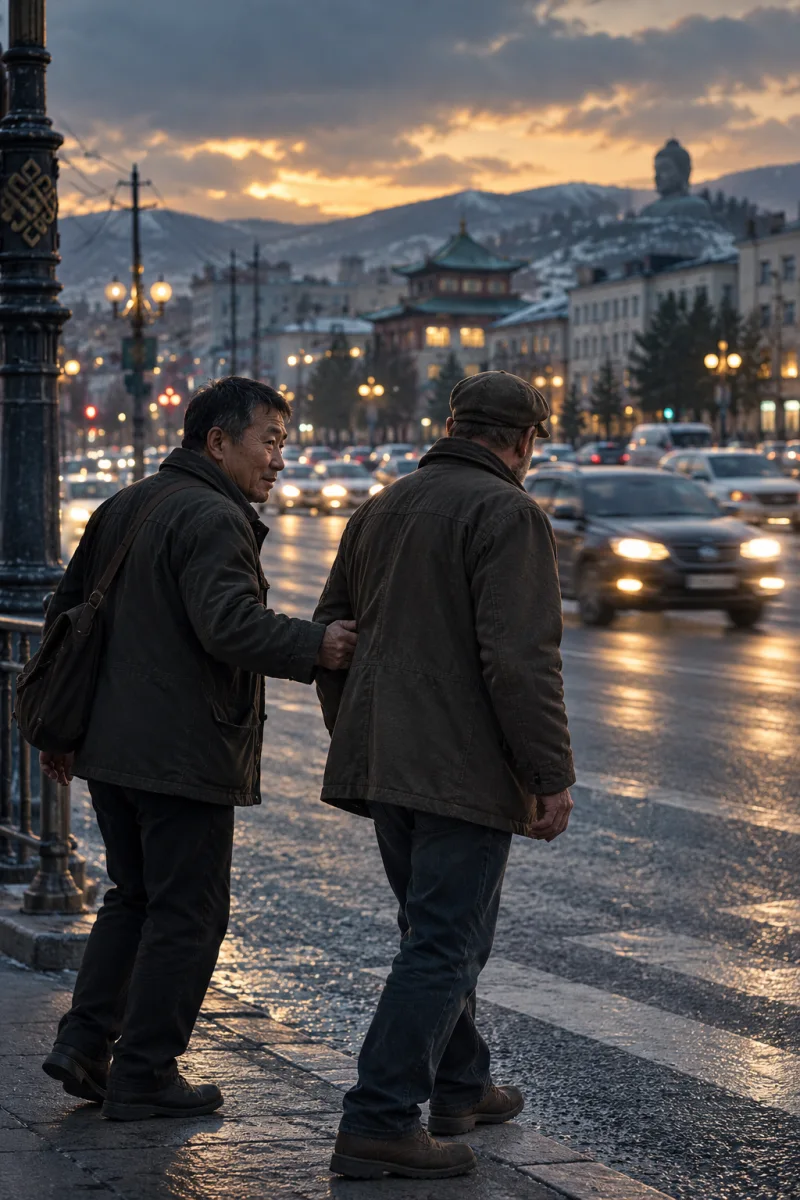
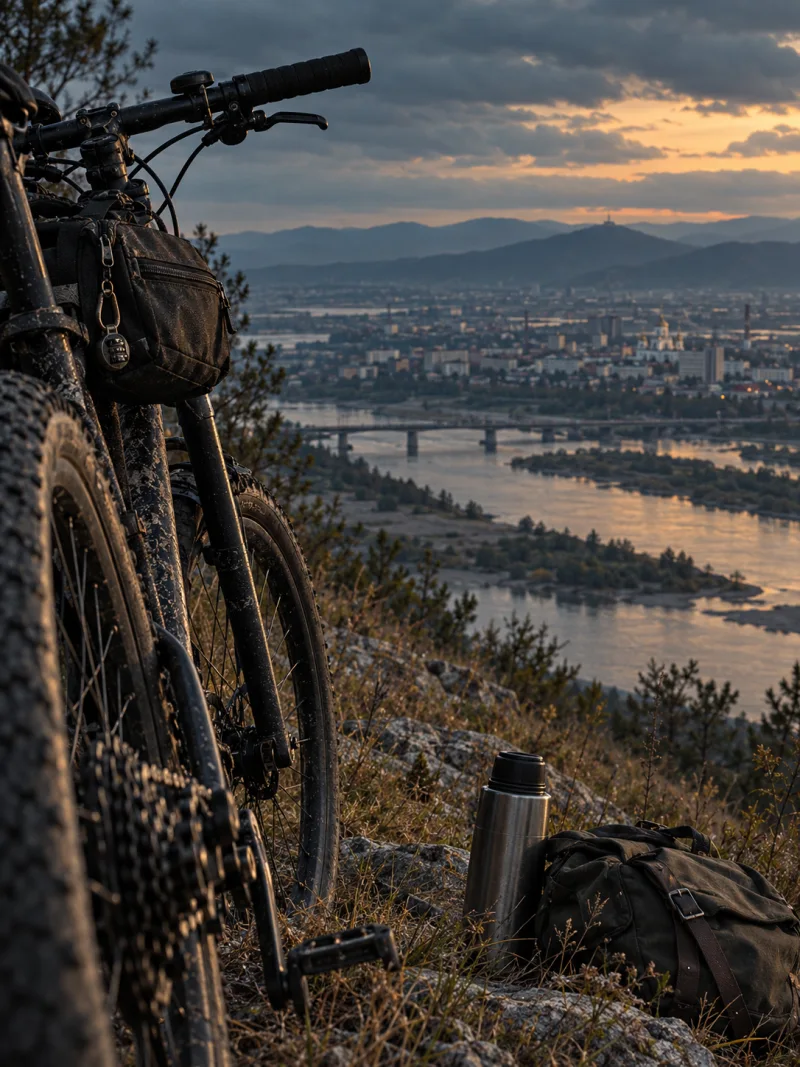
@nevsky_alexander
On Instagram: Dubai beyond the postcard — family, the city, discoveries and life between projects. On Threads: thinking out loud about design and AI. On YouTube: videos that need more room than a story. Follow me wherever you feel at home, and let’s keep in touch