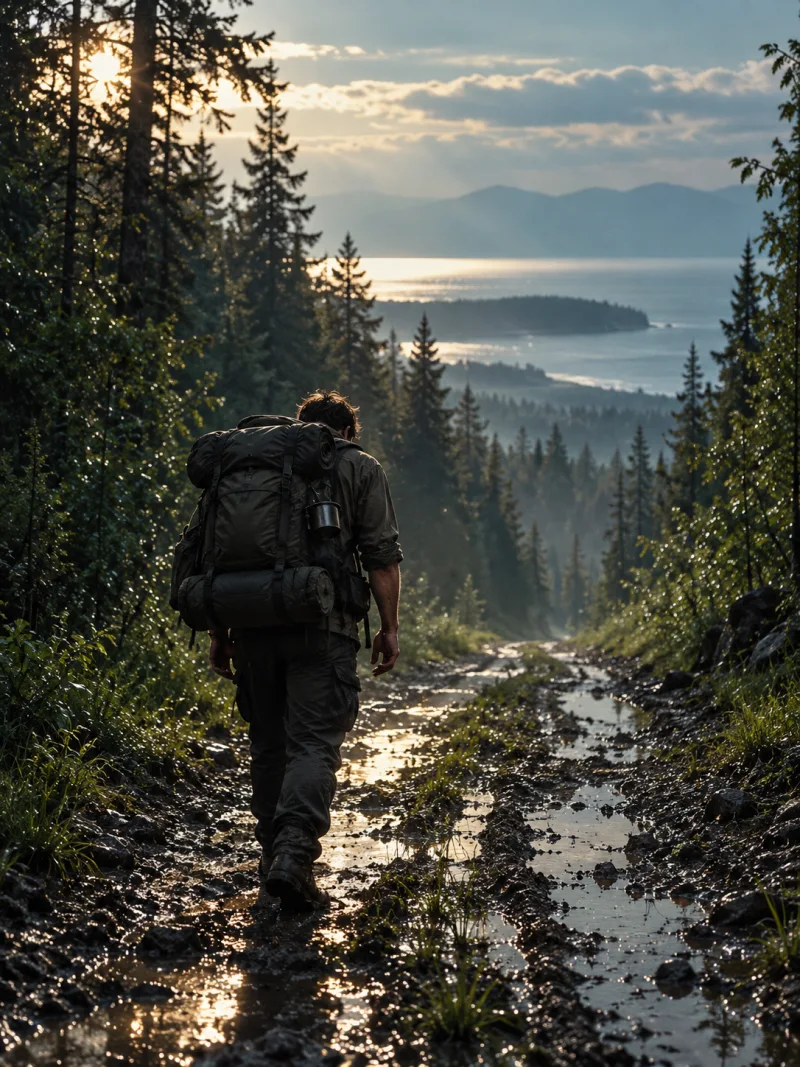
After walking twelve kilometers from the “corner” along the road to Monakhovo, I suddenly stopped, as though I had run into an invisible barrier.
The forest road climbed sunny rises, plunged into the shady twilight of the lowlands, parting, like the track of a zipper, the forest rustling damply after the recent rains. The blue sky opened to its full breadth above the carved and serrated treetops as they gradually drew apart… And it seemed there was nothing else in the world. Only the road, the forest, the sky.
And mosquitoes.
There were about eight kilometers left to Monakhovo.
This road stretched strangely, like rubber. I was falling behind schedule, and running out of strength too. The fatigue of a trek lasting many days was catching up with me. And on this road you shouldn’t walk—you should run! Despite the heavy backpack, without resting or stopping. It crosses the marshy isthmus of the Svyatoy Nos Peninsula on Lake Baikal (essentially, from the “corner” of Barguzin Bay to the “corner” of Chivyrkuy Bay). To myself, I called it the “road of death.” It was all because of the mosquitoes.
But now I had stopped… and was looking in surprise at what had caught my attention. In the roadside ditch, among the bushes.
An overgrown, lopsided grave enclosure with a rusty little pyramid-shaped marker, once painted silver. No little cross, no star, no trace of anything… What poor wretch had found his final resting place here? The graveyard theme (suggested to the muted accompaniment of the tediously whining bloodsuckers) did nothing to improve my spirits. Tears streamed from my eyes.
Not, admittedly, because I had begun pondering the transience of earthly things. A lone hiker crossing stony uplands, wandering through wild gullies and impenetrable thickets, has no time to think about that. Though sometimes… you wear yourself out all day, gulp down a mug of icy water with a stock cube stirred into it, dream of crawling into a soaking sleeping bag. And for some reason it is precisely into that interval (between “dinner” and “bed”) that they creep. Thoughts of transience.
No, no… sweat was rolling down my forehead. Mixing with the poisonous mosquito repellent I had to keep spraying myself with, the sweat turned to acid that ate at my eyes and skin. This tried-and-tested chemical spray had previously been “wing-knockingly” effective. But on the local “flying piranhas” (I suspect a special order, unknown to science, that had multiplied above this road), it made an impression for only the first ten minutes. After the recent rains, the heat was blazing up. A gray mosquito cloud, pierced by horseflies and hornets (abominations beyond belief!), swayed above me.
“How on earth did he end up like this…” Meanwhile, I was pondering the mournful resting place. “Must have been a driver who crashed while drunk. Here, as everywhere on Russia’s bad roads, it’s the national extreme sport. Getting plastered and going for more. Racing off for vodka, anywhere at all. But noiselessly rustling death, in its turn, catches up with the fugitive. Lightly touches his shoulder. Nudges his arm. The car flies down the embankment.” In the blinding haze of the ferocious day, the picture played tricks on my inflamed mind.
But then a chance came along…
And what a chance!
Something grayish-silver came rustling up behind me… (A super-gigantic mosquito cloud? A mutant hornet?! It’ll knock me over!) An SUV!! Somehow, incredibly, it had coalesced into a solid mass, materialized… Or was some murky illusion flickering before my eyes? Luminous dots? Corrosive acid hanging in droplets from my eyelashes? No, it was quite real. Matte. And painted silver. The comparison came unbidden as soon as I looked away from the little roadside pyramid.
The rustling phantom braked, settled springily on its shock absorbers, and flashed its lights invitingly. There was something striking about the vehicle’s… cleanliness, so out of place here. “Did it float over the puddles and mud, or something? Or has it just been washed with car shampoo?” The thought flashed through my mind as I ran toward the SUV that had so strangely appeared here in the back of beyond, my backpack bouncing. The driver, in a baseball cap and sunglasses, leaned across the seat and pushed the door open. I offered to put my backpack in the trunk, but the sturdy, tanned young man just waved his hand… Come on, he seemed to say, chuck it inside, don’t sweat it!
As I settled in with my backpack on the back seat, I introduced myself, and he mumbled something in reply… The soft thump of the door at that moment seemed to cut off his name. As it happened, he was heading to Monakhovo, where his friends were on vacation. And I can easily give you a lift, why wear your feet out! The off-road vehicle (or, more accurately, the “above-road vehicle”) literally began to float… With restrained power it took the climbs, smoothly traced the bends, and methodically, probing the bottoms of the greenish puddles with all four driven wheels, sliced through them with scarcely a splash. Conducting the harmonious sound of the orchestra, this maestro of forest off-roading played lightly with his fingers on the steering wheel. A massive ring gleamed on his right ring finger, and flecks of sunlight scattered from the gold and crystal facets of the watch adorning his wrist.
My clumsy backpack suddenly seemed like some country “nephew” who had unexpectedly descended on his relatives in the capital. Even the velvety seat upholstery wrinkled in disgust beneath its trampling… (And it was covered in stains, as though a map of the routes I had traveled had been projected onto it: green forests, brown plateaus, the veins of rivers. Filthy, slashed by branches, scorched beside campfires. Stuffed to the brim with everything necessary. Loaded with a tent, a sleeping bag, a rolled sleeping mat; everything damp and smelling of smoke. And strapped to it in a canvas sack were flat, disc-shaped Baikal pebbles of astonishing colors… The heartbeat of the surf, recorded in their stone memory, could be listened to on winter evenings. And the sheathed antenna of a fishing rod stuck out. And fanciful pieces of driftwood, fragments of old man Baikal’s dreams, worn away by wind and sea, were tied on top.)
The artificial coolness carried a whiff of the grave, the ionizer gave off a sweetish floral perfume, music in the hidden speakers sawed away dully and monotonously, and there was no escaping the flickering instruments on the dashboard and the navigation screen. This whole box was stuffed with electronics, shot through with radiation… as though someone had shoved me into a microwave! Only the crown of the driver’s baseball cap was visible above some peculiar headrest, and the rearview mirror—strangely!—did not reflect his face.
How many times all sorts of people had given me lifts, shared things I needed (my thanks to them!). In everyday life, the people I met might have been anyone at all, but on forest roads, having joined the eternal brotherhood of wanderers and travelers, these newly converted “brothers” were always interested in a well-traveled man. Where had I been, what had I seen, would the heat last, might the storm front turn, what were the fishing prospects, and… were there bears around? And now, wanting to strike up a conversation, I offered an opinion on the weather and fishing—what could be more topical? I said that after Monakhovo I was going to Katun, and then on to Okunevaya Bay, where I had been last summer and which I had liked very much. As for bears! Yes… I’d had an encounter myself! I vividly described what I had seen the previous summer. Thank God I hadn’t been alone then. Some guys were giving me a lift in the plainest little UAZ… And suddenly! Onto the road!! A full-grown Bruin stepped out and stood right in front of us!!! He was “covering” another of his kind, a smaller one, who ran into the undergrowth behind him. And this one was enormous, a great black hulk! A real mob boss, claws spread like a fan. And, “arms akimbo,” he seemed to “beckon” us over. As though he’d arranged a showdown here. Well, bros, made it, have you? Out you get, we need a word! Without waiting, of course, for the “bros,” who had remembered (or forgotten?) both mommy and daddy, the clubfooted fellow leisurely withdrew into the taiga. But why was I going on about it?
I guessed my silent companion (apparently indifferent to untrodden paths, fishing, and bears) was somewhere… in his early thirties. “Why, I’m about fifteen years older than him!” I chuckled to myself. But what was there to chuckle about? The mirror reflected my long hair spilling out from under a silly, crumpled sun hat, my prickly stubble, my faded T-shirt. Traces of battles with the winged host (gray streaks of sweat, red scratches on my hollow cheeks and cheekbones) did nothing to lend me gravitas. Around my neck was a cord with a charmed amulet, on my wrist a worn compass that had served my father before me. A proper nerd! As a child (no fortune-teller needed to tell you that!), I had been a diligent reader of Jules Verne, Fenimore Cooper, and Jack London. And what about the famous French physician and traveler Alain Bombard? (Already in his declining years, at 72, he crossed the Pacific Ocean in an inflatable lifeboat.) I used to fall asleep and wake up with his book The Bombard Story under my pillow.
The guy at the wheel asked indifferently, in a voice as even as the rumble of the engine, why I wandered around alone. It must be… boring, probably? And, all in all, a bit scary. Dangerous, right?
“Well, dangerous…” Questions like that always leave me at a loss. “Take a lion tamer, for instance. It’s dangerous for him to go into a cage with those beasts too, and he knows it. And frightening. So why doesn’t he just put them to sleep with tranquilizer shots? Then he could go in without a worry.”
“The tamer gets paid for it,” my opponent countered.
“There was this famous American advertisement, it won all the competitions over there. ‘If you feed your dog badly, it will become gloomy.’ Well, if you don’t overcome your fear, you’ll become gloomy too!”
And the driver fell gloomily silent.
Just then we drove into Monakhovo. Everything happened with a sort of convulsive speed: he braked, I clambered out with my backpack… The rustling cloud dissolved into the air with a bluish wisp of exhaust.
The bay at Monakhovo, cutting deep into the taiga-covered slopes, is sheltered from the winds and fringed by a strip of sandy beach. A crush of cars, tents crammed everywhere. Launches and motorboats, children shrieking, music blaring. Bustle, in short. Hoisting my backpack, I strode on down the road, which skirts the marshy floodplain behind the beach. I can’t say I felt no joy. (I’d so neatly “skipped” those eight klicks, which otherwise would have stretched to sixteen!) Yet at the same time, it was as though I had been set some problem on that road—and had flipped through the pages and looked straight at the answer.
And I ought to rest, find a spot on the shore. Dive into the cool waves, wash off the sweat and the poisonous muck. Make some tea, wait out the fiercest heat. But I was hurrying to reach Okunevaya before dark. There I’d really enjoy myself to the full. Camp, swimming, fishing. Dreams!
A high, steep bluff rises at the end of the bay. Here begins the trail toward the northern head of the peninsula, through Katun and Kurbulik, as far as Krestovskaya. In the heat, the climb is exhausting. From the summit above the precipice, a panorama opened onto the distant Barguzin Range, boundless expanses, the broad sweep of water. A stone Cosmos fallen to earth, driven into it in boulders and cliffs. Worlds of taiga stretching beyond sight… As though He in whose hands lay the Kingdom of God were holding out to you alone, in His greatest mercy!—the Inexhaustible Chalice, filled with blue haze to the rim of the horizon. And you drink from it until your head spins… swallowing the wind, suddenly noticing a tiny motorboat, like a water strider trailing white, foamy whiskers, hurrying who knows where. The coast is indented with bays. Ahead, beyond two steep headlands jutting into the water, lies Katun.
Through my binoculars, I carefully examined the distant headland’s massive, rocky brow. Greenery curled at its foot, and a little spit jutted out, almost white, like a crescent of sand. Gulls wandered about on it (their air base, apparently). From above you could see the immaculate sand of the gently sloping shore gradually disappear into the water in a halo ranging from white-yellow to emerald green (then shading into violet). At once the image arose of a tiny, uninhabited island paradise in the ocean. Unrealistically glossy, photographic, like something in an advertisement. If only I could get there… but how? Cross the nearer headland (dotted lines of paths scatter across it), climb down those… and those rocky “cheeks” and screes all the way to the water; but that cliff over there, how would I get around it? It drops sheer, plunges into the depths. How wonderful it would be to pitch a tent there, on what would essentially be my own “island”… Listen to the music of the waves, get acquainted with the gulls. Fantastic! But the nearer headland was difficult enough. And what about the farther one? I’d only waste time. All right, if I got the chance, I’d scout it out.
Taking out my camera, I took a few pictures. I drank the half-bottle of water I had left in a plastic bottle, finished a handful of dried apricots stuck together that I found at the bottom of a backpack pocket, along with some broken chocolate and rusk crumbs. The French film actress Fanny Ardant (she’s always having some trouble with excess weight) would have been green with envy at my diet.
The well-worn trail led into the forest, skirting the precipitous slopes from above. After about a kilometer and a half, I noticed a fork. A less traveled path led down the slope of a gully… It looked as though it might take me to the first headland? And give me a chance of reaching the second? And there, with luck, a way down (or an approach from the side) to the little spit I had set my heart on might reveal itself. Having decided this, I turned into the deep twilight where the midday sun could not reach. Mixed forest; wind-felled trees. The birds’ clamor would die away, then flare up again. The mosquitoes behaved in a more “organized” fashion. Apparently one “gang,” encountering the mosquito-repellent aura surrounding me—and buzzing angrily and helplessly—would pass me “from wing to wing” to another “gang,” which immediately launched its futile attack. Branches, leaves, bark, and other forest litter on the path had been ground and pounded to dust. You might suppose cows came through here. But what sort of guerrilla cows… From where? After reaching its lowest point, the path shot upward again. The undergrowth thinned and fell behind. Ahead rose a dome-shaped slope covered in shrubs and grass. It looked like the steep side of a copper cauldron belonging to giant nomads, not yet cool after the piping-hot pilaf (my associations were gastronomic, since I’d had my breakfast of a cup of soup and tea with rusks early that morning)—overturned and abandoned here forever. Granite blocks, weathered into layered “stacks,” were embedded at intervals, and you could skirt them along the now barely visible, almost erased path. Dismissing my silly fantasies about cows, I thought it was probably a goat trail. But… what goats? Domestic? Wild? More nonsense. The slope was turning ash-gray, scorched to dust, licked by the winds down to stony bald patches. I was wearing sports sandals, with special straps that supported my ankles. On the steep slope, however, the soles twisted sideways, and little stones and sand worked their way under my feet. Clearly unsuitable for extreme mountaineering. Of course, I had an excellent pair of all-purpose boots with treaded soles in my backpack. Stop, change shoes, waste time… Better (and wiser!) to turn back, then. But suddenly the thought of going back through the depths of the forest seemed unbearable. And the climb grew steeper and steeper, forcing me to scramble upward, so that it wasn’t only hunger making my stomach tighten… An unpleasant chill of danger crept over me. My backpack was loaded above my head, its center of gravity shifted toward my shoulders (making it easier to walk on a level road)—but I wasn’t going to bound about like a mountain goat that way! Either I pitched forward or it dragged me backward; I couldn’t keep my balance. Below, the rocks lay piled up. The white tongues of the breaking waves licked their jagged edges altogether too carnivorously. The damned trail dwindled to a thread. What goats… clearly it had been trodden by suicidal ground squirrels! The thread unraveled into short, pointless stretches that led nowhere, dwindled to nothing, disappeared. The only way to advance was to scramble up to a “higher level”—crawling onto the next winding, narrow terrace. But that too ended at another granite outcrop, and I had to find a way around it, or simply force my way through. Shrubs and grass pulled out by the roots when I grabbed them. A foothold either came loose with a stone or crumbled away in clods of earth. Why had I climbed up here, for the sake of what mythical “paradise”?! If I’d kept to the shaded forest trail, I’d be going down to Katun by now. Instead, I was up against a rocky “mane,” looking for any sort of “handhold” to get over it. Turn back!
And suddenly a few seconds fell out of my life, were erased.
My fingers turned into claws. That happens when you find yourself dangling twenty meters up. I dug in my claws (and would have sunk my teeth—my fangs—into something, if there had been anything to bite), trying to hold on. The bulky backpack—if I leaned even a little—would immediately tip the balance and topple me! The sole of my left sandal had twisted almost vertical, and only its toe (and my straining toes) supported nearly the entire weight of my body concentrated on them. My right foot, its inner edge toward the slope, barely fitted onto a narrow, crumbling ledge. Behind me, in the bluish haze of the mercilessly scorching sun, stretched Chivyrkuy Bay. If the gulls were wheeling about, crying ever more plaintively and anxiously—well, what did gulls matter now…
But how had I “transported” myself (almost a meter higher!) from the lower path-ledge—and ended up in this damned “dead spot”?! Something had whacked the back of my head… sunstroke? No, surely not… Hadn’t I felt something rustling behind my shoulder? Hadn’t it given me a push?
And how I’d swaggered back there, beside that mournful sign given as a warning. What did I care about the transience of earthly things! And so a messenger had been sent after me in a silver-painted “means of transport.” He could hardly turn up in a hearse! (Or was it the soul of that poor wretch, wandering and restless? Still racing along above the road, bewildering solitary travelers?) And there had been a premonition. The chill of an open grave, the suffocating floral scent, the otherworldly minimalism of the tracks, the infernal flickering of the navigation system, which had also pinpointed my thoughts, so excessively self-assured at that moment.
The empty mirror, the glassy glints in the impenetrable sunglasses, the slanting shadow of the cap’s long, beak-like visor.
An Envoy of Darkness would scarcely be interested in weather and nature and all that. (And I should have been on my guard!) But as though I’d breathed in too many chemicals (along with my “beloved” mosquitoes), I’d buzzed away at him! Given away my route. Told him what I had witnessed of the lives of the Forest Giants. Everything connected with them has a sacred meaning.
My claw-fingers slipped as they searched for a more dependable crack, a little bush, a blade of grass. To get back (I still hoped I could), I had to shift my weight onto my right leg, crouch down on it, and feel around with my left for some protrusion down there… (in oblivion, it seemed to me; in the abyss). Try going forward? But then, somehow moving sideways, I would end up on the rocky “brow.” Hang there, flattened against it without any support? And what lay ahead? One thing was clear. It would only get worse.
Stop, stop. The main thing was not to die of fear before my time. What was it Alain Bombard said… Let me remember… Thousands of people who had been shipwrecked died not because they lacked water and food. Rocking above the abyss on indifferent waves, to the plaintive cries of gulls, they died of fear!
I was practically shipwrecked myself.
But… this was turning into some kind of nonsense. An Envoy of Darkness!
What on earth had I worked myself up into? Millions of ordinary guys drive fancy cars. And one of them had given a lone dude on the road a lift. And that dude had got God knows what into his head. Overheated in the sun. What evil spirit? A regular plot by Stephen King, the “king of horror.” Too much reading.
Why, the world is arranged so that ordinary guys can drive fancy cars, and want to buy them—ever fancier, ever more loaded with extras. That’s why the guys work their asses off, earning money for fancy cars. Admittedly, others have found a better arrangement. In various ways, they take half of what the working guys earn, and buy themselves fancy cars. Both sorts take shots at one another from time to time. All perfectly normal. Some people like climate control, a floral ionizer, sawing music, and a headrest adjustable at the touch of a button… What’s wrong with getting used to your own individual microwave before civilization (judging by climate change, that’s where things are heading) bakes in a global oven? I don’t have a car, I’m eternally “horseless,” so I’m jealous. I save all year to spend two weeks feeding mosquitoes, wolfing down packet soups, washing them down with bitter tea and rusk crumbs, and shivering with cold as I crawl into a soaking sleeping bag for the night. What for? To drink a mouthful of wind from the chalice of God’s world? Just one mouthful. One little sip.
Yes, yes, yes! I haven’t done this, have missed out on that, haven’t achieved a third thing… a fifth… a tenth! Haven’traisedhaven’tplantedhaven’tbuilt. Now I’ll start turning my soul inside out!
But what’s this?
Because this is, what do you call it… I’ve never had time to think about it… A whole army of psychologists makes its living from it… That’s right, a crisis! I’m in a crisis!! I don’t know what to do, where to go, can’t move a hand or a foot. Behind me, who knows what; below me, an abyss; ahead, a stone “brow.” Perhaps the so-called “midlife crisis”? And if so, that means… The strange realization, thank God, did not pierce me like lightning or an electric shock (or I’d have toppled right off; there wasn’t even anywhere among the rocks below to put a little pyramid and a grave enclosure). The realization blossomed in a halo of color—from bright yellow through emerald green to violet receding into the depths.
Why, I’ve found myself on the slope of my declining years!
Of course! What doubt can there be? The slope of declining years, that’s it!
Oh my God… I’d never thought it would be like this, all of a sudden! How could it have happened? That slope, I’d thought… was still far away. Ages yet! The impossibly heavy backpack pressing on my shoulders, dragging me down… that, presumably, is the burden of the life I’ve lived. My life experience, meetings and partings, triumph and despair. (And I have nothing more valuable.) But there are certain generally accepted norms! Some people in their declining years study ancient Chinese; others (Sergey Mikhalkov, for example) have children. I don’t have that opportunity, of course. For Alain Bombard, that slope took the form of the Pacific Ocean. Paul Bragg, the author of the famous fasting method, even went riding on the slope of his declining years… or, more accurately, riding ocean waves on a surfboard when he was 86. A wave flattened him, and he drowned. Strange! What happens on the slope of declining years? Does the individual start “sliding” downward? Or, on the contrary, climb upward? This matters very much to me. After all, certain patriarchal figures sometimes begin their memoirs: “And now, from the summit of my age…” Or: “Standing at the summit of my years…” So there is some sort of summit, and this slope leads to it?
And what did Leo Tolstoy see when he stood on that summit?
And Ivan Bunin? There’s no one, he says, beneath the moon, Only God and I. (In the famous poem “An Icy Night, the Mistral,” written at the age of 82.)
One could reflect on that, of course… But it was still absurd… My straining muscles were going numb; I was losing the last of my strength. My soles were breaking up the miserable ledge, earth and little stones were crumbling away, as though beneath me were that very neck through which the little grains of sand, the little seconds, disappear… the time of my life! I had to do something urgently!
Think or don’t think! There remained the maddest, most desperate, yet at the same time the only way out.
And then, with all my strength, I climbed upward, began scrambling into the very sky.
Guys! Never despair! Even if you find yourself in a lousy situation, or a crisis, or on the slope of your declining years… Don’t panic! The main thing is to act. Very slowly, perhaps, but constantly, always moving forward, even a centimeter at a time, claw your way out of the shit. Because I did climb that slope; I climbed for a whole hour. And then I sat there, resting, just spitting down below now and then. And from there I made out the second slope… the farther headland… Holy cow, getting over that really was impossible! You couldn’t do it without mountaineering equipment. But I thought of something better. I have a friend who flies a paraglider, and he’s promised to teach me. So next year…
Anyway, guys! If you’re driving an SUV or speeding along in a powerful motorboat and you see a lone walker with a backpack, or a hiker dangling from a cliff, or something of the sort flying across the sky, or someone floundering in the middle of the sea… Stop and ask, “How’s it going, dude?” And help if help is needed. It’ll probably definitely be me.
Source: Baikal, 2009, No. 2, pp. 82–88. Text prepared from a scan of the magazine publication.
@nevsky_alexander
On Instagram: Dubai beyond the postcard — family, the city, discoveries and life between projects. On Threads: thinking out loud about design and AI. On YouTube: videos that need more room than a story. Follow me wherever you feel at home, and let’s keep in touch