
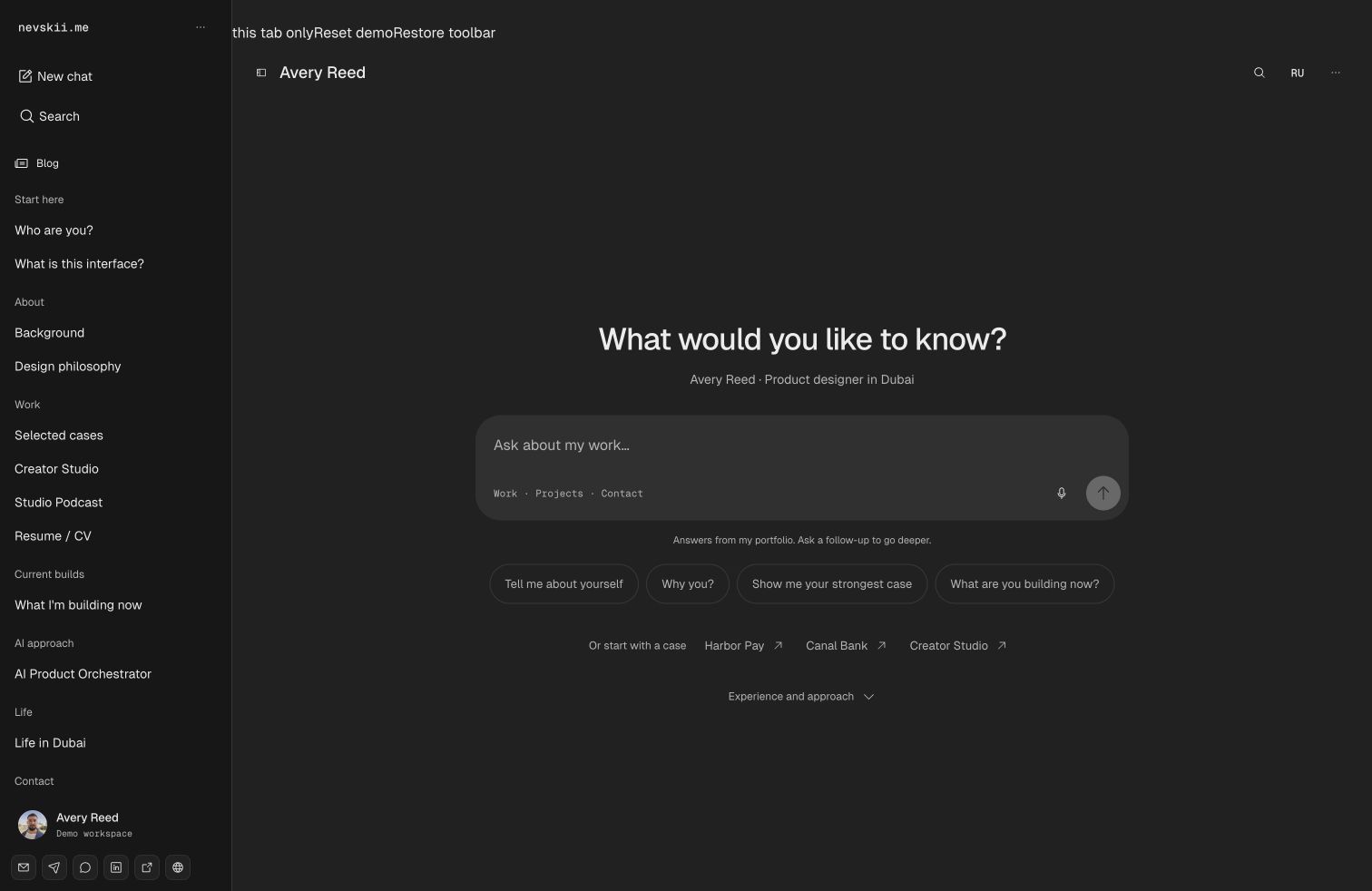
A CV is usually a solemn monologue. The author lists everything they consider important, while the reader tries to find an answer to their own question among dates, job titles and claims about teamwork.
I tried reversing that order: let visitors ask what they need. Any financial-product experience? What did I do in the UAE? Can they see a specific project? This portfolio resembles a conversation, but its value depends on how accurately it can return to the materials.
This is an archived version of my conversational CV. It shows dialogue as a way to get acquainted; the answers in this demonstration are prepared in advance.
Starting the dialogue
Archived interface · demo data
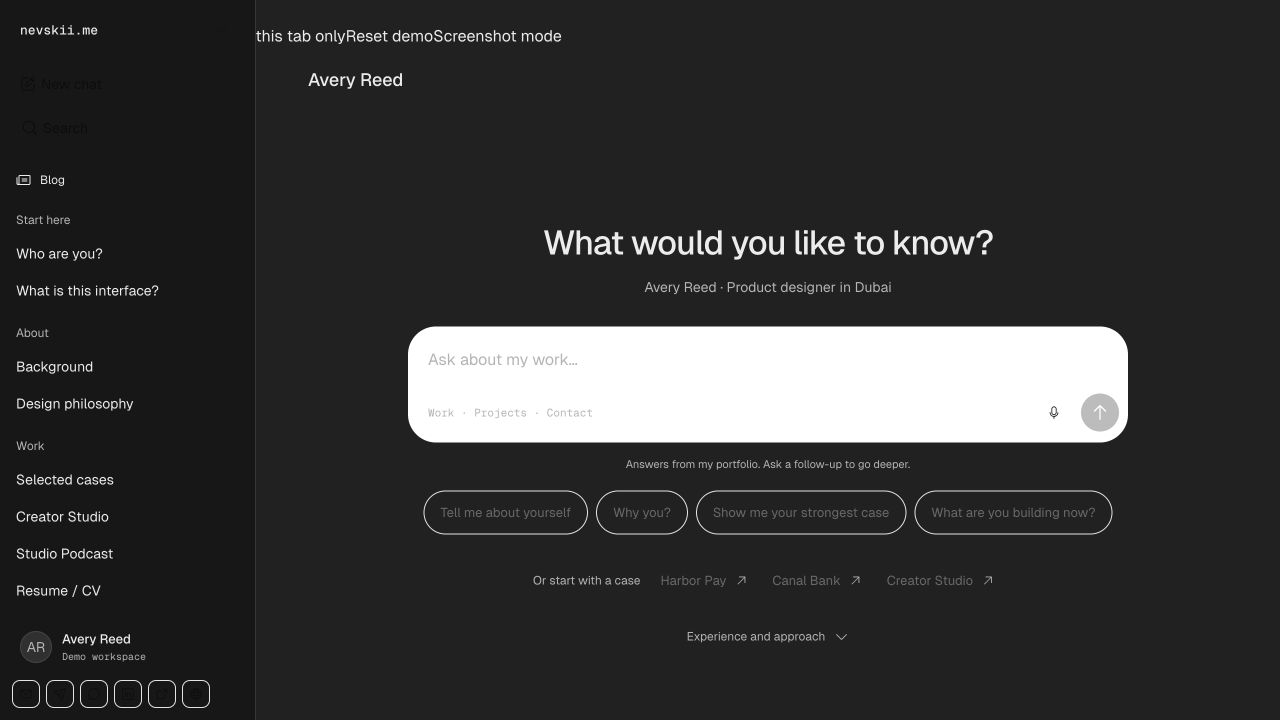
Find first, then answer well
The project has a question router: it matches queries with topics and projects, considers text matches and additional semantic signals. Direct links to a topic or project work deterministically. For open questions, the current configuration synthesizes answers through Workers AI; if generation is unavailable, it falls back to prepared author content.
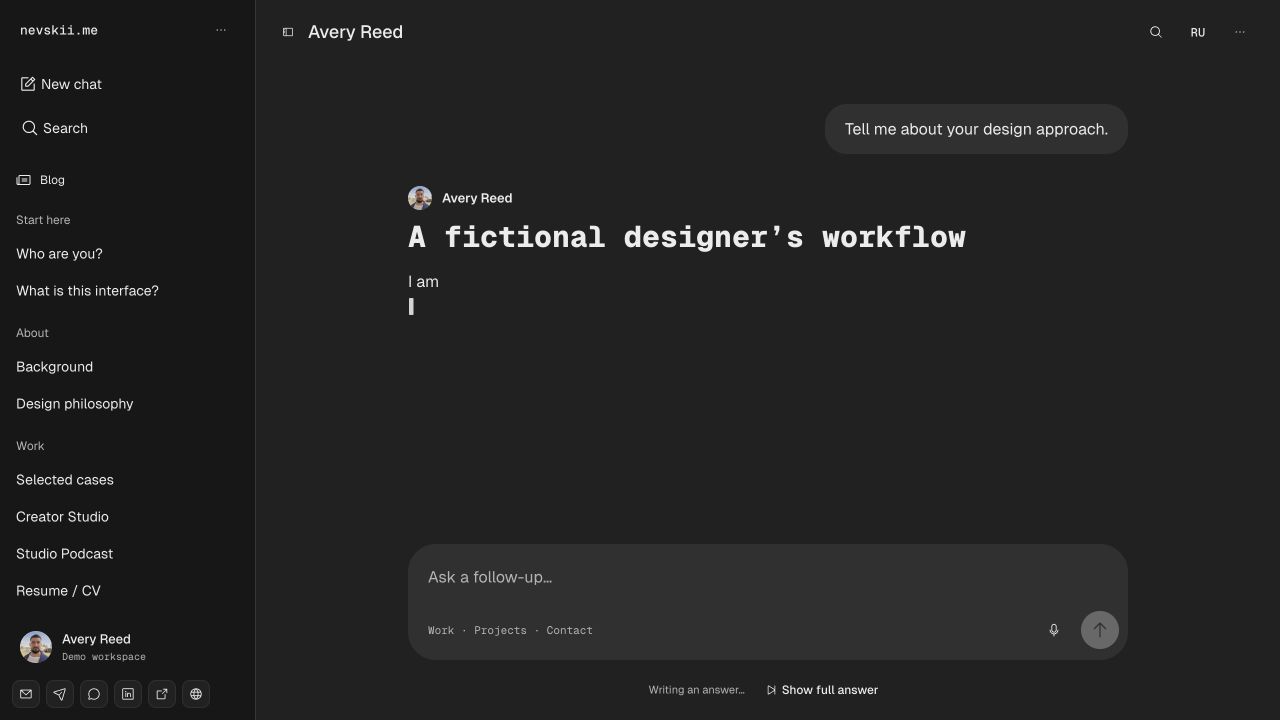
Here is an example conversation about professional experience. You can try the available topics and see how the original interface navigates prepared replies without contacting an AI service.
Prepared conversation
Archived interface · demo data
The model receives limited material excerpts and recent conversation history. Their roles differ: history clarifies the question; facts about my experience must come from content. A visitor calling me an astronaut is no reason to add a flight to my biography.
Semantic search helps when visitors do not use my wording. “Banking app” and “fintech” may lead to the same experience. But word similarity does not prove a fact: a question about leading a large engineering team must not retrieve a nearby case and silently promote me.
The answer must therefore be linked to the retrieved content. A project link is part of the answer, not an optional decoration. With a weak match, asking a clarifying question is better than assembling a convincing biography from probabilities.
Voice is another entrance
Voice changes how a question is asked, but must not change the permitted facts. After recognition, the system still has the same task: find suitable material and offer a clear path to it.
I see this as an experimental portfolio format. A semantic route in the code does not prove that every question will be understood correctly, or that visitors will prefer conversation to a normal project list. That requires observing how people use it.
I still like the direction. A good portfolio need not make everyone read the same autobiography. It can explain experience according to a person’s interests, provided the talkative interface retains a verifiable author behind it.
The result is a different way into the portfolio: visitors ask a question and get a path to suitable material. The embedded conversation is prepared for demonstration. Voice and live generation need to be tested separately from the quality of these screens.
Related stories: Source and Operator · The website terminal.
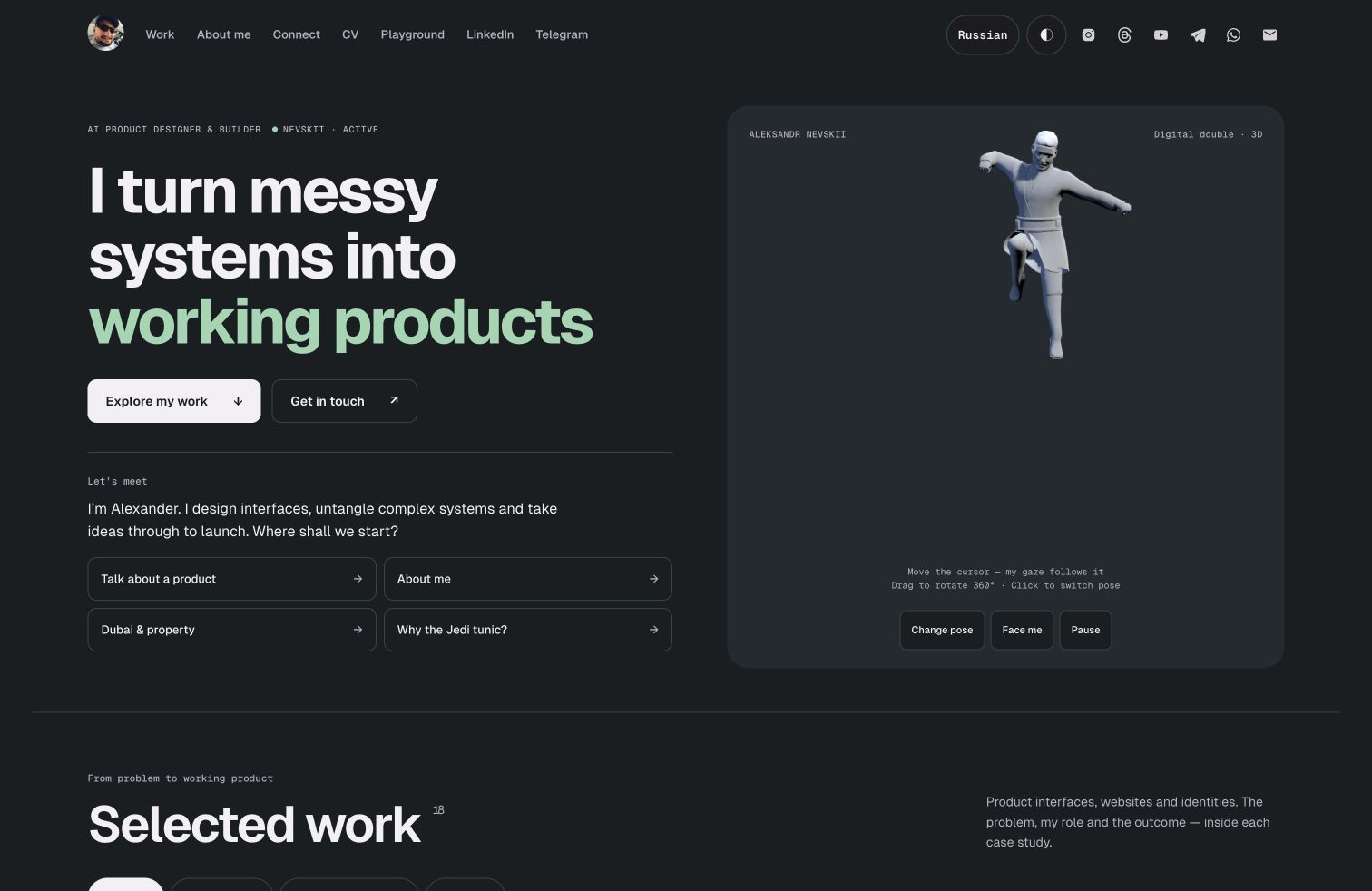

@nevsky_alexander
On Instagram: Dubai beyond the postcard — family, the city, discoveries and life between projects. On Threads: thinking out loud about design and AI. On YouTube: videos that need more room than a story. Follow me wherever you feel at home, and let’s keep in touch