
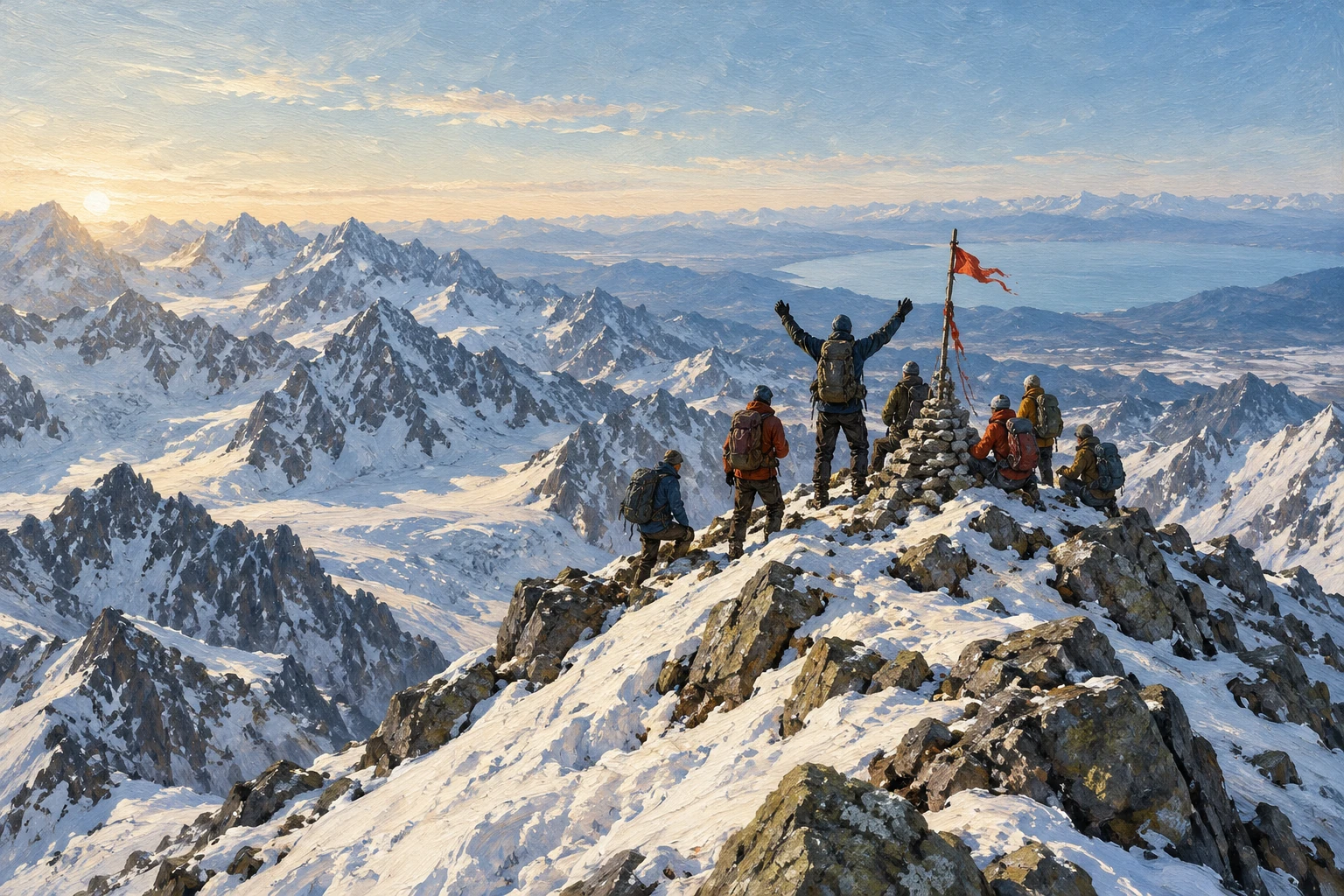
“For people of the future, staying in the mountains will become as much a part of their culture as books, music, poetry…” Stanislav Lem. Back in 1978, a group of Buryatenergo tourists, led by Stanislav Melnikov, made an attempt to climb the highest peak of Buryatia — Munku-Sardyk. But a hurricane wind and snow interfered. And now, a few years later, the power engineers again attempted to storm the summit.
Our route ran along the White Irkut River, then along one of its tributaries — Muguvek and further along the rocks — to the top. The mountains were met with wind and snow. We walk through narrow canyons and overcome steep ice terraces. A base camp was set up at the edge of the forest.
Squat firs with wide, spreading branches, birch and spruce coexist here with huge thickets of camel thorn. The beauty is indescribable. After the hustle and bustle of the city and road troubles, you can relax your body and soul. In the evening, three gloomy guys walked down past our camp.
Due to deep snow they were unable to reach the top. There are twelve of us. Two women. Can we overcome what these guys couldn’t?
And so, at sunrise, we begin our ascent. To the right and left there are chains of mountains. The climb gets steeper and steeper. Deep snow.
Hard. My heart feels like it’s about to jump out of my chest. We gulp for air. We rest every five to ten steps.
We approach the glacier and put on our crampons. We move in a team of three people. Finally, the last rocky climb, and we are at the top. There is no limit to joy.
We shout “hurray”, slap each other on the shoulders, laugh. Of course, the main thing in climbing to this nondescript stone platform at an altitude of 3,491 meters, on which our entire group can barely fit, is the sensations that we all experienced when conquering the main peak of the Eastern Sayan. After all, it was necessary to overcome laziness, excessive fatigue, and fear of cold… Here on the peak, open on all sides, a piercing wind blows.
We install a pennant with an image of a power line support and a diagram of the future CHPP-2, and take pictures. We take a last look at the snow-capped ridges surrounding us, at Lake Khubsugol, which is clearly visible from here, and go down. So, the peak has been conquered. And we have a new, hitherto unknown feeling of self-confidence, a desire to share our joy and optimism with others.
We remember with gratitude the chairman of the DSO of trade unions Rafis Yakupov, the head of the Tunkinsky Distribution Zone Vladimir Uskeev and many others, without whose participation and help our “peak” might not have taken place. The proud peak will be conquered by them another time. Eastern Sayan is an area that has long been developed by tourists. This also applies to the Munku-Sardyk mountain junction.
Once, one of the rescuers I knew from the Ministry of Emergency Situations, Viktor Kryukov, asked me about when I first climbed the highest peak of the Eastern Sayan, and my memory prompted me: in the summer of 1962. Therefore, I can say with confidence: anyone who has been here once will certainly return again. On May days, up to three hundred or more people gather here every year. Irkutsk residents are in the lead.
At base camp you will definitely meet familiar faces. Here is Vladimir Akulintsev, an adjuster of track machines and mechanisms of the Eastern Railway, with him are his two daughters, pretty, sociable schoolgirls Olya and Katya. Two years ago, Vladimir first climbed the sacred peak of Munku-Sardyk. Then he promised that next time he would definitely take his daughters with him.
He kept his promise. This year Volodya was less fortunate — he did not manage to conquer the peak. But Olya and Katya were very pleased to see the steep icefalls of the Muguvek River, the frozen bowl of an alpine lake and the festive atmosphere in the mountaineering camp. They will certainly conquer the proud peak another time.
Here we met VGTRK journalist Vladimir Zharov. Last year he climbed to the top for the first time, and with a professional video camera in his hands. In extremely difficult conditions, he managed to film material that many television viewers later saw in the “Green Turtle” program. This time Vladimir plays two roles: a full-time journalist and a public rescue worker.
Together with a group of rescuers from the Ministry of Emergency Situations, headed by the deputy head of the Buryat detachment, Pavel Shubin, he ensured the safety of mountain climbers in the most difficult area in the Northern Glacier area. Stanislav Burlakov, a teacher at the Ulan-Ude Railway College, also found himself in these wonderful places for the first time. His hike to the top and the Middle Pass is just reconnaissance. He plans to return next year with a group of college students.
Here next to me in the tent is Stanislav Konstantinenko, who has been visiting the summit for a number of years. She, according to him, attracts like a magnet and, moreover, is always different. One can envy Stanislav — despite his age, he is young at heart, and this is the most important thing. In addition to climbing to the top, there are many other routes that attract the attention of tourists.
Stanislav and I chose one of them, leading from the White Irkut valley to Middle Irkut, about 20 kilometers long. On the first of May we set foot on the ice of White Irkut. The morning was sunny and warm. The ice on the river had already weakened considerably, and in many places water was flowing.
Rubber boots helped us out. After walking on the ice for several kilometers, we left along the left tributary to the Sredny pass. At the confluence of the stream and the river, a picturesque cascade of icefalls formed, which we easily overcame. In one place a couple of white partridges were observed.
This trough-shaped valley has long been favored by snowboarders, and a year ago we watched their risky turns. True, today there were no snowboarders in sight, but we followed their tracks up. The pass saddle has already been cleared of snow. A cold, gusty wind was blowing, but we paused to look at the panorama that opened up.
We walked along the ridge. We descended along a large kurumnik to the upper reaches of the Middle Irkut. Launching over the ridge is not the best option. Most often, tourist groups traditionally go through the Contrasts Pass, which is located to the left.
In our opinion, the path through the Middle Pass is more rational. Meanwhile, we descended into the bed of the stream that gives rise to the river. Gradually the valley widens to then turn into a narrow canyon. Blue ice and icefalls are increasingly on the way.
In some places the riverbed has completely cleared of ice, and we walk along boulders rolled in by the river. The gentle spring sun, the silence after the heavy wind at the pass, the beauty and grandeur of the surrounding rocks had a calming effect. The mood was great. We already saw ourselves at the last serious icefall on our way, where a safety rope was hung along which we could go down.
A year ago, Stanislav already performed this maneuver. But you shouldn’t relax in the mountains. Suddenly the canyon narrowed sharply, and we saw a water shaft rolling across its entire width, cascading down like a waterfall from a height of at least six meters. It was obvious that our strength and equipment were not enough to provide adequate insurance.
We made a difficult decision for every tourist: to turn back and climb to the top of the canyon to go around the waterfall. The first attempt to climb aboard the gorge was unsuccessful due to the steepness of the rocks. We were forced to descend onto the ice of the river again. The day was approaching evening, and the time had come to think about a possible overnight stay.
Our assault backpacks contained a minimal supply of warm clothing and food items—bread, lard, crackers and sugar. Of course, there were matches and a knife. But if we don’t return to camp, our friends will send rescuers to search. This situation was not at all attractive.
Despite being fairly tired, we soon managed to find a narrow crevice among the coastal rocks. We made sure that the scree along which we had to climb lay firmly, there were no “living” stones. The lifting height is at least a hundred meters. Having studied the map before the hike, we knew for sure that there was a trail at the top of the climb.
So, go ahead! We climb up the stones, like steps of a ladder, to the top. The path was found very soon along the telephone line poles. So, we are standing on the famous Oka trail leading to the Nuhu-Daban pass.
Nowadays, an excellent highway leads to the Okinsky district. But the trail still remains, and the telephone line is a sure guide in a difficult situation. Soon we descended onto the ice of White Irkut. There were about five kilometers left to walk to the base camp.
At dusk we arrived at the camp where they had been waiting for us for a long time. Everyone gathered around the fire. A tourist fire… It gives rise to good feelings, and the smoke of the fire takes away worries and sorrows.
Cleansing occurs. And here, around the fire, new routes are discussed. Dear reader, if you want to see snowy peaks, blue ice on rivers, and get rid of the everyday hustle and bustle, join us!
@nevsky_alexander
On Instagram: Dubai beyond the postcard — family, the city, discoveries and life between projects. On Threads: thinking out loud about design and AI. On YouTube: videos that need more room than a story. Follow me wherever you feel at home, and let’s keep in touch