
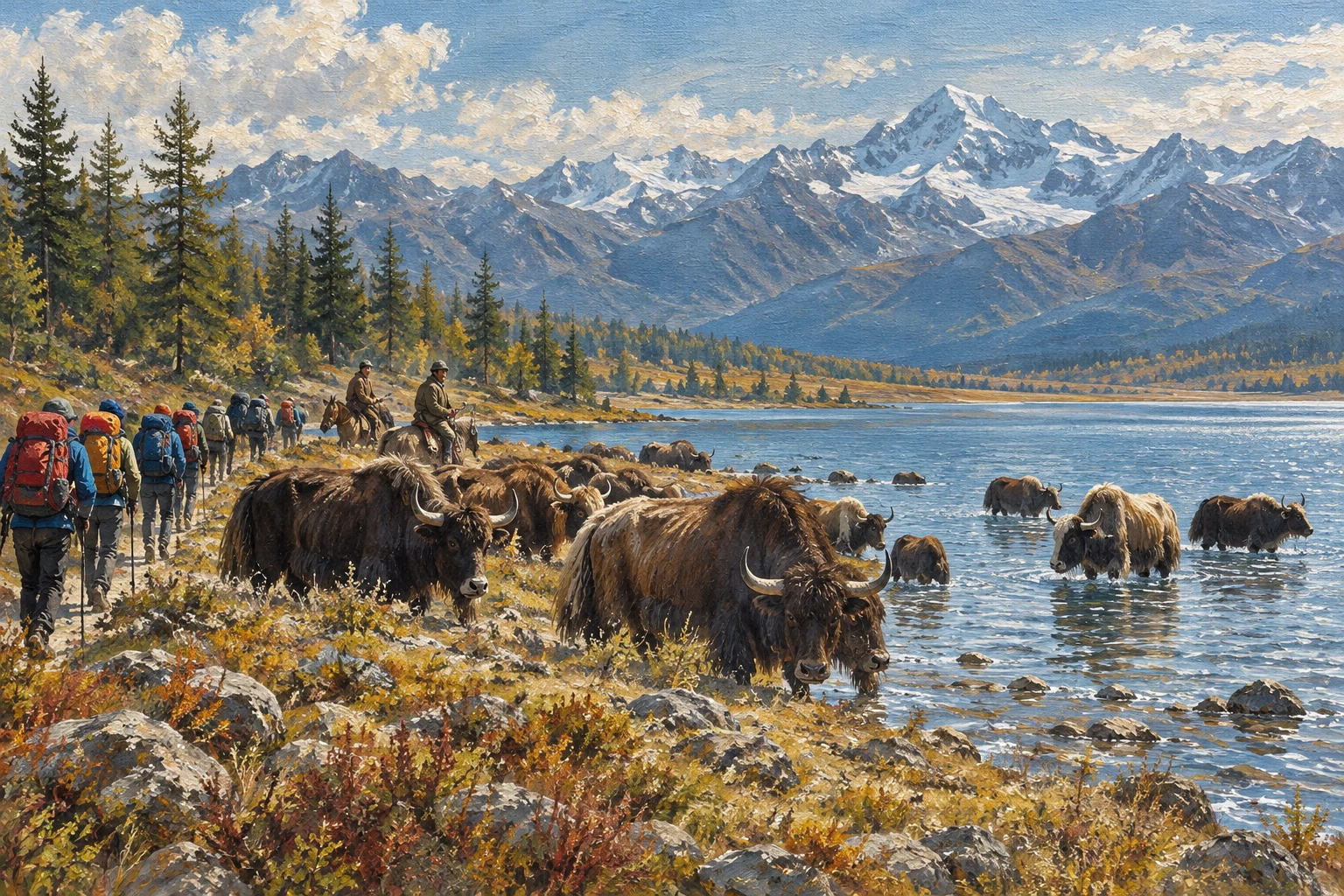
One day we found ourselves on the shore of Lake Dozor-Nur, in the Okinsky district. The day was hot, and clouds of mosquitoes and spiders accompanied us. This apparently forced a large herd of sarlyks to come to the shore of the lake, where a weak, fresh breeze was felt. And some animals wandered into the lake and stood up to their bellies in the water, experiencing, in my opinion, a special thrill.
Part of the herd was located closer to the path, and we had to follow their nose. There were 10 of us with backpacks on our shoulders, and, naturally, our appearance caused alarm among the animals. In addition, the tantalizing colors of backpacks and clothing were alarming: red, yellow, orange. The animals are alarmed, and we see how some of them take a fighting stance — with their short strong legs spread wide and their heads lowered to the ground, they follow our group with an unkind look.
We try to remain calm. No provocations! Fortunately, the shepherds were nearby and decided to meet and get to know them. They came up, said hello, and started talking.
And, by the way, we found out that they have a rubber boat. Vladimir Zharov turns to them with a request to give us a boat tomorrow to cross the Tissa and receives the go-ahead. Having thanked the hosts, we move on. Tomorrow we have to cross to the opposite bank of the Tisza and head for Balakta.
At the end of the day, we chose a place for camp closer to the planned crossing. In the morning after breakfast, throwing our backpacks on our backs and leaving the yaks alone, we go to the crossing, carry a rubber boat with us, and put it into working condition. There are 10 of us, and the crossing is delayed, since the boat can only take one person with a backpack, finally the last participant is on the right bank. We get on the path and soon come to a ford across the Sagan-Gol River.
We cross it side by side, dividing into three or four people. Today we have to walk more than 20 kilometers to the planned overnight stay in the winter road indicated on the map. And then there’s a couple more days’ walk to the village of Orlik, where we’ll use motor transport. We are in a hurry because one of the group members, Sergei Evseev, fell ill.
He needs medical attention. I’ll say right away, so as not to torment you: everything ended well. But let’s return to our sarlyks. Yes, we can say about their rich milk and sour cream, which we had to cut with a knife when the shepherds treated us.
But for some reason we forgot to talk about their climbing abilities, but they were born to climb mountains, and this is inherent in the constitution of animals. The Tibetan Yaks reminded me of this. No, I have not been to Tibet, I have not climbed the Himalayan eight-thousanders, but before the hike I read the book “Crystal Horizon” by the famous mountaineer Reinhold Messner for the second time. I’ll say a few words about the author: Reinhold Messner, over the thirty years of his activity, climbed all fourteen eight-thousanders in the world, including visiting Everest twice — and both times without an oxygen apparatus.
Moreover, for the second time I climbed to the “roof of the world” alone. Whereas even smaller peaks could not be climbed alone. Here, in the base camp at an altitude of 6,500 m, only Messner’s companion, a Canadian journalist, remained. But, as they say, winners are not judged.
So, on the pages of the book “Crystal Horizon” I met amazing animals — yaks. The yak is a domestic animal, and therefore is used in many places in Tibet as a beast of burden, and is capable of rising with a load to a height of 6,500 m. This is where I remembered sarlyks, which are somewhat reminiscent of Tibetan yaks, without whose participation not a single expedition in the mountains is complete. … The older we get, the more often we remember the past.
Many times I had to get on a hiking trail and safely complete the intended route. This was usually facilitated by careful preparation for the campaign, strict selection of the team, as well as the sometimes wonderful weather and low water in the rivers through which we had to cross. But I realized for myself a long time ago: most often, the success of the trip depended on the goodwill and sincere willingness to help on the part of shift drivers, geologists, hunters and shepherds. It is impossible to list the names of all the good people that we have met over the years along the way.
I thank everyone from the bottom of my heart and bow!
@nevsky_alexander
On Instagram: Dubai beyond the postcard — family, the city, discoveries and life between projects. On Threads: thinking out loud about design and AI. On YouTube: videos that need more room than a story. Follow me wherever you feel at home, and let’s keep in touch