
Pos. Nilova Pustyn — r. Khubyty — Khubyty pass, 1A — r. Baram-Gol — r.
Ara-Khubyty — r. Yaman-Gol — lane. Observatory — r. Narin-Gol — min. sources — r.
Shumak — Shumaksky pass, 2,760 meters — village. Nilova Pustyn. The length of the route is 150 kilometers, duration is 9–10 days. The purpose of our trip is Shumak mineral springs.
There are many legends about this amazing place… There are 500 kilometers of roads behind us, and ahead of us are 50 kilometers of high-mountain trail through the highest pass in Eastern Siberia — Shumaksky. Tourists get to Shumak via several traditional routes. The first of them, the one we chose, runs through the Shumak Pass, open from July to September.
The second entry option is through the Khubyty and Obzorny passes and the valleys of the Yaman-Gol and Narin-Gol rivers — a distance of 80 kilometers, the path is open from June to September. If desired, this route can be shortened by moving after the Khubyty Pass through the Chetyrekh Pass, located on the watershed of the Zun-Gol and Left Shumak rivers. Tourists often use the popular route: Arshan resort — Arshansky pass — Kitoy river — Shumak river — springs. From the mouth of Shumak to the springs 40 kilometers.
The total length of the route is 90 kilometers. These days you can fly to the springs by helicopter. So, we are walking through the Shumak Pass along the path of our youth. It’s probably time to tell about yourself.
This time we are going together: Stanislav Konstantinenko and the author of these lines, both Ulan-Ude residents. Our tourist experience spans several decades. Stanislav often has to wait for me on the way, since I walk slowly due to my once injured ankle. And my age is such that you can’t run away: in a month I will turn 70, and my companion will be 63 years old.
On the trail you can now increasingly meet people wishing to get to the springs using pack horses. We often see young boys and girls traveling in the saddle. But we don’t envy them. In all likelihood, they have money, since hiring a horse is not cheap.
But they do not have physical training and hiking skills, most of them smoke a lot. Stanislav and I don’t have that kind of money, but we have endurance, patience and skills in communicating with nature that we have developed over the years. The ascent to the pass goes along a steep slope covered with stone deposits. The path winds in zigzags.
We cross the pass safely. There are often difficult weather conditions here, but we were very lucky. The sun was shining and it was not just warm, but even hot. For the first time, I didn’t have to put on a whole set of warm clothes.
But the Muscovites who followed us were less fortunate. They were forced to sit under the pass for two days, waiting out a snowstorm. After a short break, we began our descent along the boulders into the valley of the Shumak River. A few hours later we reached the forest area.
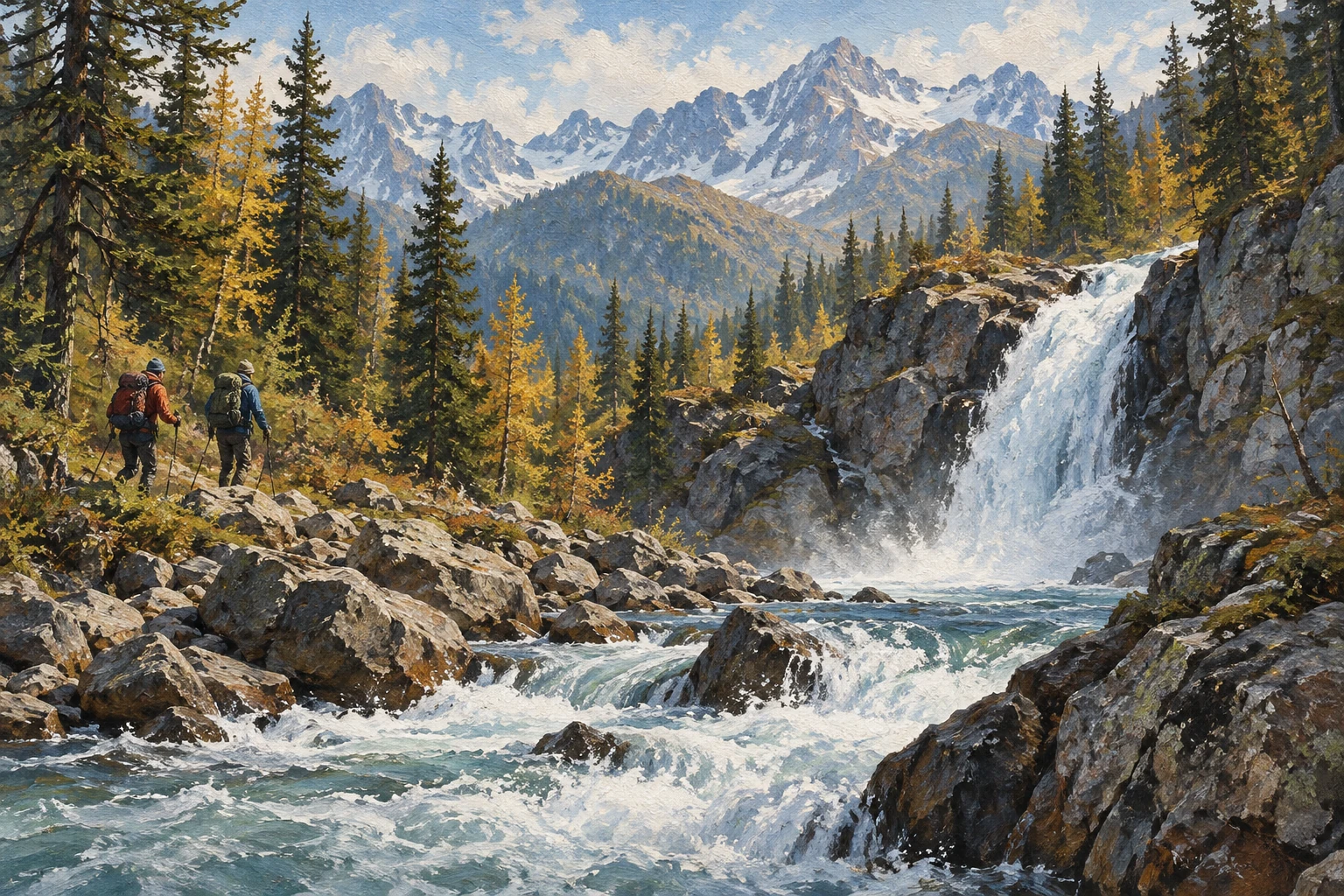
We stopped here to admire the 30-meter waterfall. By the end of the next day we arrived at the springs. We settled down in one of the huts along with a group from Zlatoust, who intended to live and receive treatment here for ten days. Most of the people here are from Irkutsk.
But we met tourists and vacationers from St. Petersburg, Moscow, Novosibirsk, Khabarovsk and Orenburg, as well as German tourists. It is good to see that after a sharp decline in mass tourism in the 90s, it is now on the rise again. The shock, fortunately, passed. We were also pleased with the organized visit to the springs in groups of up to 10 people from our native Ulan-Ude under the guidance of experienced guides.
Among them is our mutual friend Oksana Zalesova. I was on Shumak in 1990 with a group of tourists from different cities of the country. In my article published in the newspaper “Pravda Buryatii” at the beginning of 1991, “What’s there, beyond the pass?”, I wrote that Shumak was uncomfortable for tourists and vacationers. Therefore, I wanted to see twelve years later the changes that were supposed to happen.
We examined first of all the right bank part of the springs. Here, with the participation of Irkutsk residents, a small dugan with a green meadow on the roof was built, and an Orthodox cross was installed a little further away. The good-quality house of the mayor of the city of Slyudyanka flaunts in the clearing and on the left bank of the Shumak, closer to the sources, there are many newly felled buildings. But all this is done unplanned, without taking into account the future.
The river, which quickly erodes its banks and changes its course during floods, poses a great danger. Thus, the island where until recently tourists pitched their tents completely disappeared. We went through almost all the sources, keeping track of their numbering and purpose. We took a few sips from each.
Each of them has a number and an inscription on a peg or stone: “Heart”, “Kidneys”, “Stomach”, “Bladder”, “Women’s prizes”, “Male stubbornness”, “Eye” and others. So for more than a hundred sources. There are baths and healing mud. Those wishing to take radon baths will have to wait in line.
A queue in these conditions is a pleasant memory of a civilization existing somewhere. And again I return to 1990 to repeat: we need a commandant of the territory, we need a medical worker, we need a search and rescue service post, we need to introduce paid services. How to do this is, in my deep conviction, up to the district administration, the only true owner of this amazing territory. All that remains is to exercise your legitimate rights as a proprietor more boldly and proactively.
It seems that the need to develop tourism infrastructure in the Baikal region is beginning to find understanding in the upper echelons of government. This is confirmed by the latest meeting-seminar held in Ulan-Ude within the framework of the Interregional Association “Siberian Agreement”, which once again confirmed that tourism is a sector of the economy. In the meantime… While people are joking: “A patient who decides to be treated at the Shumak springs must have remarkable health and the dexterity of a climber and cavalryman…”.
We spent only seven days at the springs and in the Tunkinsky Goltsy, but we received a wonderful charge of health and peace of mind. The words from the author’s song And Mikhalev’s grief “Sayans” come to mind: … Listen — the river beats into the rocks, The pass is frozen in the distance. This is what we were looking for and finally found…
@nevsky_alexander
On Instagram: Dubai beyond the postcard — family, the city, discoveries and life between projects. On Threads: thinking out loud about design and AI. On YouTube: videos that need more room than a story. Follow me wherever you feel at home, and let’s keep in touch