
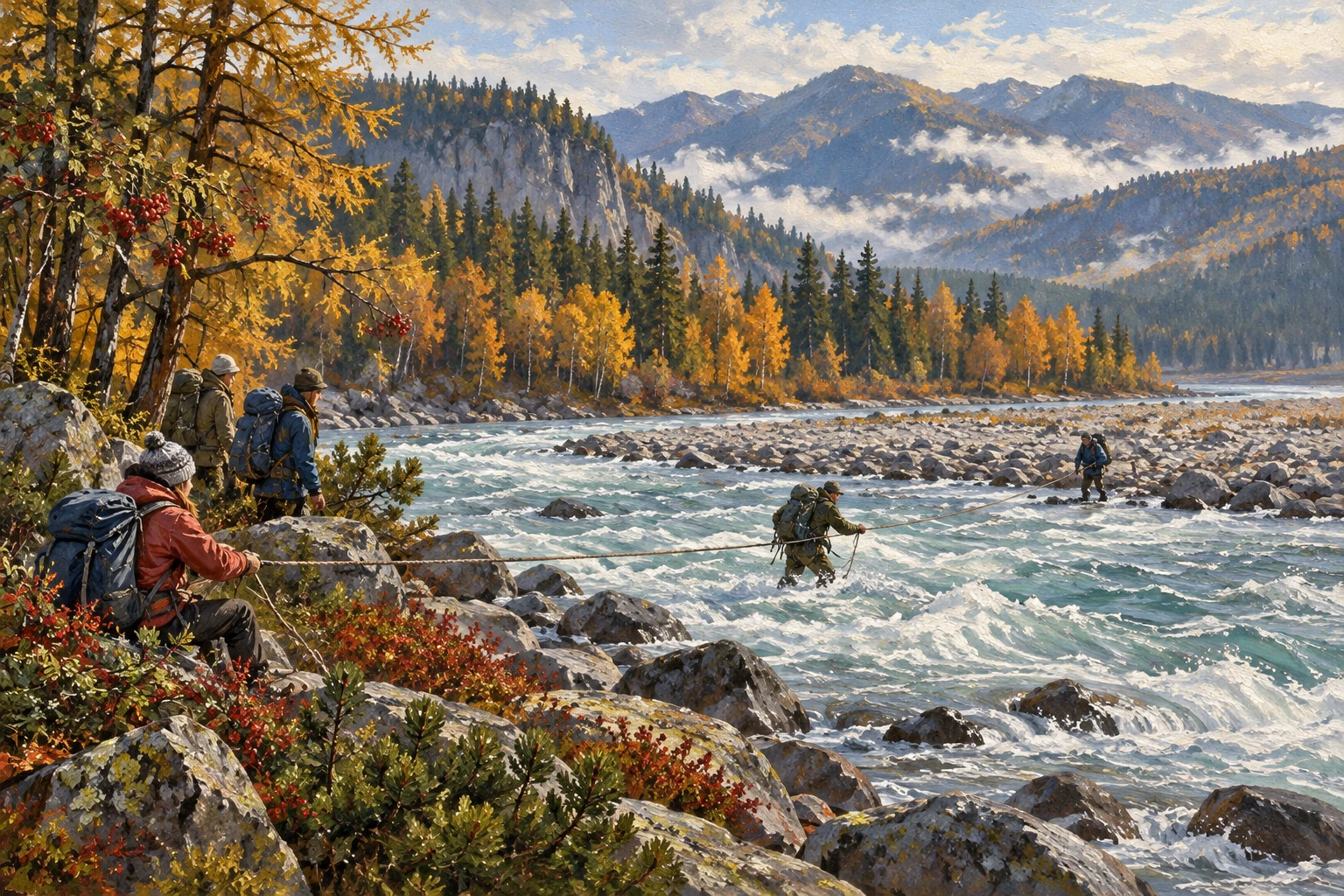
… The river, all covered in white breakers, rumbles over the rocks. The old horse trail either goes up or down to the riverbed itself. The Transbaikal autumn is raging all around.
Bunches of rowan berries hang over the path, and lingonberries with ripe dark cherry berries spread like a carpet nearby. Cones are strung on the elastic branches of the elfin tree, somewhat reminiscent of Christmas tree decorations. The Tuldun River, before merging with a powerful stream, makes a sharp bend. Cutting it off, the path leads to the shore at the place where we have to cross.
We dropped our backpacks and reconnoitered the ford. As a rule, the strongest and most experienced participant goes first. With the safety end of the rope behind his back, Gennady Pavlov enters the swift current. Feeling the bottom with his foot, he slowly moves to the opposite shore, which is at least forty meters away.
In the middle of the river, apparently having tripped on a stone, Gennady swayed, and it seemed that the elastic water flow would knock him off his feet. This time everything worked out fine. After a few minutes, which dragged on especially long, Gennady was in shallow water. We breathed a sigh of relief.
A rope is stretched like a ringing bowstring over the river. Now there is a railing. The next person to take this route is Gennady Kozlovsky, a tourist from Krasnogorsk near Moscow. Now that the crossing has been established, it’s time to introduce my fellow travelers.
Gennady Kozlovsky is not the first time in Buryatia. Together we visited the Svyatoy Nos Peninsula, the wilds of the Barguzin Range, and the exotic Valley of Volcanoes in the Eastern Sayan. Among us, he is the oldest and most reliable. Behind him, Viktor Kozlov, fastened with a carabiner to the rope, enters the water.
On the route, Victor usually goes last, overloaded with photographic equipment. But from each trip he brings wonderful shots that have a place at any photo exhibition. But before I introduce you to the next participant, I’ll tell you about who provides insurance at the crossing. This important task was entrusted to Irina Gofyngo.
Irina confidently ties tourist knots, because the safety of her comrades depends on it. She also plays the guitar very well and is the author of many tourist songs. At rest stops we listen to her with pleasure. Now I look at her fingers, which continue to deftly knit knots, and it seems to me that she skillfully plucks the strings of the instrument.
It was here that her original song “Muysky Region” was born. Using a taut rope with belay, my companions take turns crossing to the other side. Nadezhda Venediktova and Tamara Kokorina form the backbone of the group. We walked hundreds of difficult kilometers: we froze together under the Sayan passes, got wet in the September rains on the Barguzin ridge, and at the height of summer we walked through the snow on the glaciers of Topographers Peak.
We also have two Tatyanas!!! Petrova and Zhidileva. But let’s get back to the crossing. I’m left alone on the shore.
Now it’s my turn. Having untied the end of the rope attached to the stone, I make a chest harness and enter the water. The water flow falls with its multi-pound weight. They insure me from the other side.
Soon we all gather on the rocky shallows and unpack our backpacks. Climbing up the slope, it’s as if we find ourselves in another world! Before this, we walked through the unsteady mires, among the taiga, but here, in the vast clearings, in the light birch groves, there are flowers, the smell of mown grass… This is how our meeting took place with the Promising Spit, which we had long dreamed of.
Probably, the first prospectors were pleased with the spoils collected in leather bags, and christened the merciful scythe with a name containing thanksgiving and hope. But, as the old-timers told us, “the scythe turned out to be promising, but not very rewarding.” The prospectors left these places long ago, hoping to weigh down their bags somewhere in the thicket of the Baunt forests. Here, just below Tulduni, is perhaps one of the most beautiful places on Vitim.
The alignment is widened, with the original structure of the slopes — and a huge pebble-boulder spit fits far into the riverbed, framing the turn of the river, on which the waves of the Tuldun Shiver play. Before us is Vitim — the prototype of the Shishkovskaya Ugryum River. Even before leaving, I wrote down in my diary a quote from Vyacheslav Shishkov’s novel “The Gloomy River”: “The picture was free, wild, majestic. The sliding mass of water was closed on one side by a rocky shore covered with dense forests, and on the other it merged with the blue distance of the horizon.”
In the evenings there were fogs in the distance. Low clouds stretched past the dawn. When the sun rose, there was always a light breeze. The ripples of the river lit up…”
But isn’t this Vitim and isn’t that how I saw him from the Promising Spit? Years will pass, but the memory will retain the long crossing, the smell of mown grass, and the happy days of the hike in the fall of 1989.
@nevsky_alexander
On Instagram: Dubai beyond the postcard — family, the city, discoveries and life between projects. On Threads: thinking out loud about design and AI. On YouTube: videos that need more room than a story. Follow me wherever you feel at home, and let’s keep in touch