
Pos. Orlik — b. Sentsa — summer camp Khongorey (base camp) — Valley of Volcanoes — mineral springs Zhoigan — Topographers Peak — Expedition Pass — r. Arzhan-Khem — r.
Senza — port of Oka. The length of the route is 210 kilometers, duration is 16 days. The expedition, organized in July 1986 by the Buryat Council for Tourism and Excursions, which included seven experienced tourists, had a goal: to study the tourism opportunities of the Okinsky district, as well as to improve the professional level of members of the republican route-qualification commission. The expedition passed and described the indicated route.
Many years ago I had the opportunity to see volcanoes for the first time: Avachinsky — in Kamchatka, Ebeko, Mendeleev and Tyatya — in the Kuril Islands. Tyatya especially stands out from all of them. The shape of this volcano is amazing, graceful and regular; it’s not for nothing that experts say: “Compared to Tyatya, Vesuvius is a lopsided freak.” You have to travel a lot, swim across the ocean to see this miracle.
But is it necessary to travel that far? How many of you know that there are volcanoes in Buryatia? … The path, after circling the lake, continues to lead north along a wide valley. On the sides of the path carpets of large and bright colors delight the eye.
We also see yellow poppies, purple violet flowers, orange flowers, and blue flowers of columbine flowers. In some places, flowers courageously coexist with snowfields descending from the chars. At times the trail dives into thickets of polar birch and willow. A kite soars high in the sky.
Silence and peace all around. And ahead, the contours of the volcano emerge more and more clearly in the form of a truncated cone, named after the researcher Peretolchin. We dreamed about this meeting for a whole year, from the very moment when the plan for the expedition to the Big Sayan matured. But they saw a silhouette familiar from the photographs and stopped.
They looked at each other and, silently throwing off their backpacks, began to examine the miracle that had appeared. Somewhat to the left was Lake Tukhuren-Nur, from which Khadarus began his run. We were at the threshold of the Valley of Volcanoes. We crossed the ford to the left bank.
We unexpectedly met a group of tourists from Minsk. These short meetings are unusual in their efficiency. There is always not enough time on the route. Therefore, in a few minutes you try to get the most necessary information.
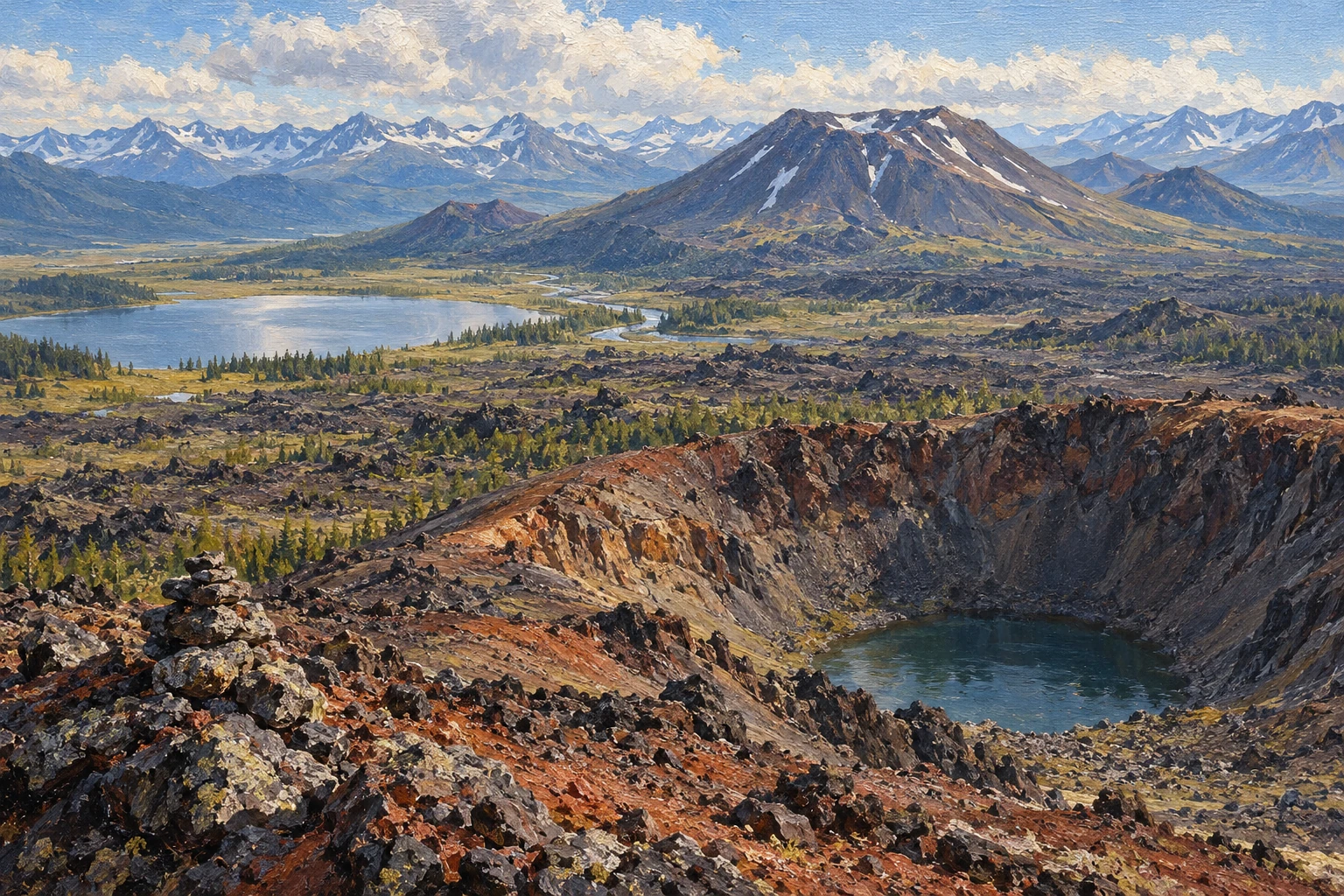
Managers usually compare maps and make amendments. We met, stood for a while, and each went our separate ways. About another hour of walking and we entered the Valley of Volcanoes. This — almost devoid of vegetation, a huge field of solidified lava — is one of the most stunning places in the Great Sayan.
It captivated us with its harsh beauty and grandeur. Having set up camp on the high bank of Hadarus, we went light to the volcanoes. Until the end of the day we examined the Peretolchina volcano. It rises 110 meters above the lava flow, its slopes are overgrown with bushes and larches.
At the top there is a crater 140 meters across, with a small lake at the bottom. The temptation to go down is great. We carefully descend along the brown slag crumbling under our feet. Near the lake there is a tour made of volcanic bombs.
We took down the note from the tourist group from Minsk, left ours and climbed up. The day was fading. It was necessary to return to camp. About four kilometers to the west, another, larger volcano is visible, named after the famous geographer P.
A. Kropotkin, who explored these volcanoes more than 120 years ago. He not only described them, but also sketched them. One of the volcanoes, as already mentioned, is named after the researcher Peretolchin, who tragically died on a lava flow near the volcano in July 1914 under rather mysterious circumstances.
Passing through the Khoytogol mineral springs the day before, we saw a memorial cast-iron plaque installed there with the inscription: “On July 3, 1914, mining engineer from Irkutsk Sergei Pavlovich Peretolchin, born on October 20, 1863, died during geological surveys. Placed by his loving wife in 1915.” As far as we were able to find out from the local population, this cast-iron board accidentally ended up quite recently at the Khoytogol springs, and there is a need, in our opinion, to move and install it at the site of Peretolchin’s death. Tourists in Buryatia should definitely do this noble deed.
That evening we sat around the fire longer than usual. A gust of wind brought the daytime warmth of the valley, and it seemed to us that the volcanoes were breathing their warmth on us. The next day we went to the Kropotkin volcano. The valley is filled with frozen lava for many kilometers.
The path is barely visible on the petrified stream. We climbed the volcano and descended into its crater, which is about 60 meters deep. During the tour, at the bottom of the crater, a note was taken from Irkutsk geologists Mironov and Ivanov, who visited the volcano in August 1985. On this day, many meters of film were shot.
I really wanted to show everything that we saw here to our friends upon our return. On the third day we left the Valley of Volcanoes. We took a new route. The path lay to the most famous Zhoigansky mineral springs in these parts and the harsh mountain junction of Topographers Peak — the heart of the Big Sayan.
And even though we were not pioneers, we still experienced a joyful feeling. Each of us again and again found something new for ourselves. We will tell about this to everyone who is irresistibly attracted by the romance of long roads and the thirst for discovery. We returned after a three-week route, scorched by the mountain sun, blown by the winds, washed by downpours, having absorbed vivid impressions of the wonderful land, the amazing people we met along the way.
Under the wing of the plane floated the vast Oka Plateau, surrounded on all sides by alpine mountain ranges, which, according to Academician Obruchev, “is like Tibet in miniature.” We flew over the famous Oka Trail, which until recently was accessible only to pack horses. Nearby, along the highway under construction, dubbed the “road of life,” heavily loaded Urals and ZILs walked one after another. They were in a hurry to deliver the necessary national economic goods to the region.
Okin residents worked and lived in the cares of the Republic of Buryatia.
@nevsky_alexander
On Instagram: Dubai beyond the postcard — family, the city, discoveries and life between projects. On Threads: thinking out loud about design and AI. On YouTube: videos that need more room than a story. Follow me wherever you feel at home, and let’s keep in touch