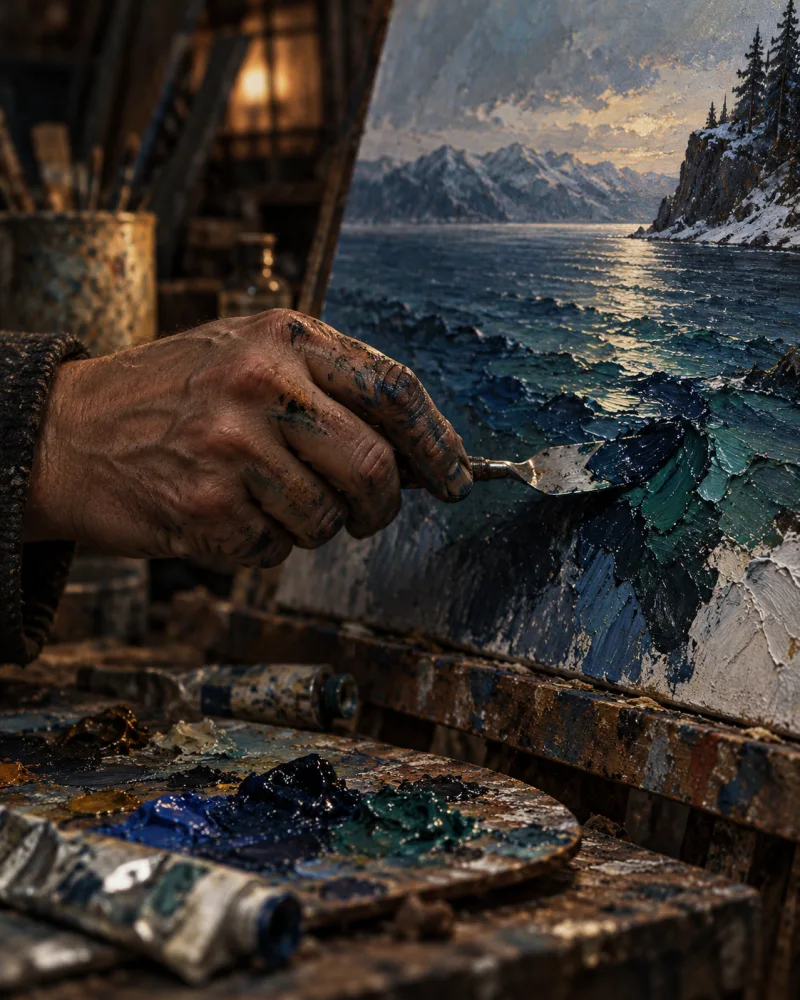
When the Lord painted Baikal (and He is undoubtedly an Artist), He used a thick, dense technique of painting (known as impasto).
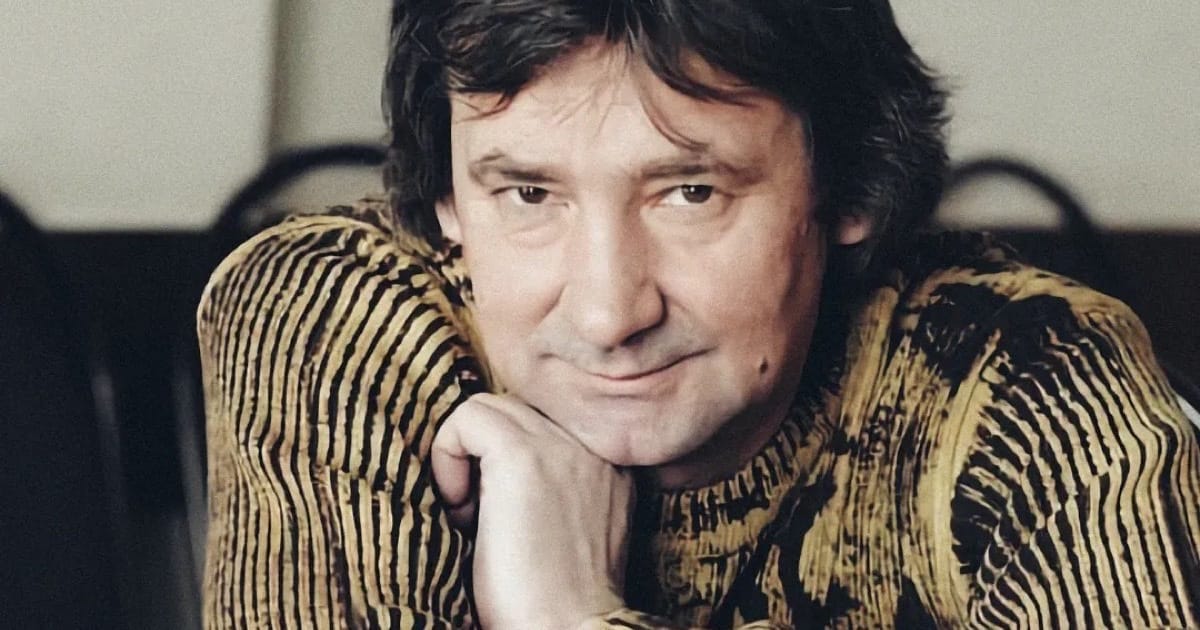
It is remarkable that this is precisely the style in which Vladimir Nikolayevich paints his pictures. For a quarter of a century now he has worked as a decorative artist at the Palace of Youth (in Mytishchi), and in his spare time he paints. Vladimir Nikolayevich does not stint on paint. He squeezes out almost a whole tube and one, two!—with the palette knife… This way and that! Another tube; and another. Carmine, azure, emerald green, strontium yellow! Every stroke is so generous (like Vladimir Nikolayevich’s soul) that the paintings look shaggy.
Recently he painted a picture of me at Baikal: I am squatting at the edge of the surf, cleaning a fish. Vladimir Nikolayevich himself has never been to Baikal; he painted it from what I told him, and from looking through the hundred thousand photographs I had taken on my yearly hiking trips there. To tell the truth… no one would ever guess it was me in the picture… (that is, you can sort of very vaguely tell it is me). Well, there is some shaggy fellow sitting on the shore, smiling—and cutting up what you might call… a tuna, is it? or a shark? (Vladimir Nikolayevich clearly overdid the size of the fish).
If I have taken a paltry hundred thousand photographs, Vladimir Nikolayevich has probably painted a million pictures. He takes them to the local gallery, to the Artists’ Union, to an exhibition… And sits there, dozing, seemingly asleep. But most of his works are kept in “storage” (in the bomb shelter beneath the Palace, actually). Because of them it is impossible to get into the shelter (let alone for anyone to find safety there if, God forbid, anything should happen). He mostly depicts the countryside around Moscow, monasteries and churches, the beautiful, restored (or still neglected, but beautiful all the same) former country estates of the nobility that survive in the Mytishchi district. Having finished another painting, he sits down before it in our workshop (I work at the Palace too; there are two decorative artists on the staff) and peacefully falls asleep. Then suddenly he wakes, takes a keen look with one eye… grabs the palette knife… Touches something up, removes something superfluous. Or paints over a patch—one, two!—changes something, renews the picture of the world.
One, two! This way and that… I think the Lord exclaimed, sweeping a carmine sunset across the whole canvas of the sky above Baikal, flinging down the azure of the water’s surface, the emerald green of the forests. At first sight it strikes you… with its untidiness? its shagginess? But look more closely, and in the thick of the carmine there is a sea of radiance; the shades are elusive, changing with every breath… for which one can only thank Him Who granted one the chance to be there, to be present.
Every holiday I set off for the rugged shores of Baikal, on another hike. And I notice… (it is impossible to close one’s eyes to it) how petty little people, having taken to powerful four-wheel-drive jeeps and superfast motorboats, armed with repeating firearms, fine-meshed nets, electronic fishing rods with echo sounders, push ever farther into places once inaccessible and therefore still pristine. Well, and what can they create?
Dead, scorched earth behind them.
Mountains of rubbish, bottles and plastic; a dump.
Sometimes I can just see it: having forced their way into the protected wilderness with powerful engines, a party spills out of an off-road vehicle (crawls ashore from a superyacht). The souls of these small and wretched beings are laid low by the beauty unfolding before them. It is hard to take in all the shades of meaning revealed upon the tablets of Sky, Sea, Forests. Yet these petty little people… “Well, come on, bring it out! Let’s get started, shall we…” commands the ringleader, keeping a relentless eye on everything. And out come the sacks. The glass of vodka bottles, the plastic of large beer bottles, the tin of empty cans, scraps of paper, the vile mould of disposable tableware… They scatter it all around them. Burn away everything living with the napalm of their campfires. Fell the trees.
And it is hard, so hard for them, as it is for any human soul, to do such vile things! But they carry on to the last of their strength, having stunned themselves with vodka so they will remember nothing of what they have done. Well, is that it, have we shat all over the place? We have. Phew… Weary, emptied out, they climb into their conveyance. Clear off, evaporate, melt into the bluish petrol exhaust.
I know that one day the Artist, knitting His brows and noticing something amiss in the picture, will smile into His beard and—as Vladimir Nikolayevich does—brush away the orange speck of my tent somewhere on the shore beneath a mountain, erase the spark of the little campfire beside it… Lightly touch the spot with pure strontium yellow, renewing the strip of sand at the edge of the surf.
And I shall disappear.
Or perhaps, taking a keen look… one, two!—He will paint over all humanity, spreading like grey, vile mould beneath the wondrous sunsets, beside the transparent waters, amid the murmuring forests.
Hmm, Vladimir Nikolayevich… He will put the painting away in the basement beneath the Palace. And doze off again, snuffling peacefully. Sometimes I look at him and whisper hurriedly… “Our Father, who art in heaven…”
Source: Baikal, 2009, No. 2, pp. 77–78. Text prepared from a scan of the magazine publication.

@nevsky_alexander
On Instagram: Dubai beyond the postcard — family, the city, discoveries and life between projects. On Threads: thinking out loud about design and AI. On YouTube: videos that need more room than a story. Follow me wherever you feel at home, and let’s keep in touch