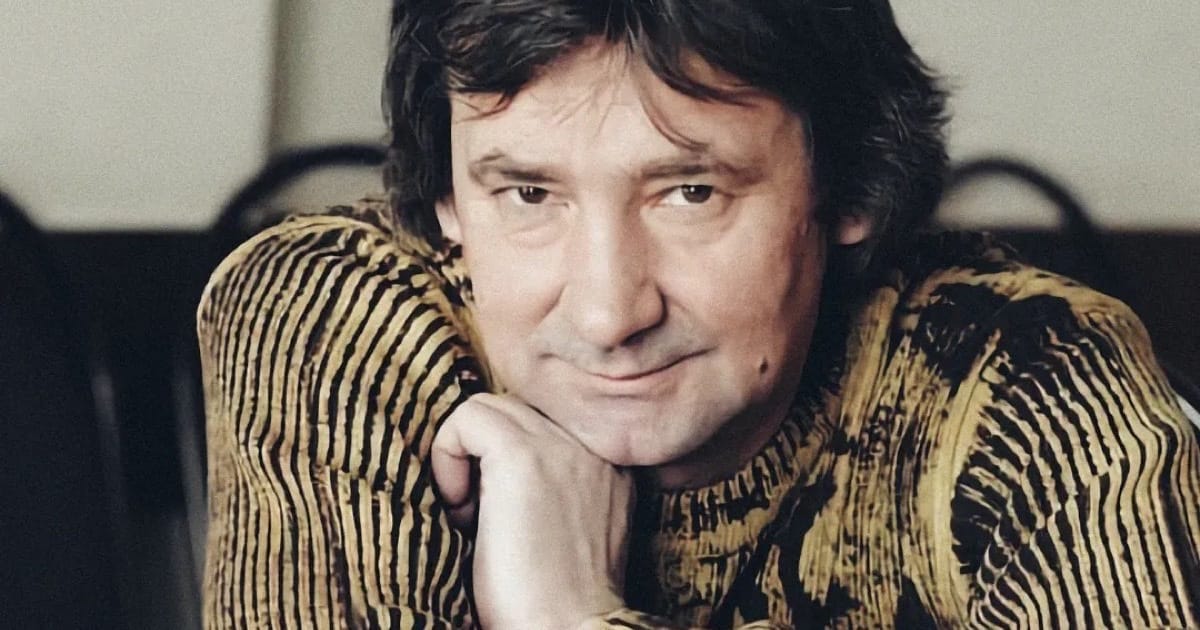
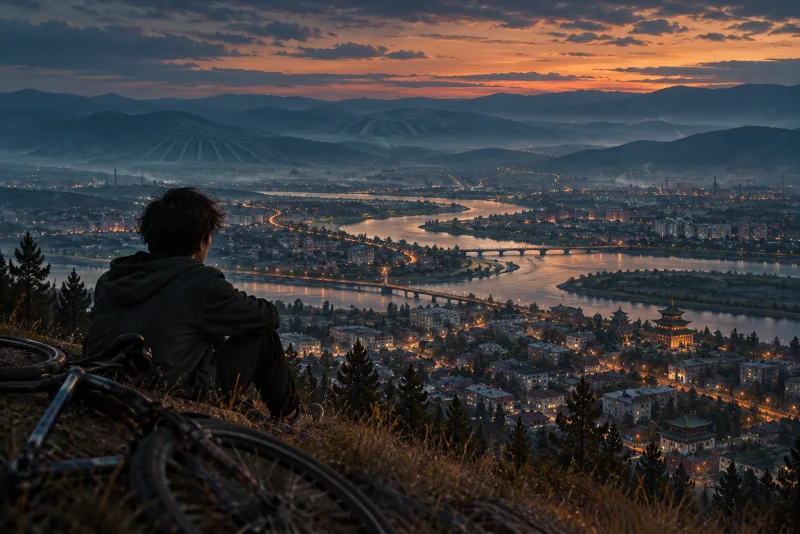
Once, back in the eighties, I wrote a science-fiction novella about my hometown, Ulan-Ude. In it, the blue hills that ring the city, visible from anywhere within it, were the ragged edges of a crater left by the explosion of a crashing spacecraft. Our city, I imagined, preserves in its foundations the ghostly architecture of that starship, which arrived from unknown reaches of the Universe, only to meet with disaster and break apart at the confluence of the Selenga and Uda rivers. Perhaps some of those “astronauts” survived? Perhaps their far, far distant descendants are among us today? I wandered through the city and felt, at certain points, an energy that seemed to rise from underground. You could imagine that here, close to the surface, some “generators” were still working, emitting magnetic waves. Something did draw you in, after all; you wanted to keep coming back—to feel the warmth of some long-ago—and wondrous—memories welling up in your heart.
I remembered what the city looked like “from above” from childhood. Often visiting my father at work—he was deputy chief engineer at Buryatenergo—I saw any number of diagrams scored with dotted power-transmission lines, encircling and threading through the city, linking multicolored squares, circles, and triangles: these were the distribution substations. And later, after reading Wells and Yefremov, the image emerged of a vanished spacecraft, buried deep beneath the visible reality of streets, squares, and buildings.
For some reason, these places always made me want a drink. Port, say. Which was what I drank. And on endless walks—often in the company of fellow “astronauts”—we joined these points along the magnetic lines running through the city. All its inhabitants seemed somehow special to us, steeped in a poetic spirit, given to philosophical debates, reciting verse, painting, playing music, and dancing; and all the girls, of course, were aliens.
At the end of my science-fiction novella, the hero finds the “launch key”—and initiates the launch. Deep in the bowels of the earth, rocket engines begin to work. Ulan-Ude breaks free of the ground, rises into the sky. It flies away, our entire city, to other Galaxies. Returns to its ancestral home.
This is, of course, a science-fiction scenario.
And yet, no… What is happening now is turning that science-fiction premise into a brutal reality. The greatest British astrophysicist, Stephen Hawking, responding to US president Donald Trump’s decision to withdraw from the Paris climate agreement, warns: “We are close to the tipping point beyond which global warming is irreversible… In thirty years, earthlings will be forced to leave the planet.”
…From my apartment window I can see the Trans-Siberian Railway. Day and night, freight trains head East. The flatcars are piled high with timber. China is stripping Siberia bare. Our last fallen defenders—Siberian pines, larches, birches—are being sent in an endless stream to the “mass grave” of our “friendly” neighboring state.
Our “flying saucer” grows ever heavier with concrete architecture, with the iron horde of cars. The crimson eye of the sun peers ominously through clouds of ash from the burned taiga; on some days it blazes so fiercely that +36°C in the shade feels cool!
I still believe that all of us, the people of Ulan-Ude, are aboard one ship—even if it is invisible, ghostly. Lines of an extraordinary love for all that is exalted, mysterious, “extraterrestrial”—radiation from those very “generators,” still pulsating with power from some eternal source beyond the reach of human understanding—pass through our hearts, uniting us into the crew of a “starship.”
I’ll give up port and take up healthy living. If I manage to live those thirty years, then I promise you, people of Ulan-Ude—I know where the launch key is, how to enter the launch code. Still, you shouldn’t put too much faith in me. We all need to act together today—to stop destroying the last of what remains!
Source: Baikal, 2017, No. 4, pp. 100–101. Text prepared from a scan of the magazine publication.

@nevsky_alexander
On Instagram: Dubai beyond the postcard — family, the city, discoveries and life between projects. On Threads: thinking out loud about design and AI. On YouTube: videos that need more room than a story. Follow me wherever you feel at home, and let’s keep in touch