
AI has a remarkable quality: it never minds adding another paragraph. And another. With enough automation, you eventually discover that an editorial team’s main limit is a person’s ability to read everything it has already produced.
In early Content OS, I explored the path from Custom GPT to a structured content package. ContentPack was meant to pass on prepared fields, blocks and localized text rather than a pile of chat replies.
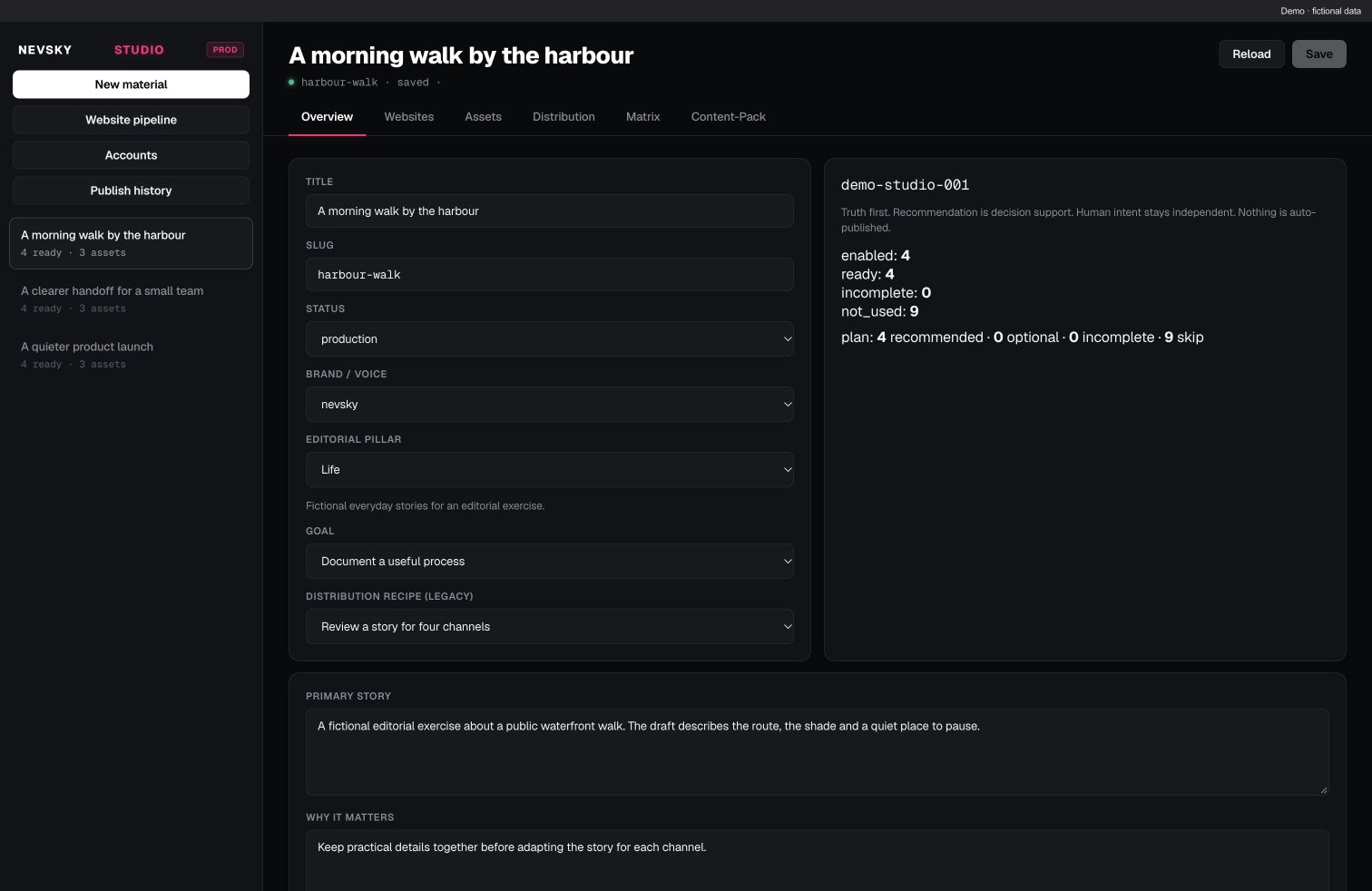
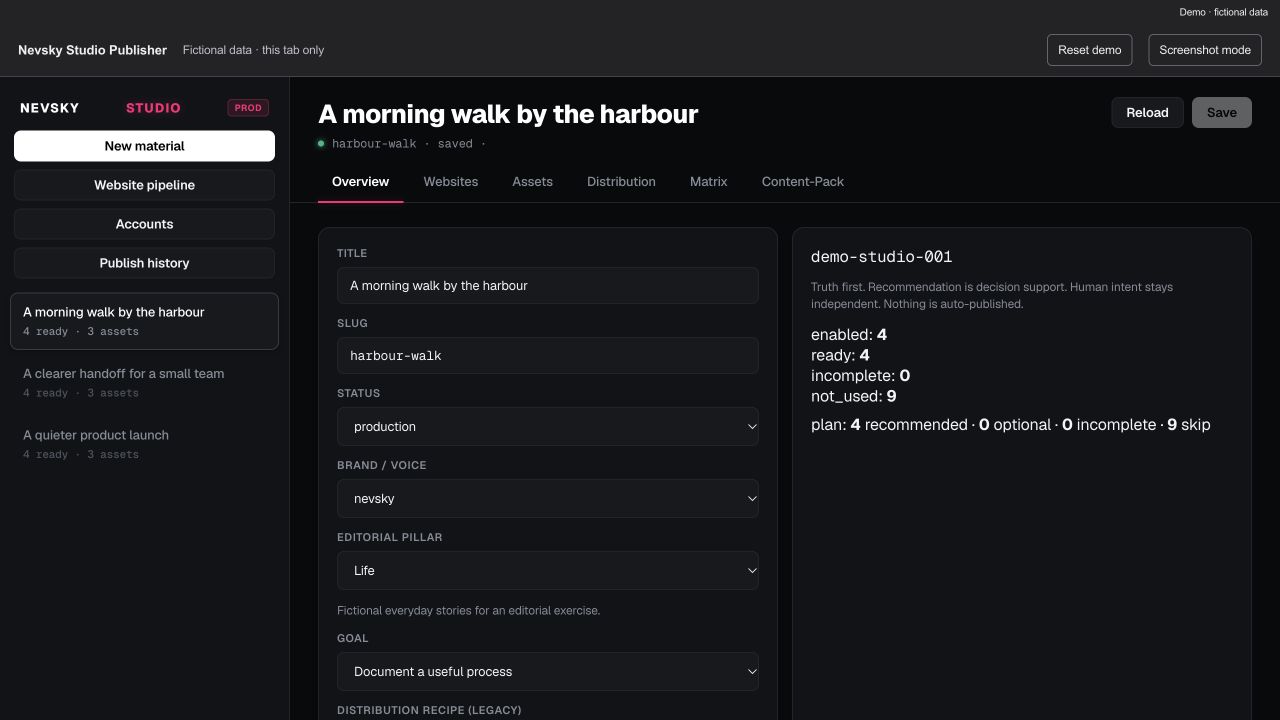
Below is an archived Publisher interface with fictional content. The source story is assembled in one editor; this is an early experiment’s screen, not the current nevsky.ae publishing system.
Source material editor
Archived interface · demo data
A package needs to know what it changes
A link to the source version is useful in such a format. If the text has changed since the package was prepared, an old proposal cannot silently overwrite newer work. The experimental process used a source fingerprint and selective application of changes for this.
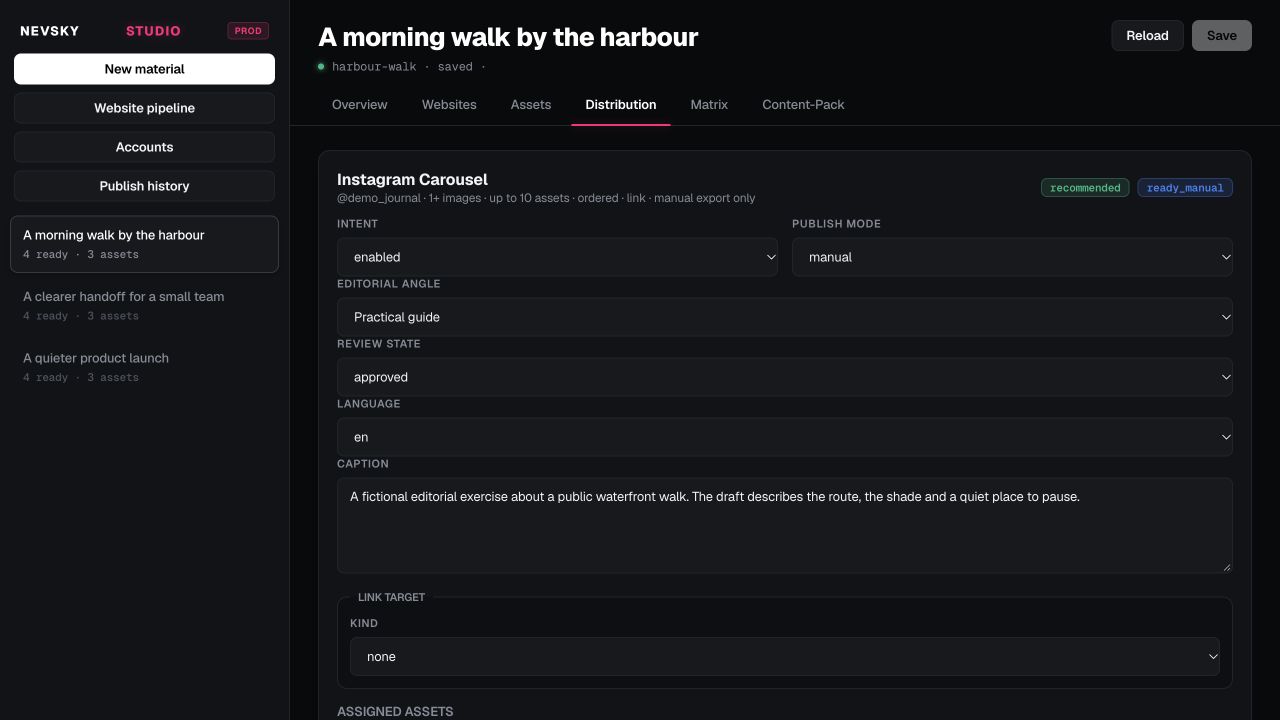
Here the material is arranged into platform cards. You can inspect prepared English versions and the distribution editor. This demo sends no publications.
Versions for different platforms
Archived interface · demo data
Schema validation asked whether the package was structured correctly. Semantic checks asked whether its parts belonged to the material. These are different questions: flawless JSON can contain an invented biography, a missing caption or another article’s translation.
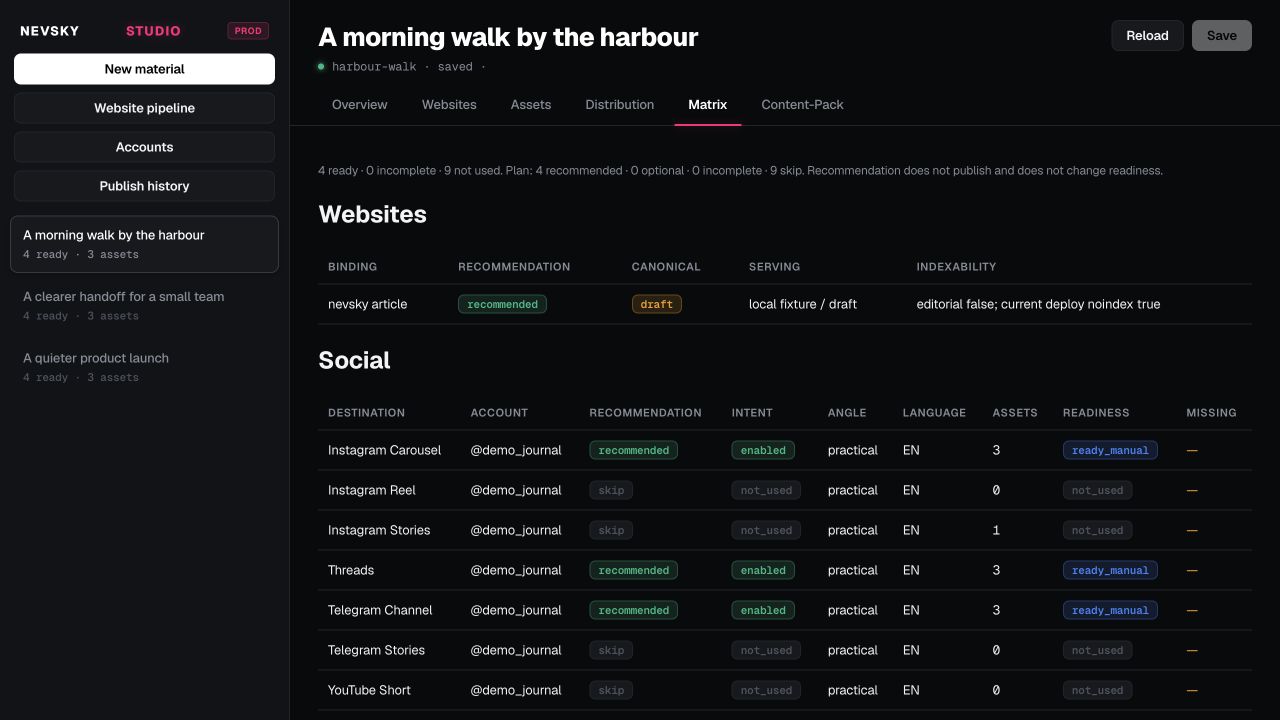
The matrix shows the state of fictional materials across publishing channels. It is another way to see which parts of a package still need editorial work.
Readiness matrix
Archived interface · demo data
The package was a proposal for changes. Passing a syntax check was not supposed to turn it automatically into a public page.
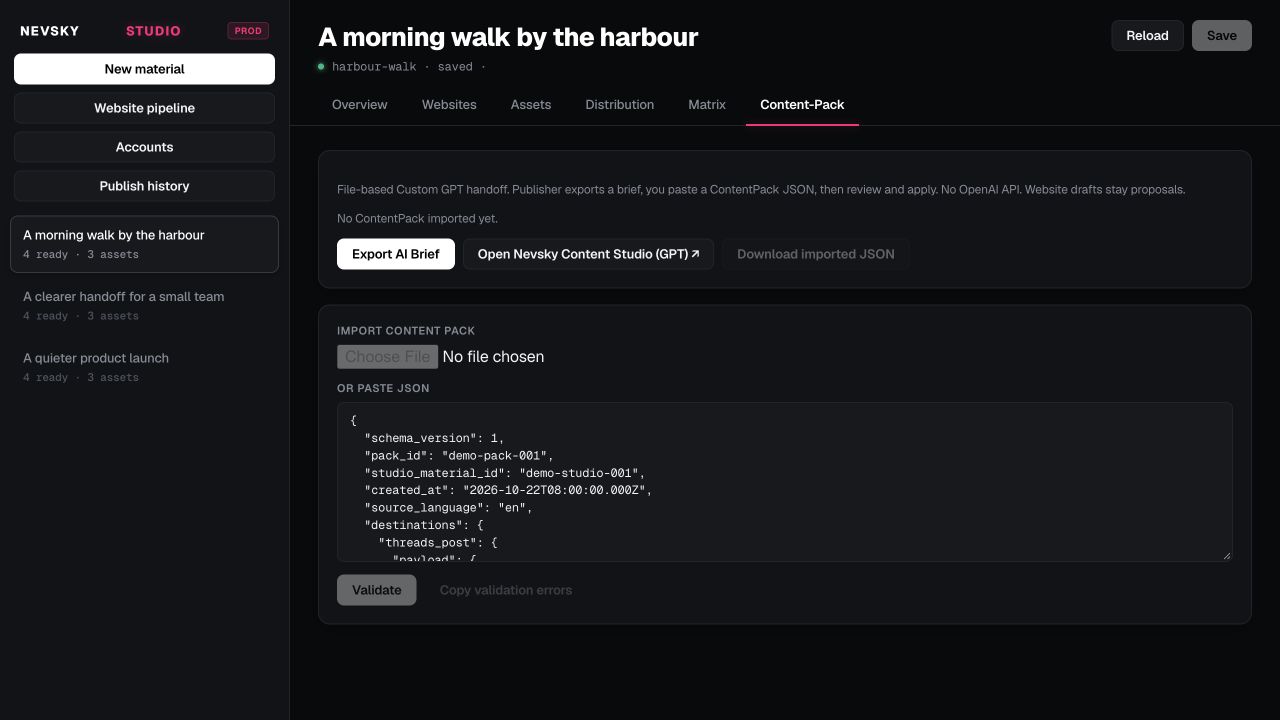
This screen shows a JSON package for handoff. Its output structure can be examined; the package’s existence does not authorize automatic publication of its contents.
ContentPack handoff
Archived interface · demo data
What works for me now
For nevsky.ae, I chose a more direct sequence: prepare and approve the Russian text, translations, images and presentation; hand them to Codex; change the files in content; view the result locally; make a separate publication decision.
That is the current workflow. ContentPack remains useful experience in designing editorial handoffs, not a hidden automatic publisher running my blog today.
Manual handoff may look like a step backwards. But it puts a pause in the right place: before other people see text under my name. During that pause, you can notice an old prototype described as a finished product, a technical term used as decoration or an event the author supposedly lived through that never happened.
From early Content OS, I kept structured material and change checking. Today’s blog uses its own preparation process and manual acceptance of text. The Publisher interfaces show the earlier tool, not another active Nevsky.ae editorial operation.
Related stories: The history of Nevsky.ae · Contra MCP Starter · Source and Operator.

@nevsky_alexander
On Instagram: Dubai beyond the postcard — family, the city, discoveries and life between projects. On Threads: thinking out loud about design and AI. On YouTube: videos that need more room than a story. Follow me wherever you feel at home, and let’s keep in touch