
Slyudyanka — HMS “Hamar-Daban” — Devil’s Gate pass — r. Spuskovaya — r. Utulik — r.
Shibitui — lake Patovoye — Patovoye Highlands — Devil’s Gate pass — Slyudyanka. The length of the route is 170 kilometers, duration is 14 days, of which 12 days are running days.
The old guard of tourists is painfully familiar with the “pinching feeling of the road” that unconsciously arises at the beginning of spring. Finally the day comes when the backpacks are packed and the train tickets are in hand. So, let’s go! The fast train carried us away into the starry summer night.
From that very moment, everything that had recently seemed like a beautiful dream began to come true. Early in the morning we went out onto the platform of the Slyudyanka railway station. This is where our journey to the mountains began. There are eight of us and the same number of huge backpacks, which contain everything we need to leave our usual civilization for two whole weeks.
Along sleepy streets we reached the outskirts of the city. Further the path lay along the Slyudyanka River. I will not dwell on the description of the beginning of the route, since this is a traditional route along which hundreds of tourists pass in summer and winter…. By the end of the second day we approached the Devil’s Gate pass.
At noon the next day we were at the pass. A pleasant surprise awaited us at the pass. During the tour we found two control notes. About the bottom of them was left by graduates of school No. 60 in the city of Ulan-Ude.
“We are heading to Chersky Peak,” the guys wrote. — The weather is not bad, the mood is great. We wish all tourists happiness, health and much, much luck…” Under the note were the signatures of Yana Zandanova, Slava Badmaev and others. As is tradition, we left our note on the tour.
After that, we took pictures and stood silently at the obelisk to Vladimir Razhev, who died here in an avalanche in the winter of 1988. We left the pass along a path winding along the sources of the Spuskovaya River. The entire valley is filled to the brim with thick fog. On the high bank at the confluence of the Spuskaya River and the Utulik River, in former times there was a hunters’ base, known among tourists as the “Utulik Shelter”.
Over the years, I had to ski this route two or three times. The spacious, warm hut along the way hospitably opened its doors every time. Now we were passing by the ruins that remained of the hunters’ base. It’s a shame and sad.
The path turns sharply towards Utulik. After Spuzovaya, its valley seems wide and bright. Having gone down to the water, we chose a convenient place for ford at the end of a pebble spit and, in a wall of two or three people, crossed to the opposite bank. In deep water, fording through Utulik is almost impossible; even a horse is carried away by the current.
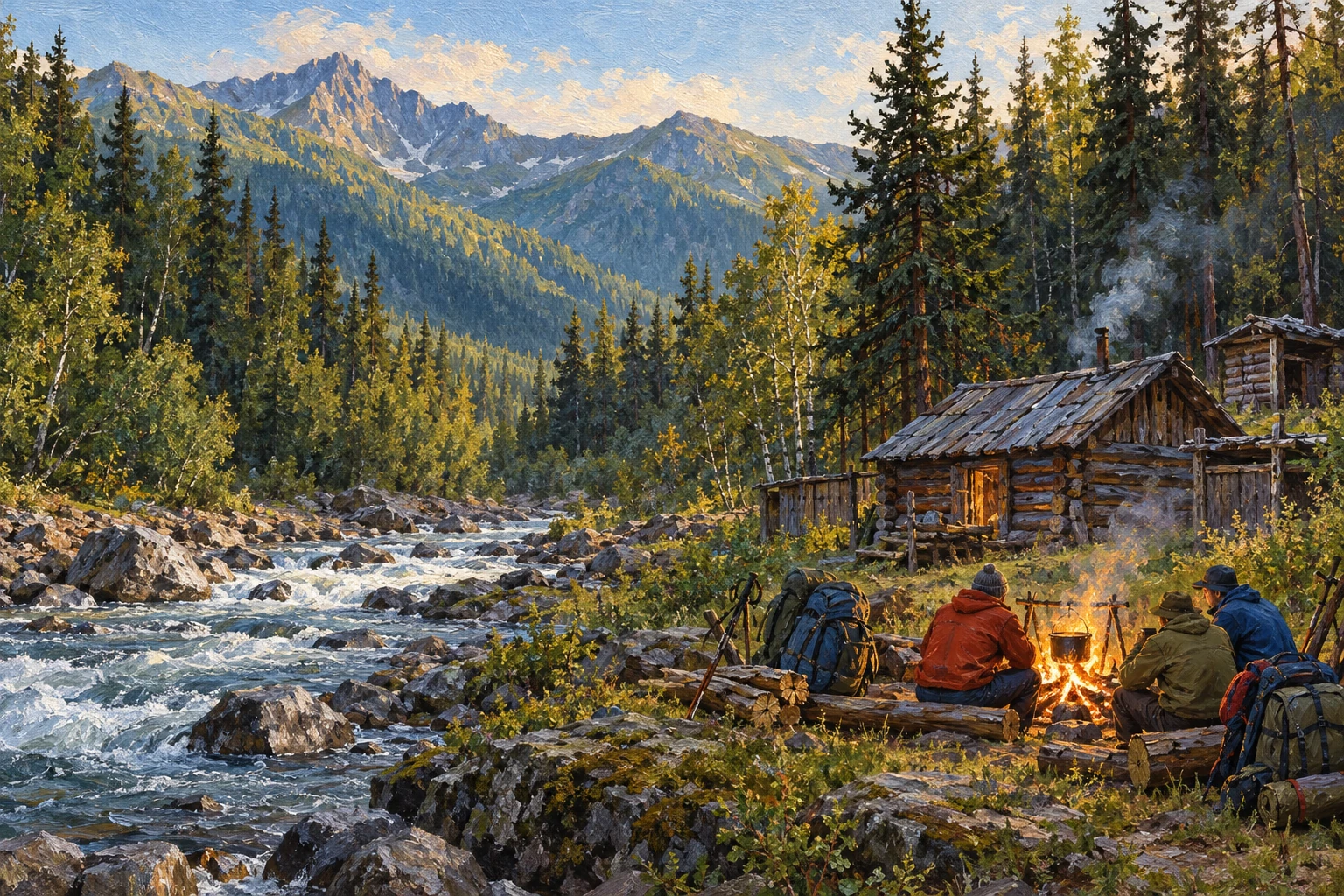
After the crossing, we set up camp in a birch grove. That evening we sat around the fire over a mug of tea, discussing the events of these days. And very close by, the river roared in the riffles, and it was pleasant to listen to this never-ending melody. The morning turned out to be sunny.
Without haste, we packed our backpacks and headed out onto the trail. On this day, our route ran up the Shibutui River, a large right tributary of the Utulik. Doveberries grew in abundance along the path. Having thrown off our backpacks, we enjoyed the miraculous berry.
Very soon the thirst disappeared, and a surge of strength was felt. More and more often we came across mushrooms — russula and boletus. They were collected on the go. Mushroom soup was now on the menu for dinner.
Now I remember those days with pleasure. The upper part of the Shibutui flows for more than three kilometers in the canyon. The height of the walls squeezing the river reaches 200 meters. The large waterfall is beautiful; you can go down to it after leaving the canyon.
A few more kilometers, and the zone of subalpine meadows with small islands of forest begins. A traveler who finds himself here is amazed by the forbs. The umbrellas of the hogweed, or more simply the “bear’s pipe,” rose the highest. I have only encountered something similar in Kamchatka and Southern Sakhalin.
Finally, the difficult climb was over and a magnificent panorama of the mountain plateau opened before us. It is level, slightly covered with coarse grass and dwarf shrubs. Lake Patovoye is blue ahead. The tour is difficult near the fork in the trails.
In it we find a note from Angarsk tourists from the Horizon club: “07/16/96, the fourth day of the journey, we are going to the Snezhnaya River… The leader of the hike is V.I. Gurchenko.” We’re going across the plateau.
The lake remains on the left. We hurry to reach the forest area to choose a place to spend the night. The cedar tree has darkened. This means there’s a fire ahead and it’s warm.
Another, sixth, overnight stay. To the left, far below, the river roars. It is here that the first largest river in Khamar-Daban, the Snezhnaya, originates. The next day we go down to the river.
We walk first along the stones, then along the path. The trail is swampy and often lost in moss. It was cloudy in the morning and raining in the middle of the day. On this day we reached the final point of the route on the Kharnakhoituy River.
We spend the day here. After a day we leave to cross the Khamar-Daban ridge for the second time. On the tenth day of our journey we descend from the mountains along a fast and noisy river with rifts and rapids. We wandered through Shibutui four times.
Kzimovyu Gavrilov (named after the hunter who built the winter hut) approached at the end of the day. The winter hut is located on the left bank. It is quite spacious. Nearby is a suitable hole for fishing.
Near the winter hut there is a bathhouse. So we heat the bathhouse and try to catch fish. The bathhouse was a success, but the fishing, I admit, not so much. We decide to try our luck tomorrow.
We’ll stay for the day. The morning is quiet and sunny. Three people, Volodya, Borya and Oleg, go fishing. And in the evening there is a festive dinner.
The most luxurious dish, as you guessed, was the fish soup, prepared by Borey Agalakov according to only one recipe known to him. Each got two good graylings. Then they drank tea brewed with herbs and roots collected here, next to the winter hut. The fire burned hotly, and its flickering flame illuminated our happy and slightly pensive faces.
Three days later we stepped onto the platform of the Slyudyanka station. We were returning home after a two-week route, having absorbed vivid impressions of the wonderful mountainous country called Khamar-Daban.
@nevsky_alexander
On Instagram: Dubai beyond the postcard — family, the city, discoveries and life between projects. On Threads: thinking out loud about design and AI. On YouTube: videos that need more room than a story. Follow me wherever you feel at home, and let’s keep in touch