
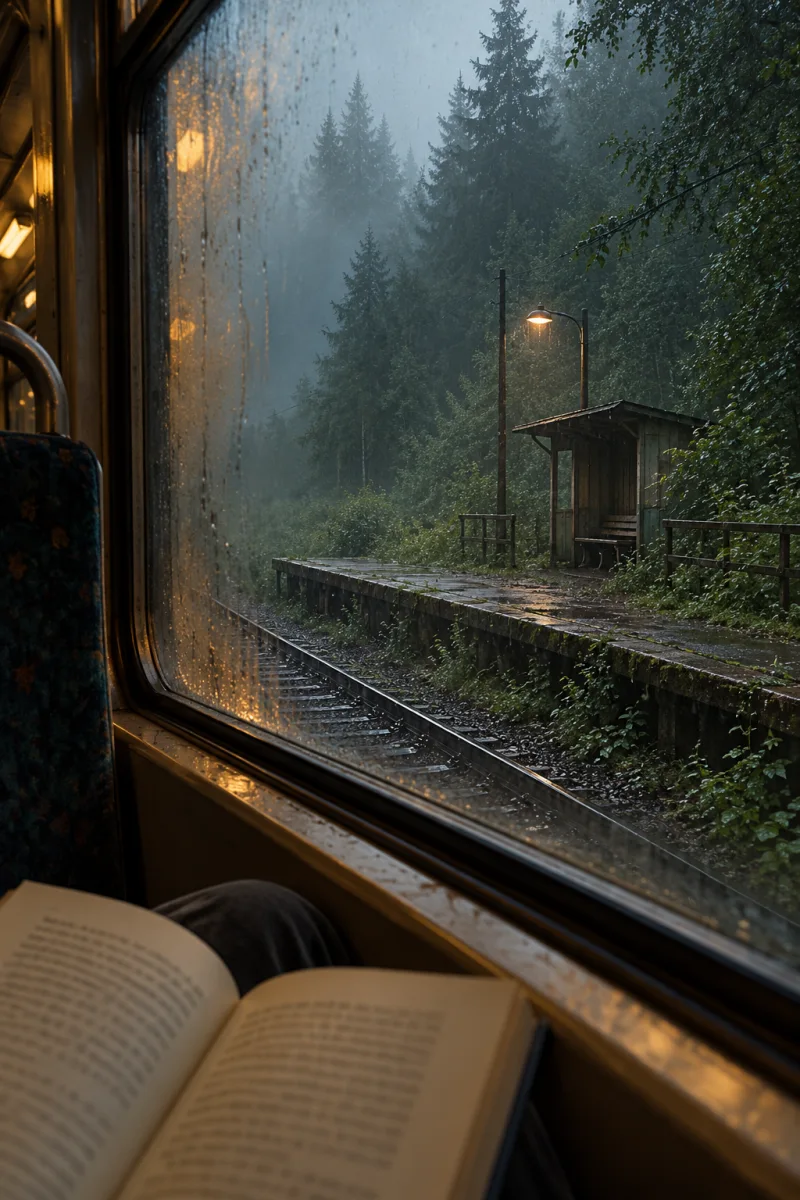
After taking a job at an exceedingly boring firm, I travelled two days a week to a little town almost on the boundary of Moscow Region; my work took me there. The rotating schedule meant that the first week I went on Monday and Tuesday (and had the other days off), the second on Wednesday and Thursday, and so on… It was a two-hour slog to this town on the commuter train, no fun at all, of course, but gradually I got used to it. I took a book along… though I only read for an hour; my eyes grew tired. The scenery outside the window was dull and familiar, and there was nothing left but to surrender to the daydreams and reveries conjured up by the monotonous clatter of the wheels.
And about an hour into the journey, halfway there, stands… well, let us call it “Pyatovo platform” (and farther on, “Sedmovo” and “Desyatovo”: the names are invented so as not to disclose the actual places).
I had made several trips to this little town (though it felt as if I had been travelling for an Eternity) when something I had happened to notice began to occupy my mind. At Pyatovo, some rather… strange people, to my way of thinking, would get on. Usually six or eight, sometimes ten: young people, and older men and women too. They rode past Sedmovo and got off at Desyatovo. There were always new faces. Those boarding took seats close together: several people, usually the younger ones, talked and laughed among themselves, while the others sat silently, keeping to themselves—and it was impossible to tell whether everyone in the “group” knew one another. They rose as if on command, making for the exit at Desyatovo, then walked along the platform towards the nearby forest.
Later, looking forward, you might say, to these encounters, I studied them closely. And remarkable characters they were, indeed! What had first made me notice them… perhaps they were lean, trim? Yes, there was nothing “flabby” about them; one sensed a certain inner discipline, a wholeness. They dressed for the outdoors—like people going to their dachas, mushroom pickers, or hikers. Many had “kolobok” rucksacks (as I remembered them from childhood) and Abalakov rucksacks (canvas monsters covered in straps and buckles). And those who did not fit the description of “hikers” carried heavy-looking baskets, covered with clean pieces of linen, with currant leaves on top and various wild plants. The canvas bags with rope handles they sported… why, those were genuine rarities! With a “print” (as people would call it now) of a young Pugacheva, or Boyarsky, or Demis Roussos.
What was this “Eighties Disco” business?
And their clothes?
None of the synthetic jackets fashionable nowadays, none of the brightly coloured tracksuits. Sweatpants bagging at the knees, cotton army fatigues, anti-tick anoraks, hand-knitted sweaters, green work clothes, raincoats. On their feet—the most basic canvas shoes, trainers (if you could call them that) made in Kimry, kirza imitation-leather work boots, rubber boots. Now and then you caught sight of jeans on the boys and girls: rugged cowboy style, legendary American brands. But storm jackets were particularly popular—faded and darned, often with a homemade, half-erased stencil on the back: “Altair Student Construction Brigade,” “Brigantina Student Construction Brigade,” “Danko Student Construction Brigade,” “Dalstroyspetsmontazh,” “Kamchatka. Fishing Season,” or something of the sort. Today’s fashion designers cultivating the “vintage” trend would have turned green with envy at the sight of such exclusive pieces.
Of course, nowadays there are “historical re-enactment” clubs where enthusiasts recreate costumes and immerse themselves in any era from Peter I to the troubled years of the Civil War. There are also devotees of chivalric romances or Tolkien’s books: they make armour, dress up as hobbits, hold their costumed games. Perhaps these strangers in their “fancy dress” also gathered in their own “special-interest club” and set out on a “weekend hike,” nursing a nostalgia for the blessed (depending on whom you ask) Soviet days?
Or perhaps they were extras with a film or television crew, and a film set in the stagnation era was being shot somewhere nearby? If that was so, I thought, the casting people who had selected the types for this epic (an expensive one, no doubt, considering the painstaking work of the property masters, prop makers, and costumiers) had done a magnificent job! For their faces… they seemed to be awaiting something wonderful. And looking at them warmed your heart, because there was a certain romance in their eyes (naturally, it was the girls’ eyes that interested me most).
But no, surely not… they looked nothing like anyone connected with today’s show-business crowd.
They had no mobile phones, paid no attention to anyone (and attracted none to themselves). Among the “hikers,” the favourite pastime, I think, was looking at and discussing maps of the area: worn and, as they say, “having seen better days.” Sometimes these were blueprint copies (I think that is what they are called), or even diagrams drawn in ink on tracing paper. If the weather was sunny, with no rain, the girls brought in wildflowers and armfuls of coloured leaves, making beautiful arrangements from them. Almost all the older women knitted or worked macramé without looking up. Someone would be having a bite to eat. Hard-boiled eggs, cucumbers and bread, a tin of sprats or “Tourist’s Breakfast.” Tea from a Chinese thermos decorated with bright flowers. It seemed that a sort of sphere surrounded them, containing their own world. And yet, even if it was their world—everything in it was achingly familiar, recognisable. As though you yourself had only just been travelling somewhere in just the same way, with friends, with girls, with rucksacks and guitars… But where had those days gone?
They often had guitars with them, and some lad, holding “the curve of a yellow guitar” close (its soundboard covered in oval pictures of blonde beauties: those transfers were brought home by demobbed soldiers who had served with the Group of Soviet Forces in Germany), would pick at the strings, addressing the girls listening in reverent stillness. Naturally, both “My darling, my woodland sunshine…” and “Somewhere wild rosemary blooms on the hills, pines pierce the sky…” featured in their repertoire.
It was hard to say what they did for a living. Well, students… that much was clear. Doctors, teachers, engineers? And ordinary workers, drivers, nurses, shop assistants? Why were they together, where were they going? No, it was not that they were trim or lean… not that their clothes were now “obsolete”… that was not what it was about them! Nor was it romance, nor reminiscences in the “Amateur Song Club” vein. I could not identify that elusive something: what was it about them that moved and intrigued me so?
And as I pondered it, I suddenly understood.
In their eyes there was none of that serpentine symbol (glowing like the sign above a currency exchange)—the dollar sign did not dance and writhe in their pupils, did not coat everything around them in a glossy, yellowish-green film of decay, as is, sadly, so common nowadays in the eyes of my contemporaries.
My contemporaries? But who were they… those whose faces seemed to reflect the glow of pioneers’ campfires (no, not the children’s organisation)—the pioneers who go first, kindling fires on distant shores and founding new cities?
It all became clear quite unexpectedly.
One day, when I was already on my way, my supervisor called. A technical problem had arisen, and I need not travel to the little town that day. Well, if there was no need, there was no need. I waited for the next stop so I could get off and go back; it turned out to be Pyatovo! And these… strange “partisans of Time” (or “in Time”?) were just boarding the last carriage (some were still running up to the platform); apparently they were late that day, but the driver waited until the last of them had jumped aboard.
So that was where they came from… out of that forest over there! It was about half a kilometre away along a well-trodden path, black with mud after the recent rain. There were no houses beside the platform, only railway buildings. A poorly asphalted road led off to the right along an avenue of trees; presumably the mythical Pyatovo lay somewhere there (if it existed at all). The path from the platform went left across a withered, abandoned field. The autumn day was now overcast beneath the oncoming clouds, now shiveringly clear, when diffused sunlight through wind-torn gaps sprinkled everything around with a living, shimmering stream of gold descending to the earth. I decided to walk to the forest and breathe the autumn air, bitter with rotting leaves and grasses, evoking an aching sense of loss. The path was sodden, and crossing the field was difficult; in many places I could make out the ribbed prints of rubber boots. Gradually I went deeper into the forest, and there, whenever the sun came through—a riot of colours, a multitude of shades, shifting pictures, the flutter and glide of falling leaves… It drew me farther in; it seemed that just a little farther, just beyond this bend, there would be a new revelation, something never seen before: something converging, woven and grown together out of other possibilities, fragments, reflections, glints and patches playing over the many-coloured leaves. I was not thinking of any particular riddles or mysteries the forest might reveal to me. Nor did I want to weave anything inexplicable, even if such things existed, into the beautiful harmony of nature fading and yet—one could only hope!—to be reborn through the winter oblivion ahead.
Forgetting the time, I walked along the path, which had narrowed into a trail and was climbing a slope. Gusts of wind roared through the treetops, but mingled with them was a sort of… tinny jingling, was it? The forest was full of that ringing rustle, swelling and dying away, as though some fairy-tale Serpent in greenish, rusted tin scales were crawling invisibly among the trees. What sort of hallucinations were these? Reaching the crest of a rise, I found myself on a strip cleared through the forest, now overgrown with underbrush; the trail ran across it. But… never mind the clearing! Towering over it was something that, for a moment, stopped me dead, struck me utterly dumb!
Broadly speaking, it was an exceedingly tall fence (four or five metres high, I reckoned).
It was an iron fence.
Leaning poles, once painted military green (now peeling and rusted in many places), stretched away on either side, dwindling into the distance and merging with the undergrowth. The trail plunged into a breach in this “fence,” made by a pine that had fallen, perhaps during a storm. You could run across its trunk as over a little bridge into “that forest”… But somehow it seemed different to me. Dark. Mysterious. And it “roared sternly.” What was this delusion, how had this thing come to be here? And it was not a “fence” in the literal sense! A cable stretched between the poles, strung with long, narrow strips of thinly rolled metal. It was these that gave out in the wind that mournful sound, with a note of the graveyard clinking and rustling of tin wreaths, half groan, half lament… as though from a multitude of otherworldly voices. Giant blinds in “military” style! Abandoned scenery (made, however, with a morbid urge towards gigantism) for Tarkovsky’s film Stalker? Many of the strips were twisted, bent, punctured… by falling meteorites? rammed by the bodies of mighty birds? or had gigantic elk battered and torn the wretched tin “noodles” with their antlers? Branches of aspens, maples, and birches had grown into and become entangled with the iron scrolls, breaking up the chipped “comb” with foliage.
A sudden realisation pierced me… why, it was a curtain!
It was the Iron Curtain.
Yes, the very one that had isolated our country from the rest of the world since the beginning of the Cold War! There is no point arguing now whether that was good or bad—such was the historical reality, and at the time it was a necessary condition for the socialist state’s survival. But here… I had always thought it was an image, a purely figurative expression! The trail I stood on vanished into this “black hole,” into this passage?—crossing?—between worlds?! What the devil!
If this was the Iron Curtain, it was logical to suppose that it should “fence off” our country’s borders all the way around. Why was it here? Extending its line in my mind, I tried to picture where, at what point, it crossed the railway. Everywhere was developed and settled; there could be no stretches of forest remote enough to hide it where no one would know about it. But perhaps this was a prototype, after which the real “enclosure” had been built around the USSR? The Great Wall of China, for example, really exists; or the Berlin Wall, swept away by the wind of history. And this one?—leaning, rusty, made of the tinplate used for food cans. Little wonder that, in the end, the isolation of the socialist camp was shaken (from without and within, one must admit) and collapsed overnight.
Let it be the damned Iron Curtain, but in this case it might fence off a top-secret testing ground where experiments had been conducted on… time? on people? The grounds of some closed institute, some “post-office box” establishment? (The NKVD-KGB-FSB’s ears were plainly sticking up behind this “fence.”) And now… everything had fallen apart, nobody cared, funding had stopped, there had been a leak? (“A seepage of people,” I rhymed involuntarily.) The appearance on the commuter train of “people from behind the Iron Curtain” began to make sense… Why, they were our own people, genuine Soviet citizens! Some overlap, a technical hitch in the “chronal interaction of events”? (Such things happen: many Tibetan religions, the culture and mythology of Tibet, are founded on this.) “Those people” came out here through the “rupture” and… having travelled, for some reason, from Pyatovo to Desyatovo… plunged back into their own time.
If you slipped through the breach and followed the trail… where would you end up? Back in the past? With the voices that had fallen silent, the laughter and songs of friends that had ceased to ring out? (And so many of them had been frozen stiff by the wind that swept away this Curtain too.) With the tender glances of girls that had shone their last, with whispers dissolved into the night? The memories and eddies of Time (which had even numbed my hands and feet) made me feel th-th-thoroughly uneasy.
The trail might be mined. The “fence” was electrified. Where was I, anyway? Had I lost my way altogether?! Forcing myself by an effort of will to turn, I slowly started back… then ran for all I was worth. I reached the platform out of breath; a train pulled in, and I leapt into a carriage as though someone were chasing me!
The next day my supervisor called again: the problems had been fixed, and according to the schedule I was due to make the trip. They boarded at Pyatovo. A tall lad in a storm jacket faded by sun and rain and scorched at campfires, his friend in a blue track jacket, and three giggling girls on the seat opposite them settled nearby, across the aisle from me. Ah, my dear ones… I thought, my head bowed low. If only you knew what you still have to live through! Which of you will remain a doctor, a teacher, an engineer? Which of you—perhaps this lanky fellow in the storm jacket—will find work as a racketeer? And his friend, that one by the window—will he fall to a gangster’s bullet? Which of you girls will decide that the oldest profession is a perfectly respectable occupation in society, and one that pays handsome dividends? Who will rake in millions, and who, like me, will be glad of any work at all? You will have plenty of jeans and bright clothes, and then mobile phones will come along. And something else will appear in your eyes… A sinister, writhing symbol. Well, if not in yours, then in your children’s. They will consider it wild, inconceivable folly to kindle fires on distant shores and found new cities. But… God grant, of course, that for you, my friends, things will turn out differently.
These thoughts struck me as nothing but “an old man’s grumbling”!
For, despite everything, we were speeding along in a merry, ringing commuter train, shot through with autumn winds and sunbeams at September’s ebb. A guitar appeared in the hands of the tall, fair-haired lad (his tanned face was framed by an equally fair, soft little beard). He touched the strings, tuned them quickly and precisely, and began singing softly; the others joined in with harmonious voices. It was a familiar song I loved from the wonderful film Sannikov Land, where it was sung by the splendid Oleg Dal, who, sadly, died before his time. “All is illusory in this turbulent world…”
I listened, but there was something strange… they were singing different words from the familiar ones. And from the quick, warm glance one of the girls suddenly cast at me, followed by a peculiar, sly look from the guitarist, I suddenly understood… They knew that I knew their secret. And they were singing for me:
All is illusory in this turbulent world,
There is only the FOREST, hold fast to it.
There is only the FOREST between past and future.
It is this that is called life.
Source: Baikal, 2009, No. 2, pp. 78–82. Text prepared from a scan of the magazine publication.
@nevsky_alexander
On Instagram: Dubai beyond the postcard — family, the city, discoveries and life between projects. On Threads: thinking out loud about design and AI. On YouTube: videos that need more room than a story. Follow me wherever you feel at home, and let’s keep in touch