
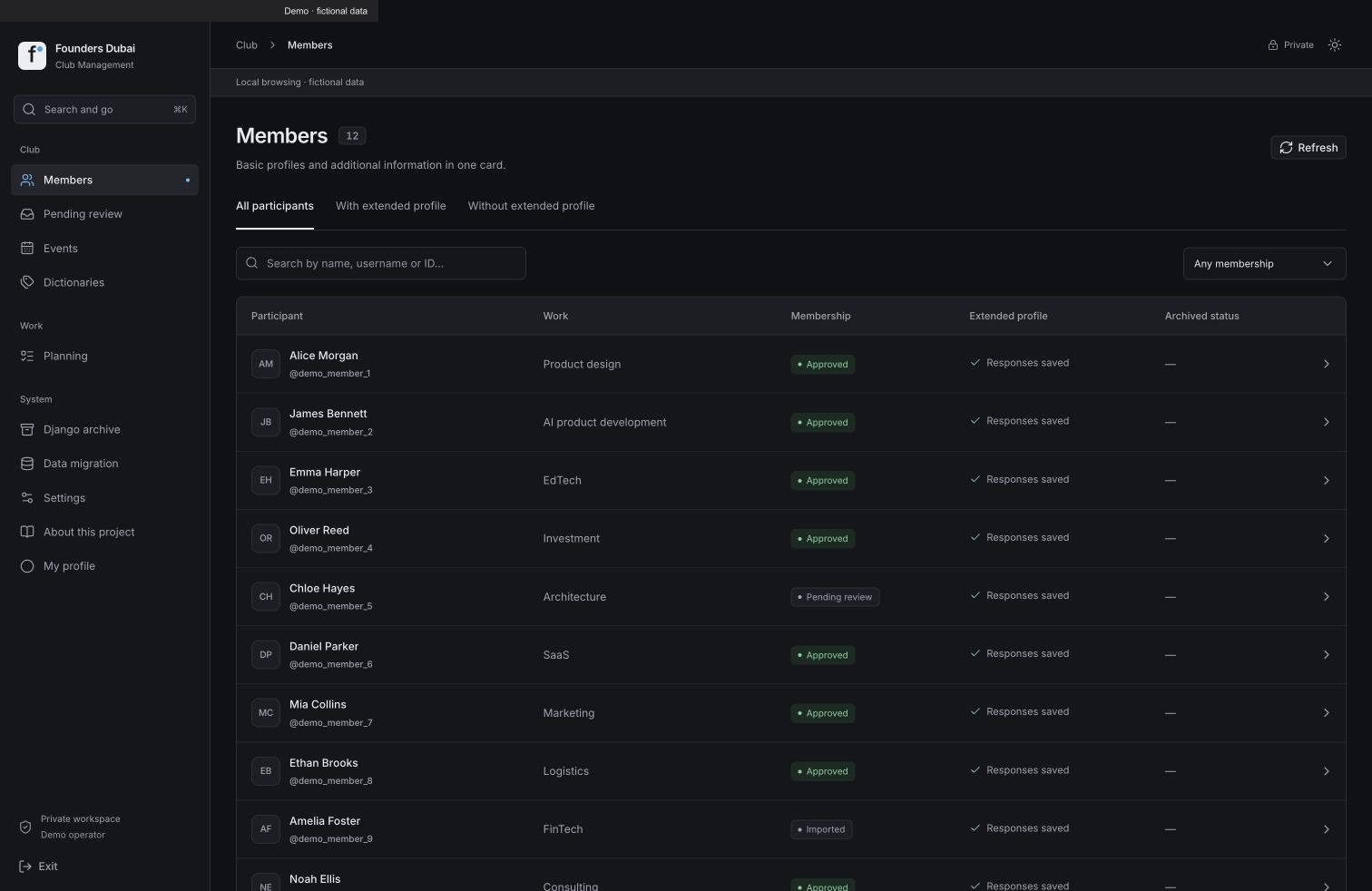
An entrepreneurial community is easy to count: this many members, that many meetings. Useful memory is much harder to preserve. Who knows whom? What is someone doing now? What did they write when they joined? Who promised to return to a conversation after an event?
I built the CRM for Founders Dubai around these distinctions. A member card is more than a contact in a list. It connects the person’s original answers, current information, events, and team actions.
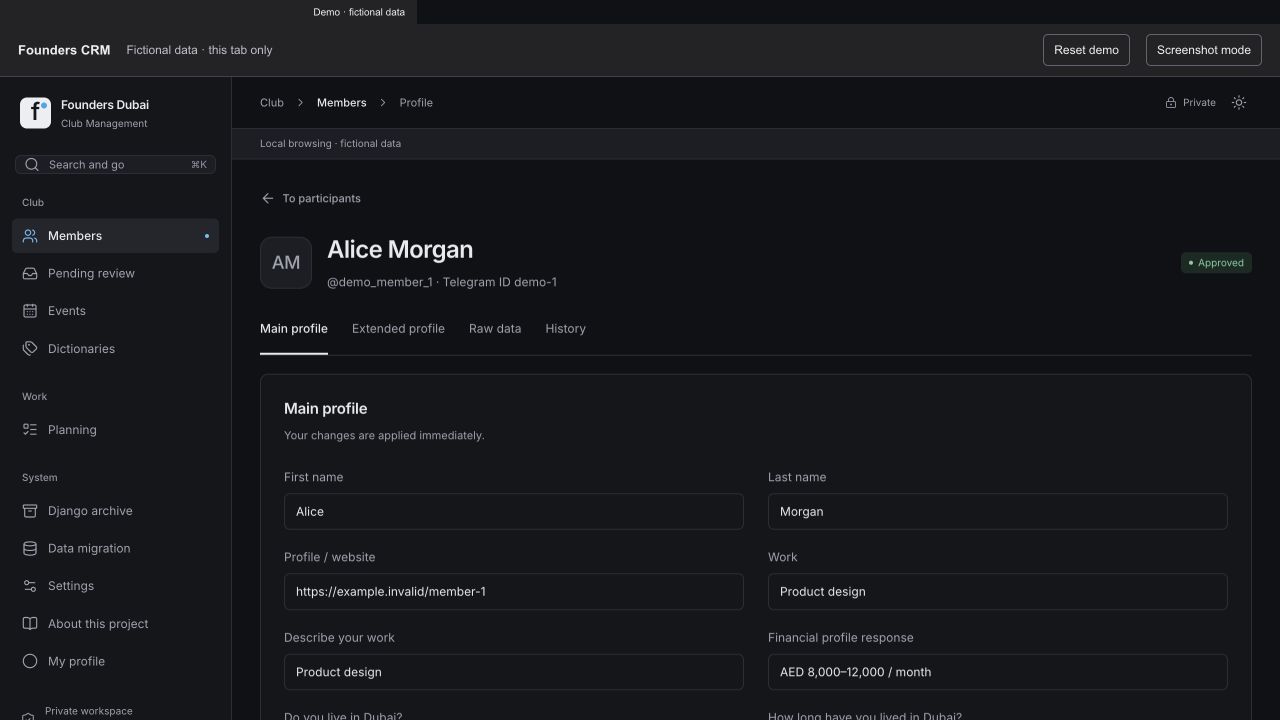
Below is a fictional Founders CRM member’s card: a profile, company information, and participation history. It demonstrates the structure of a working record, not access to the community database.
Member card
Archived interface · demo data
An application must not be rewritten retroactively
Original answers are stored separately from editable current information. A person may change company or line of work. The organiser needs to update their card, but that does not mean the member originally submitted the new version.
Changes have a history and an author. Supported operations allow an edit to be undone while retaining a record of what happened. That is more useful than a generic “last updated” field, which gives a time but lets everyone innocently shrug.
One task, three views
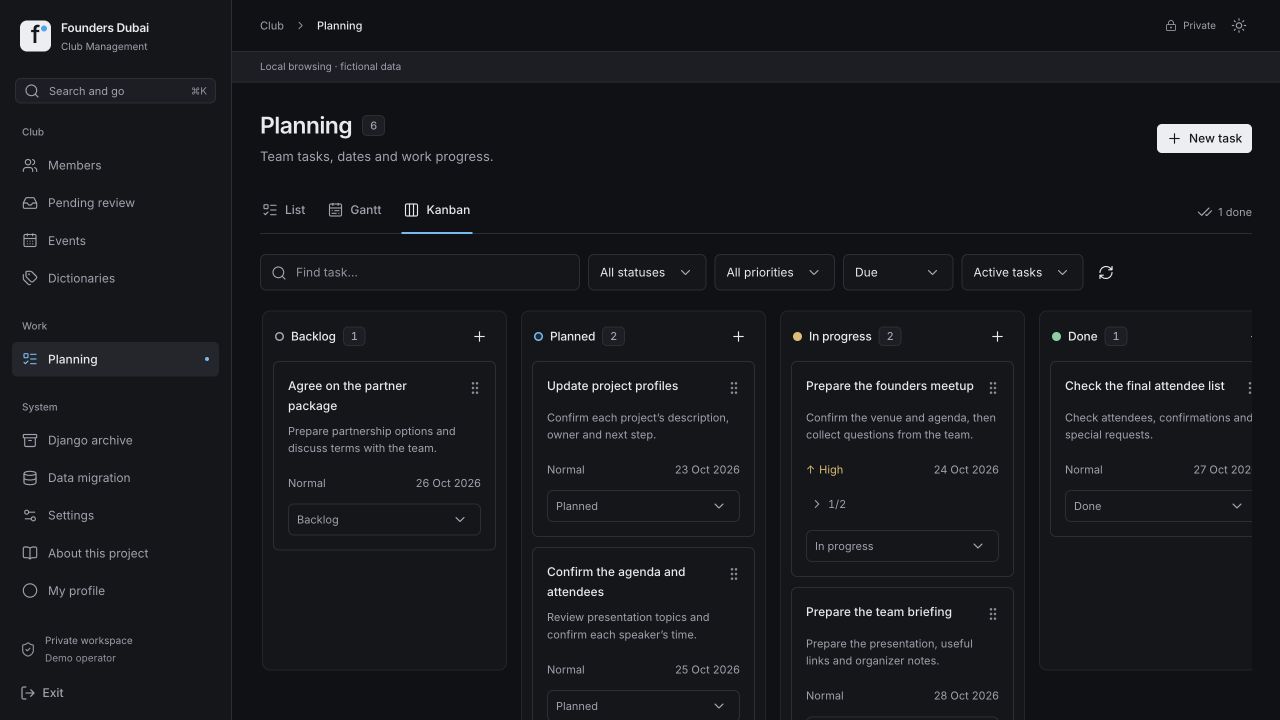
Planning includes a list, kanban, and Gantt chart. It is easy to build three beautiful applications that gradually disagree. These views therefore work with shared tasks and subtasks.
Tasks from the same demo are open on a kanban board. You can see their stages and available local actions; the team’s real tasks are not changed.
Team kanban
Archived interface · demo data
A private MCP interface exposes permitted operations to ChatGPT. The convenience of ordinary language ends where a concrete action begins: a task needs the correct project, status, and access. An assistant saying “done” does not itself write anything to the workflow.
The main application uses React and Vite; the backend is a Cloudflare Worker with D1. A Telegram Mini App gives members their own profile and limited features. Organiser information must not become public merely because two people opened the same link.
The same name does not mean the same person
The ecosystem contains independent services and earlier data. A matching name or Telegram username is not enough to merge two identities automatically. Discovering that after someone else’s history has appeared on a member’s card is particularly unpleasant.
So transferring capabilities between systems and transferring people are different tasks. You can reuse a proven component without importing someone else’s permissions and information along with it.
The organiser’s workflow starts with a member card and continues through the team’s shared tasks. Original applications, current information, and edit history are stored separately so the new state does not rewrite the past. The article shows demo records, not the community’s member database.
Related stories: Founders Dubai community website · The studio and our work together.

@nevsky_alexander
On Instagram: Dubai beyond the postcard — family, the city, discoveries and life between projects. On Threads: thinking out loud about design and AI. On YouTube: videos that need more room than a story. Follow me wherever you feel at home, and let’s keep in touch