
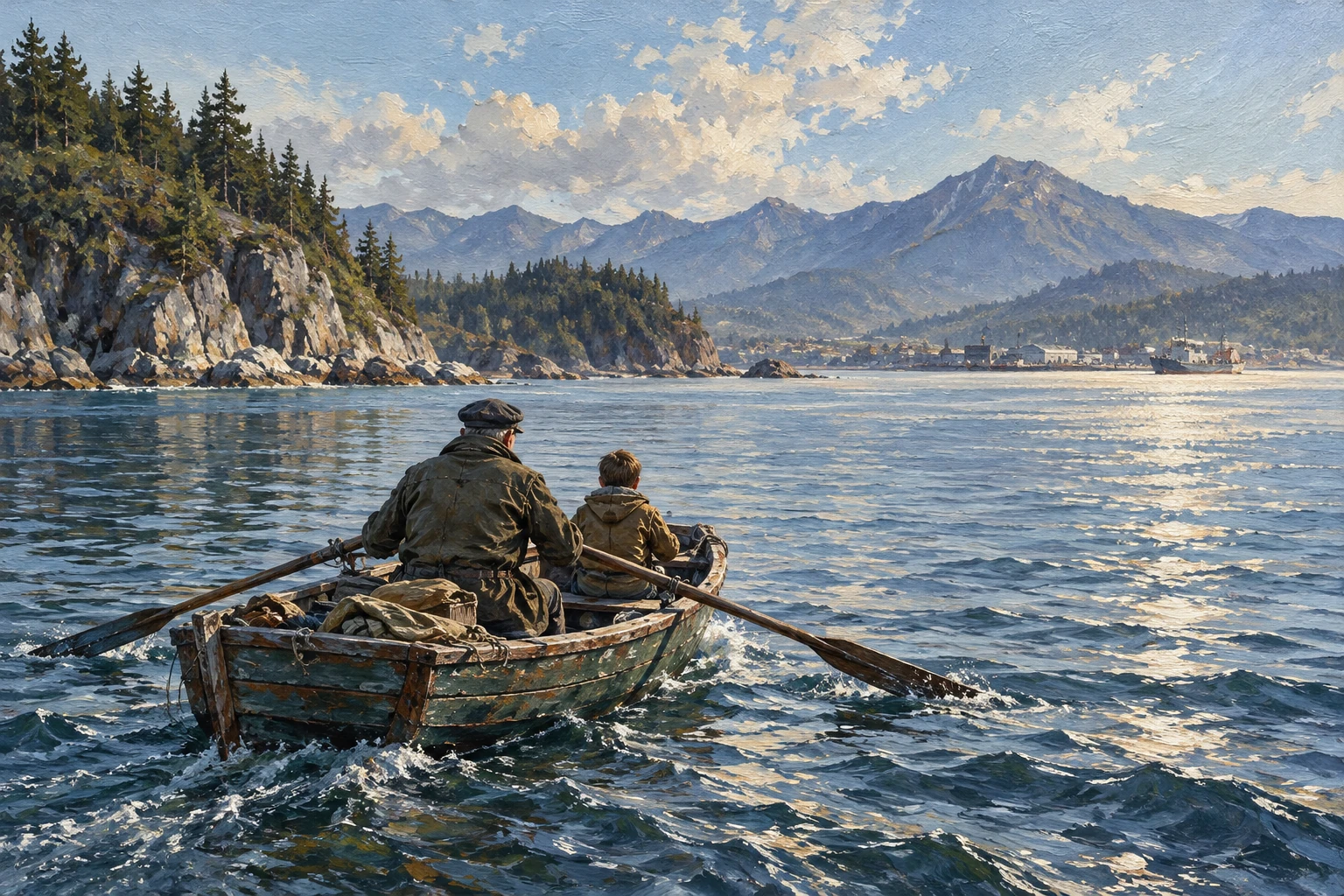
Re-reading Jules Verne’s novel “The Children of Captain Grant,” where the crew of a schooner accidentally discovers a bottle with a note in the stomach of a caught shark, I involuntarily remembered an incident from my distant childhood. It happened on Sakhalin Island. One day, on a deserted seashore, I found a bottle. It was an ordinary bottle, tightly closed with a long stopper coated with mastic, the bottom from the inside was filled with cement mortar, as I realized later, this was for its stability in a vertical position.
But the most intriguing thing was the letter in the bottle. No, I did not dare to break the bottle in order to get the letter as quickly as possible. Rejoicing at the unusual find, I ran to my grandfather. Together we opened the bottle, and finally I had a letter in my hands, received, one might say, by Neptune’s mail.
Main part
The letter was written in three languages: Russian, English, Japanese. It contained a request to the finder: to tell the place, date and time that was needed to study the currents in the sea. It was proposed to transfer the data to the Pacific Institute of Fisheries and Oceanography (TINRO, Vladivostok).
I prepared the letter, and a few days later my grandfather and I boarded a boat and headed to the post office. This required crossing the vast Viakhtu Bay. In calm weather, the crossing took more than one hour by rowing boat. I handed in the letter at the post office, and my soul felt lighter.
After all, I did a good deed. And many years later, I ended up in Vladivostok and visited the museum of the TINRO Institute, but I was not able to meet the right people. However, even today I do not lose hope: maybe one of the institute’s employees will respond. Back then I simply didn’t have enough time.
On this day, our motor ship “Turkmenia” left the cozy Golden Horn Bay and entered the Sea of Japan through the Eastern Bosphorus Strait. New adventures awaited me.
@nevsky_alexander
On Instagram: Dubai beyond the postcard — family, the city, discoveries and life between projects. On Threads: thinking out loud about design and AI. On YouTube: videos that need more room than a story. Follow me wherever you feel at home, and let’s keep in touch