
Once I walked past a school in my city and watched how the children, going out of the porch, unanimously took out their cell phones and carried on a variety of conversations. I remembered my distant school days. We lived in a small fishing village on the seashore. There was a brutal war going on.
Everything was in short supply, including school textbooks. They exchanged textbooks with each other. Often, in order to take a vacant book from a friend, it was necessary to walk quite a bit. There were no home telephones.
Something had to be invented. They came up with it. Our school stood on the very shore of the sea, and sea romance did its job. We studied Morse code, made red signal flags, tried this type of communication and were satisfied.
Of course, the telegraph speed was low, but that suited us. It was necessary to convey two or three words, for example, “Has history become free?”, and receive the answer “Yes” or “No.” Then, to get a textbook, I went to a friend who sometimes lived quite close. But the weather on Sakhalin did not spoil us: frequent stormy winds, fog, rain, frost.
Mobile phones were still too far away. Maybe someone will remember these years? Please respond. Many years ago I had the opportunity to see volcanoes for the first time: Avachinsky in Kamchatka, Ebeko, Mendeleev and Tyatya in the Kuril Islands.
They are all somewhat similar to each other, and at the same time, no two of them are alike. Perhaps the Tyatya volcano stands out especially. The shape of this volcano is amazingly elegant and regular, and it is not without reason that experts say: “Compared to Tyatya, Vesuvius is a lopsided freak.” You have to swim a lot across the ocean to see this miracle.
But is it necessary to travel that far? When I was leafing through my travel notes from previous years, I came across a note. Here I give its content: “Comrade! The products belong to the expedition of the Buryat Council for Tourism and Excursions, headed by Nevsky V.”
A. We went out to describe the route to the Valley of Volcanoes, we will return on July 25 of this year.” V. Nevsky, 07/22/1986 17:00.
Having carefully packed the food and written a note, we left it in the shepherds’ summerhouse in the Hongorei area. From here it is about 30 kilometers to the volcanoes. The route, passing the Khoytogol mineral springs, went north. … The path, going around the lake, continued to lead north along a wide valley.
On the sides of the path carpets of large and bright colors pleased the eye. We also see yellow poppies, purple goblets of gentians, orange ones of roasters, and blue ones of columbine. In some places, flowers courageously coexist with snowflakes descending from the loaches. At times the trail plunged into thickets of polar birch and willow.
A kite was soaring high in the sky. And the air was filled with silence and some kind of serenity — I still remember this state of nature. Here ahead, the contours of the volcano emerge more and more clearly in the form of a truncated cone, named after the researcher Peretolchin. We have been dreaming about this meeting for a whole year.
From the very moment when the plan for the expedition to the Great Sayan was matured. But they saw the familiar silhouette of a volcano and suddenly stopped. Silently throwing off the backpack, they began to examine the miracle that had appeared. We were at the threshold of the Valley of Volcanoes, and soon found ourselves in the valley.
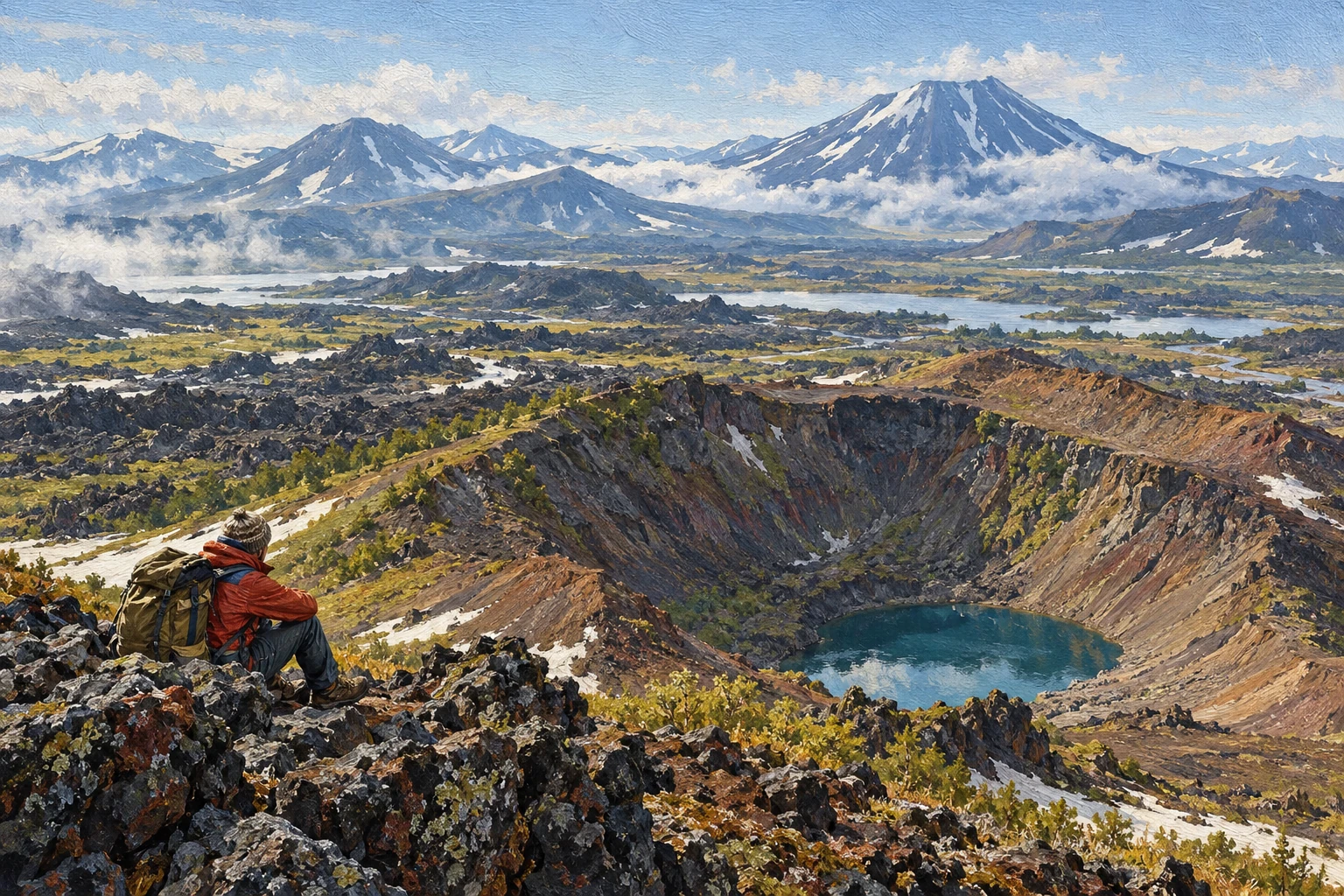
This vast expanse of solidified lava, almost devoid of vegetation, is one of the most exotic places in Sayan. Having set up camp on the high bank of Kadyr-Os, we set off lightly to the nearest volcano Peretolchina. It rises 110 meters above the lava flow, its slopes are overgrown with bushes and rare trees. At the top there is a crater 140 meters across, with a small lake at the bottom.
The temptation to go down is great. We carefully descend the brown slag. Below the lake is a tour made of volcanic bombs. We took down the note from the tourist group from Minsk, left ours and climbed up.
The summer day was fading. It was necessary to return to camp. That evening we sat around the fire longer than usual. A gust of wind suddenly brought the daytime warmth of the valley, and it seemed to us that the volcanoes breathed their warmth on us.
Passing through the Khoytogol mineral springs the day before, we saw a memorial cast-iron plaque installed there, which read: “On July 3, 1914, mining engineer from Irkutsk Sergei Pavlovich Peretolchin, born on October 20, 1863, died during geological surveys. Made a loving wife in 1915.” This cast iron board accidentally ended up at the Khoytogol springs, so it was advisable to move it to the place of Peretolchin’s death. And a year later, the board was indeed moved and installed at the site of the death of the researcher of the tourist group from Ulan-Ude.
Thank you guys. The next day we went to the Kropotkin volcano. The volcano is named after the famous geographer and revolutionary anarchist Prince P.A.
Kropotkin, who explored these volcanoes 120 years ago. He not only described them, but also sketched them. This is a larger volcano that has retained its classic forms to this day. The valley here is filled with frozen lava for many kilometers.
The path is barely visible on the petrified stream, slag creaks underfoot. Again we went up and down into the crater, the depth of which is about 60 meters. During the tour, at the bottom of the crater, a note was taken from Irkutsk geologists Mironov and Ivanov, who visited the volcano. On the third day we left the Valley of Volcanoes.
We took a different route — through the pass to the upper reaches of the river. Arshan. During these days, hundreds of meters of photos and film were shot. We really wanted to show everything that we saw here upon our return to our friends and adventure lovers, who will have many discoveries and encounters with interesting natural monuments.
But in order to see everything, you need to make more than one trip into the depths of the Big Sayan. Have a nice trip, friends!
@nevsky_alexander
On Instagram: Dubai beyond the postcard — family, the city, discoveries and life between projects. On Threads: thinking out loud about design and AI. On YouTube: videos that need more room than a story. Follow me wherever you feel at home, and let’s keep in touch