
One day we met with Vera Aleksandrovna Lubsanova, the head of the “Top-in-the-Forest” tourist club, a Nordic walking instructor. Most of us know her under the pseudonym Vera Shvedka. The day before, Vera and a group of tourists returned from a hike along the popular route to Charsky Peak in the Khamar-Daban mountain range…. The famous train “Naushki — Irkutsk” arrived in Slyudyanka in the middle of the night, it was still dark.
Five of us, with skis in our hands and backpacks on our backs, went down to the platform. Someone suggested that the canteen was open 24 hours a day in the carriage depot, and we, leaving our skis and backpacks at the station, moved along the railway tracks to the canteen, where we were fed porridge with butter, and for tea we were served pancakes with sour cream straight from the frying pan. Thank you. Everyone was happy, returning to the station, took their backpacks, skis and went out into the city.
Having passed the outskirts of the city, we got onto the ski track. Now forward and upward, forward and upward. The ski track meandered through channels, climbed onto the coastal terrace, straightening the bends of the river. The Slyudyanka Valley, quite wide at the beginning, gradually narrows and acquires a typical mountain character.
It boils over many kilometers of areas, squeezed into a tight canyon, forming cascades of rapids and waterfalls. Often the ski track goes from one bank to another, avoiding pressure points and meandering among huge boulders. This route from Slyudyanka to the high-mountainous weather station “Hamar-Daban” with an ascent to Chersky Peak 2,090 m above sea level is especially popular on holidays. Meanwhile, the sun rises higher and higher, for another moment — and its rays filled the narrow gorge.
The weather station is located on the watershed of the Slyudyanka and Podkomarnaya rivers at an altitude of 1,600 meters above sea level. The transition from the Slyudyanka station to the weather station took about seven hours. The last two-kilometer climb pretty much exhausted us. Finally, we open the gate and enter the courtyard of the weather station.
The dogs greeted us, to our surprise, peacefully. We met the weather station employee on duty on the porch, and he greeted us. There are five of us, including two women. We asked permission to spend the night in the hut and received consent.
We go in and settle down in the warmth. After dinner we go to sleep on the floor. The house is warm until the morning. In the morning I got up, as usual, at six o’clock and went outside.
The day was bright and frosty. I went to the woodshed to split a few logs for warm-up. I put on my top, took a cleaver in my hands and began to chop the sawn logs. I remember that the cleaver was unusually heavy, there was some kind of royal mark on its blade, it pierced by itself.
I just raised it and lowered it, the block instantly shattered into two halves. And even though nearly 60 years have passed since then, I remember it well. We take with us only crackers, chocolate and a flask of tea. The ski track is deserted today.
During the entire journey, we met only a hunter returning home after a successful hunt, two meteorological service employees after duty, and several tourists rolling towards us. But it must be said that the route is especially popular on weekends and holidays. The main place here is occupied by Irkutsk residents. The ski track, gaining height, rushed along the serpentine towards the nearest char.
The altitude begins to take its toll. We stop to rest more often. The ski track, having risen to the top of the char, branches. The left one leads to the top of Chersky Peak, we also turn off.
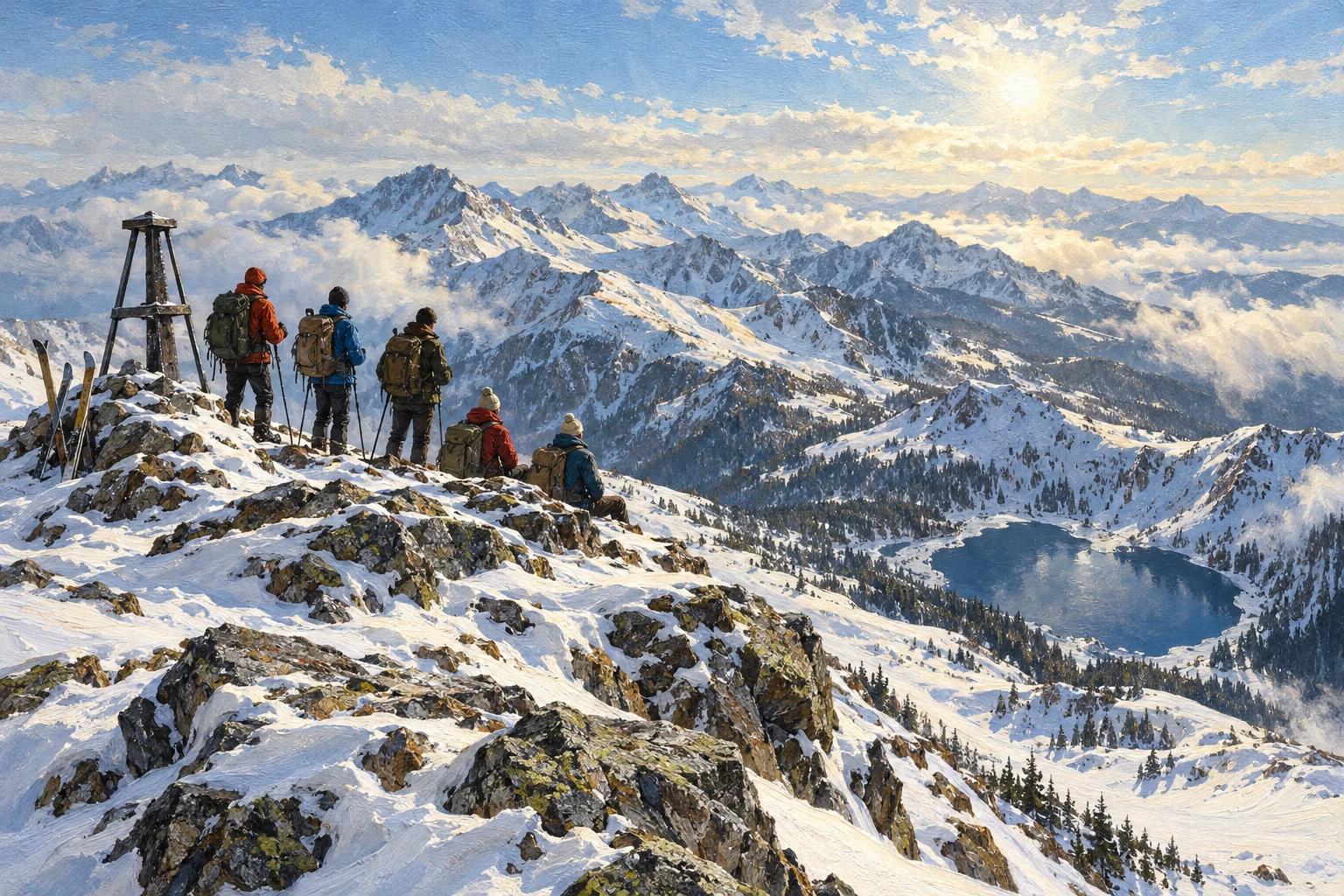
It is worth mentioning that the slopes of the char are covered with thickets of golden rhododendron. It blooms in May-June. At this time, there is often still snow in the mountains, and the sight is extraordinary — snow and flowers. From here you can see below the picturesque mountain lake Heart, which in its shape really resembles it.
Trees no longer grow here, only occasionally you come across a bush that tenaciously clings to the stones. Soon the forest ends, and it is impossible to climb further on skis. The prevailing winds here swept away the snow and exposed rubble and stones. Let’s go without skis.
Relatively quickly we manage to climb to the second char; here, after resting a little, we prepare to cross the stone isthmus between the char. This is the most difficult and dangerous section of the path — the isthmus is narrow, sometimes narrowing to half a meter. We are moving very slowly, and besides, we did not change our shoes, so we are walking in ski boots, which adds inconvenience and danger. The soles of the ski boots are leather, slippery, and there are deep chasms on both sides of the isthmus.
We move slowly and carefully, using ski poles for support. A few meters away the path is blocked by large snow drifts. Finally, the isthmus was safely passed. Hooray!
There are no more than 300 meters left to the triangulation sign at the top of the peak. One more throw and we are at the top. Having reached the tour, we take out a note from the sleeve left by tourists Kotov and Zantuev on February 15, 1962… The difficult path has been overcome.
You can rejoice. But the cold makes us quickly write a note about our small victory. We put it in the sleeve, take a photo and leave the top. Soon a strong wind rises, the weather noticeably deteriorates, shaggy clouds float across the sky.
No matter how difficult the ascent was, the descent turned out to be more difficult and dangerous. Taking great care and helping each other, we descend to the abandoned skis. The top of the peak had already disappeared into the clouds. Getting on our skis, we continue our descent.
I must say that we were using regular cross-country skis with rigid bindings. Only many years later I was able to purchase real touring skis with metal edging from Beskyd. We continue our descent from the char. Sharp turns, cliffs, rocks — it’s difficult to brake in time.
We fall, get up and continue rushing down. About the bottom, only the thought drills into the brain: “Don’t break the skis…”. And now we are finally at the gate of the weather station, we will spend the night here. Despite the difficult day, I almost don’t feel tired, I’m in a fighting mood.
The women immediately understood everything correctly: “We need to prepare a festive table.” The commander, without any extra effort, takes out the treasured army flask from his backpack, which, of course, is not empty. We had a good time. The third day of our ski trip was probably the easiest.
It was very pleasant to roll downhill for almost the entire 30 kilometers: it was breathtaking, the kilometers flew by quickly. And now the Slyudyansky marble quarry, or the Pereval enterprise, has already appeared. Most tourist groups now arrive in Slyudyanka not by train, but by hired minibus. The driver will take you directly to the trail, and you won’t have to walk through the entire city.
There are two attractions in the city: the railway station, built entirely of white marble, and the private museum “Gems of Baikal”. Its creator V.A. Zhigalov, unfortunately, passed away this year, but his wife and daughter will be happy to receive visitors.
Tourists will be able to stay at the Khamar-Daban and Chersky Peak tourist centers by making reservations in a timely manner. Every time it naively seems to me that after reading my article, at least a few people will want to shake off the routine of everyday affairs, feel pleasant fatigue in their muscles, and breathe in the taiga horizons. I will consider that I have fulfilled the task of popularizing a healthy lifestyle. But the nature around us, under the rapid onslaught of man, is quickly changing its appearance, so walk, drive, fly, in short — hurry to see the Earth!
@nevsky_alexander
On Instagram: Dubai beyond the postcard — family, the city, discoveries and life between projects. On Threads: thinking out loud about design and AI. On YouTube: videos that need more room than a story. Follow me wherever you feel at home, and let’s keep in touch