
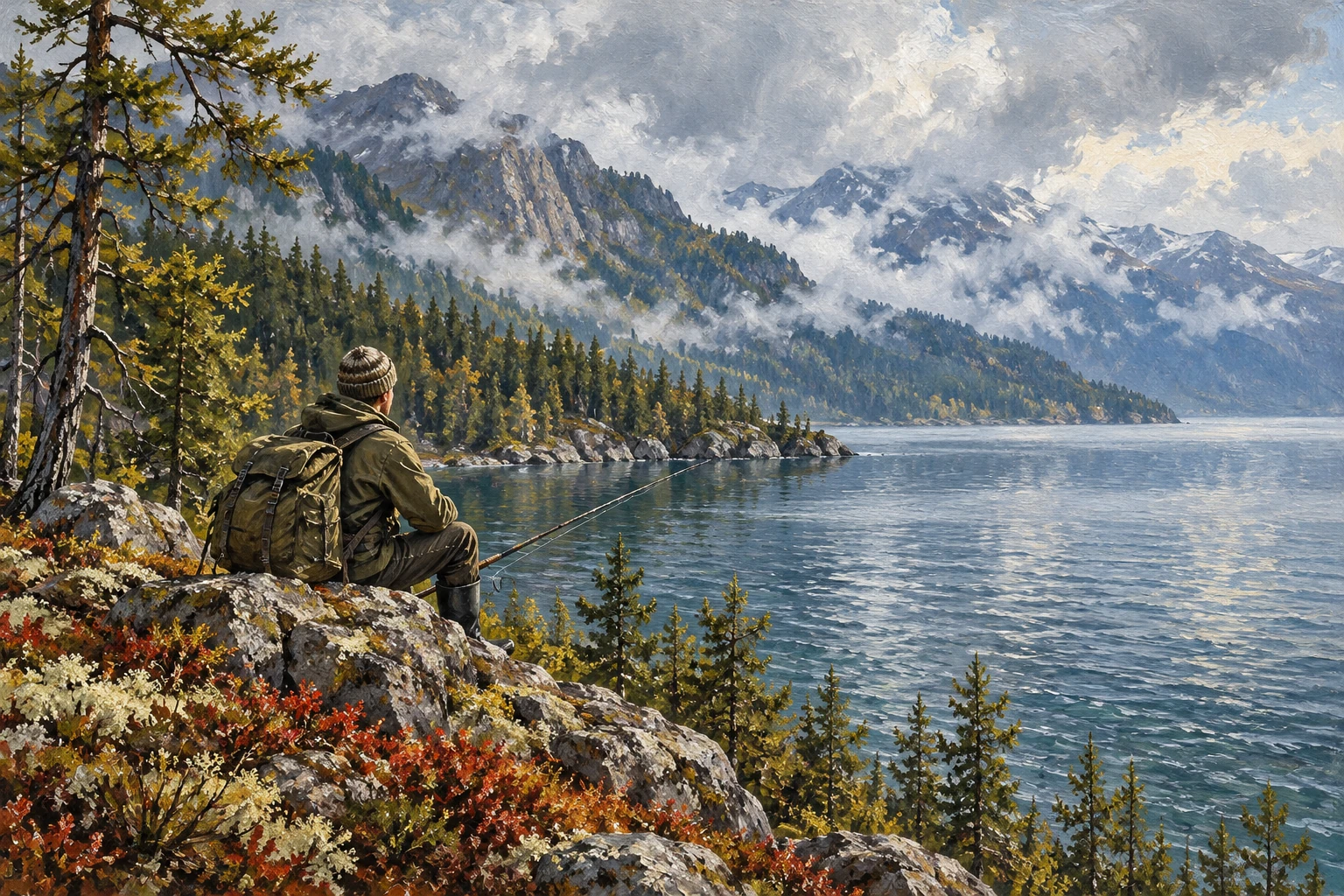
I was born and raised by the sea. My small homeland is Sakhalin. There I learned to row and steer a boat, set nets and use a cast net. When I accidentally came across the Ural Pathfinder magazine with an article about Lake Frolikha, its beauty and picturesqueness were tempting.
The lake was also known to have an abundance of fish. But the real curiosity of Frolikha’s fish wealth was a rare red fish for Siberia — the Davachan char. And I must say that I immediately realized that this was mine. He quickly assembled a team of 7 people.
Our journey began from the port of Baikal, where we boarded the Komsomolets motor ship. The ship was filled with tourists from different cities of Russia. We had to get on board the Komsomolets to Khakusy Bay and join the tourist trail there. The transition from Peschanaya Bay to the port of Ust-Barguzin was memorable.
Here we were caught in a storm, Baikal showed us its harsh character. The south wind “kultuk” was blowing, steep waves, hitting the side of the ship, flew cascades of spray onto the deck, it was beautiful and a little creepy. Photographers were right there, waiting for an unusual shot. I must say that throughout our journey I liked the cheerful voice of the captain, who spoke into a megaphone, addressing those waiting for the ship on the shore: “Don’t worry, comrades!”
We’ll take everyone!” And, indeed, they took everyone. Apparently, the captain knew well what this not very comfortable ship was capable of. Having filled the cabins, tourists began to settle down on the upper deck, which soon began to resemble a flower meadow, decorated with orange, blue, yellow, and red tents.
The crew of the ship is apparently already used to this. At stops, the captain now shouted into a bullhorn: “Move to the other side, otherwise we will not be able to dock!” And the passengers obediently crossed. On the third day the ship entered Khakusy Bay and dropped anchor.
The sailors, lowering the motorboat, began to transport passengers ashore. Our turn came when the motorboat returned for the third time. On the shore we agreed with a local resident that he would give us a lift to Ayaya Bay. It’s a stone’s throw from Lake Frolikha – eight kilometers along a well-worn path.
The next morning we board the motorboat, and after a couple of hours the boat gently rests on the golden sand of the beach. We unload and have breakfast. There are thickets of dwarf cedar with heavy cones all around, and a carpet of shiksha and reindeer moss underfoot. In front of us is a good well-worn path, which clearly speaks of the attractive power of the lake.
Throwing our backpacks on our backs, we set out on the path. About four hours later we approached the lake, crossed the channel on a raft and climbed the steep bank of the Valunny Peninsula. We only had time to set up tents and light a fire when it started to rain. The water level in the lake began to rise before our eyes.
The sandy beach opposite the camp disappeared under water. After sitting in damp tents for three days, we decided that we would no longer wait for favors from nature. We knew that we were on a peninsula, not far from the source of the Frolikha River, here the river, with the roar of an courier train, was rushing towards Baikal. We decided to cross the peninsula on foot and set off in the rain.
About an hour later we came to a scattering of stones that went down to Khobot Bay. The path running along the shore was under water, the depth in many places reached the knee. We continued to move forward, and more and more often we had to wade through the water, avoiding bushes and rocks. And the rain kept pouring down and pouring down.
Before leaving for Frolikha, I believed that we would find ourselves in a real “bear’s corner”, but, apparently, I was mistaken. After Khobot Bay, tourist stops began to appear more and more often. Our meeting with tourists from Novosibirsk was pleasant. We met them back in Irkutsk, at the beginning of our journey.
Seeing our deplorable state, the girls treated us to hot tea. This was just the thing, and we moved on at a good pace. The next meeting turned out to be even more interesting. After we said goodbye to the Novosibirsk residents, a winter hut appeared on a sandy cape.
In the winter hut we met a group of hydrologists who told us a lot of interesting things about the lake. Of course, wonderful nature, a wonderful lake. We turned back from the hydrologists’ winter quarters, believing that we had completed our task. On the way back we took a different route along the shore of the Valunny Peninsula in order to learn more about the lake.
And the fishing for which we went to Frolikha failed due to high water caused by continuous rains, which is generally a rare case for Buryatia, but in the summer of 1971 this was exactly the case. I tried to catch the “goldfish” both from the shore and from the raft, I caught it by changing lures, but no fish would take the hook. Davatchan is an endemic fish, or loach, as it is popularly called. The bright red meat of Davchan is especially popular among fish gourmets.
Go to Frolikha, maybe you will be lucky, friends! You just need to keep in mind that the Frolikhinsky reserve is currently organized here and without special permission, fishing, hunting, and collecting wild plants are prohibited within the boundaries of the reserve. What can be said about these measures? There is only one thing: the nature of Baikal is very vulnerable and the whole world needs to protect it.
Due to heavy and prolonged rains in the summer of 1971, we were forced to shorten our travel time. On the fifth day we left Frolikha. We had at our disposal two rafts left by our neighbors, on which we crossed the lake and took the path leading to Ayaya Bay, from where we began our fascinating journey. Then again boarding the motor ship “Komsomolets”, stationed in the roadstead, and heading to the port of Baikal.
The hard-working motor ship sailed for more than 10 years.
@nevsky_alexander
On Instagram: Dubai beyond the postcard — family, the city, discoveries and life between projects. On Threads: thinking out loud about design and AI. On YouTube: videos that need more room than a story. Follow me wherever you feel at home, and let’s keep in touch