
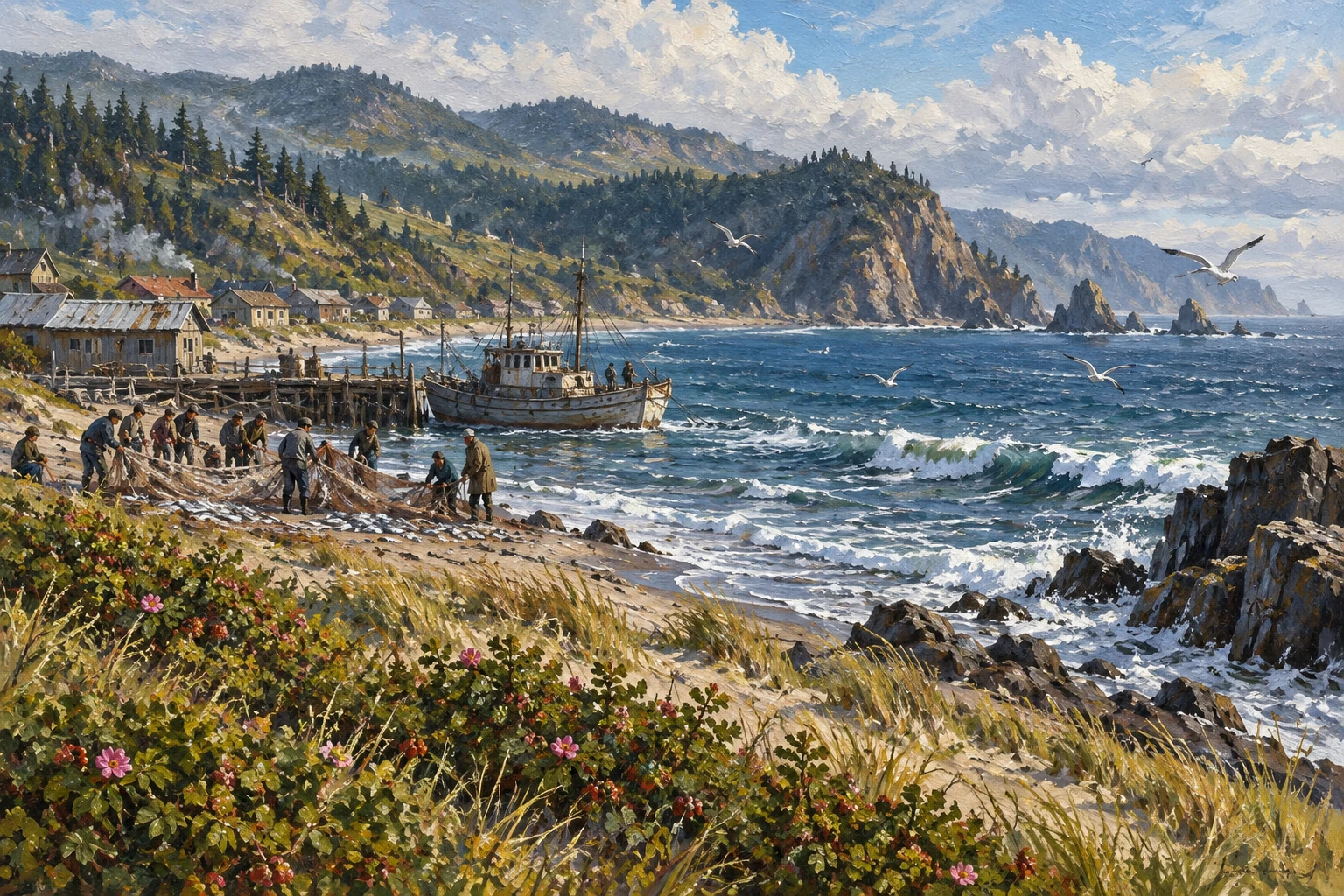
Our family lived for a long time in the small village of fishermen and lumberjacks Tangi on the shore of the stormy Tatar Strait. I was then 12–14 years old — the age of romantics and adventurers: I wanted to see everything with my own eyes, and even better, touch it with my hands. We walked to the seashore and further along the surf line, where under our feet there was dense sand, as strong as asphalt. Ahead of us is a powerful rock at the end of the cape.
A chaotic pile of stones stretched away from the rock, along which at low tide one could escape from the shore. Deep, mysterious crevices and grottoes were visible between the stones. Yellowish-brown thin algae swayed on the flat slabs like feather grass bushes. In the pools one could see a sea urchin under a gray rough shell, a bright red sea snake, a water snake…
This is how we learned to love the sea and its inhabitants. One day I was walking north along the seashore. Here is the neighboring village of Khoe, I cross the river flowing through the village on a wooden bridge, there are no cars here. I see that the tide has begun, so the nearest Cape Wandi can no longer be reached by the shore; we will have to climb up and go around it along the mountain.
At noon I approached the Nivkh village of Trambaus. There was a river in front of me, it was impossible to ford, and I was forced to call for help. Soon a boat landed on the shore, and a local resident, without further ado, transported me to the other side, and I continued on my way. At the end of the day I approached Viahtu Bay, where my grandfather met me.
We sat down to drink tea brewed with herbs. I was proud to have walked about 50 kilometers during the day. And here I will spend the whole summer before school. I remember Viakhta Bay well.
It is separated from the shore by a low sandy ridge of dunes, overgrown with extensive clumps of shiksha and thickets of creeping Sakhalin rose hips. The bay was connected to the sea by a narrow neck, and every six hours, when the tide began, the sea rushed into the bay and filled it to the brim. The depth grew before our eyes, and it became scary. The southern shore of the bay was low and partially swampy, while the northern shore was high and steep.
There was a village here, which had a store, a post office, and a first-aid post. Several times over the summer, my grandfather sent me with one of the adults to the village. We got into the boat and sailed across the bay. A few days before school I was returning home.
When I sat down at my desk, my thoughts were far, far away. Our school was located on the edge of the village, right next to the sea, on a sandy shore. During autumn storms, the waves splashed almost right next to the windows. While the fishing season was going on, we also took part in it: every morning, when fishing boats returned with nets full of herring, we were called for help.
The whole school ran to the pier and dismantled the nets, freeing them from fish. This was our contribution to Putin. We sat down at our desks, but the sea did not let us go for a long time. The waves were still splashing before my eyes, the sound of the wind and the cries of seagulls were in my ears.
And it seems to me that this symphony of the sea accompanies me all my life. I am grateful to the sea for teaching us life.
@nevsky_alexander
On Instagram: Dubai beyond the postcard — family, the city, discoveries and life between projects. On Threads: thinking out loud about design and AI. On YouTube: videos that need more room than a story. Follow me wherever you feel at home, and let’s keep in touch