
The other day we met our old friend, a TV journalist and experienced traveler, who had just returned from a trip on the ice of Lake Baikal. For supporting him on his solo journey, he gave us a brand new compass as a present. Having thanked him, I picked up my respected compass, yellowed with age, with the body glued together in several places. A wave of memories involuntarily washed over us.
Every summer we gathered as a friendly team and went to the most treasured corners of Buryatia. I remembered the trek across the Barguzinsky ridge. We called the last pass at an altitude of over 2,000 m “Dream” and completed the tour. Why Dream, someone will ask.
Probably, friends, because even below, in the bustle of cities and the flow of cars, people were really eager to come here. And I was especially happy that our dream came true. With the advent of the Nordic walking hobby in our lives, numerous walking routes for Nordic walkers have appeared in the vicinity of the city of Ulan-Ude, each of which has its own “zest”. Here is the new route and the Brigantine Pass.
Where does this maritime name come from for a pass 3,500 kilometers from the ocean? Let’s try to tell how this happened. Even before the first equipped trail appeared in our city, which was included in the “Great Baikal Trail” system and connected the two most popular recreation spots among citizens and guests of the capital, the “Scandikhods” independently paved the trail. The path from the threshold of the ski base on Arshan serpentinely climbed up the mountain and along the tops of the ridge, crossing the routes of two high-voltage power lines, descended to the gates of the Ethnographic Museum of the Peoples of Transbaikalia on Verkhnyaya Berezovka.
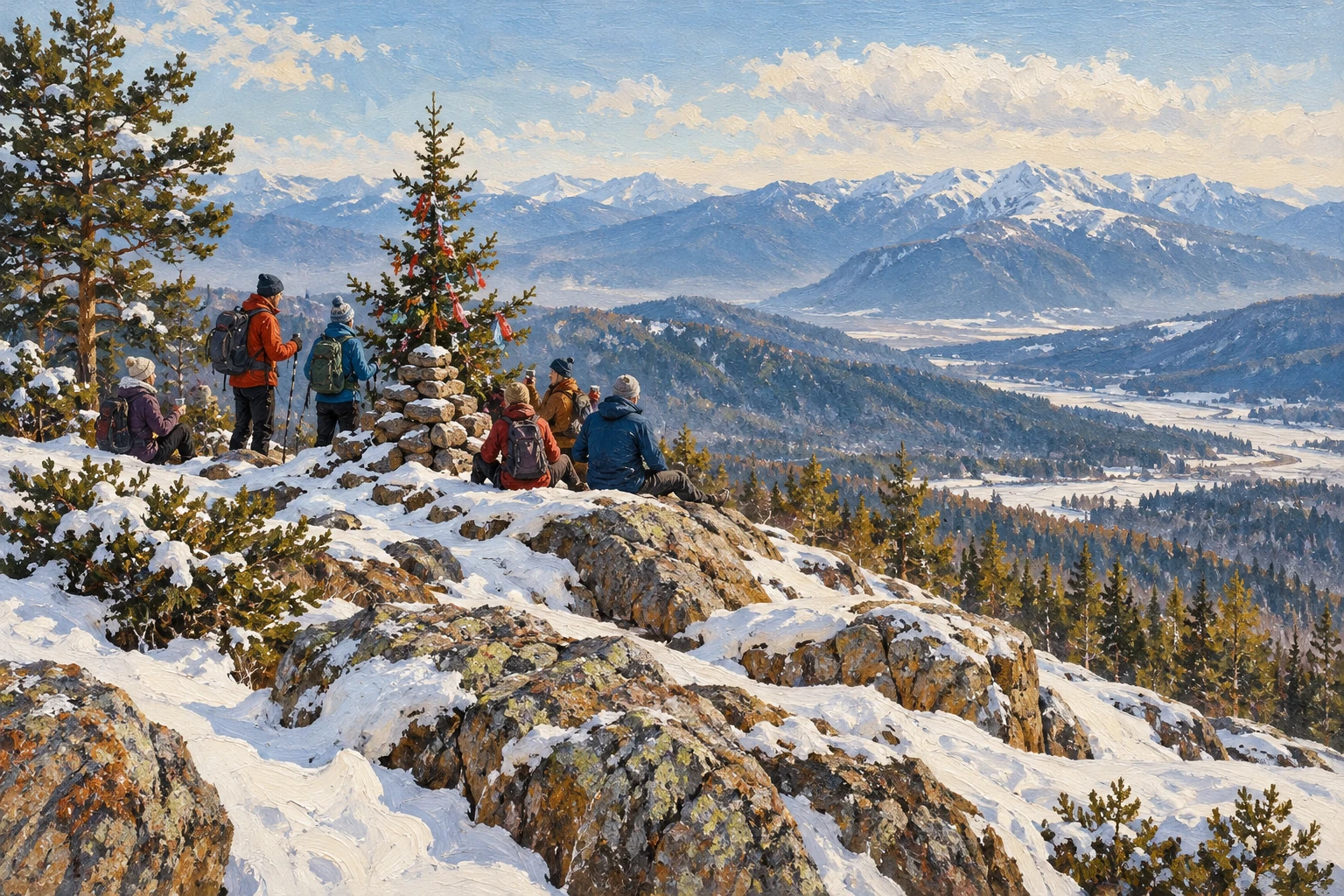
The length of the trail is more than seven kilometers. On New Year’s Eve 2013, we came here with a group of about 20 people. It was planned that halfway at the nearest nameless pass we would decorate the Christmas tree with the toys we had brought and open the champagne. Everything worked out.
But how could it be without a song, and the song began to sound. It was the favorite song of tourists, “Brigantine,” permeated with the winged image of romance. Beautiful male voices sounded over the pine forest: “… for the furious, for the rebellious, for those who despise the comfort of a penny…”. It was performed by three tourism veterans.
The audience applauded. In March, on the last day of Maslenitsa week, forgiveness day is celebrated. We met again on the trail at the now familiar pass. People happily hugged and forgave each other.
A merry round dance was organized around the brought multi-colored doll. And again the favorite song “Brigantine” was performed by the same veterans. The last thing left was to burn the Maslenitsa doll. Amid joyful exclamations, Andrei Suknev sets it on fire.
After that, we packed our backpacks and hit the road again. Nordic walking instructor Vera Lubsanova leads us along the trail. And even if the pass does not appear on official topographic maps, it will remain in our souls and our memories. A new route among picturesque nature leads to the Dryazgovity stream.
The length of the round trip route is about 25 kilometers. It is advisable to go overnight. The route starts from the final stop “Kulkison”. Climbing all the time along the stream, you come to an interesting place, which tourists call “Stone River”.
Here, moss, lichen and rust cover the surface of the stones with either yellow-brown or light gray spots. There is stone chaos all around you. Sometimes it seems that a powerful stone stream has stopped in its run… You also stop, amazed and fascinated by an unusual natural phenomenon.
Nature does not tolerate fussiness or, as they say, “cockroach races.” Stop it, man. Listen: somewhere deep under the stones a stream gurgles and the pikas that have chosen these places whistle loudly. From here the path to the top of Mount Dryazgovitaya.
Its height is 2,149 meters above sea level. This is the highest peak in the vicinity of our city. From the top you can see the Barguzinsky tract, rapidly rushing to the north. There is a wonderful view of the blue taiga expanses of the Ulan-Burgasy ridge.
Nowadays you can often hear among the “Scandi walkers”: “Today we are going to the Singing Pine.” The route starts directly from the city bus terminus. It connects the Malaya Rechka pad and the Kulemin pad. For those who don’t know the meaning of this word, let us explain: “a homemade trap for small fur-bearing animals.”
At the top of the pass in ancient times there was a noticeable pine tree with a double top. Under the gusts of wind, forest melodies sounded in its elastic branches, so the veterans dubbed it “singing.” This name stuck. One winter I heard at the ski resort: “Mom, today we went up to the Singing Pine.”
There are still many interesting routes, but we will write about them next time. It’s safe to say that Nordic walking came to our city — and not just as a tribute to fashion, but as a sure path to a healthy lifestyle. According to the most conservative estimates, more than 500 people regularly take part in walking. But the amateur movement must be directed in the right direction.
Apparently, the time has come to unite spontaneously emerging groups and amateur clubs into a powerful sports and health movement, let’s call it that. And if it is not possible at first to create an association or federation, then the city club is definitely needed by the “skandikhods”.
@nevsky_alexander
On Instagram: Dubai beyond the postcard — family, the city, discoveries and life between projects. On Threads: thinking out loud about design and AI. On YouTube: videos that need more room than a story. Follow me wherever you feel at home, and let’s keep in touch