
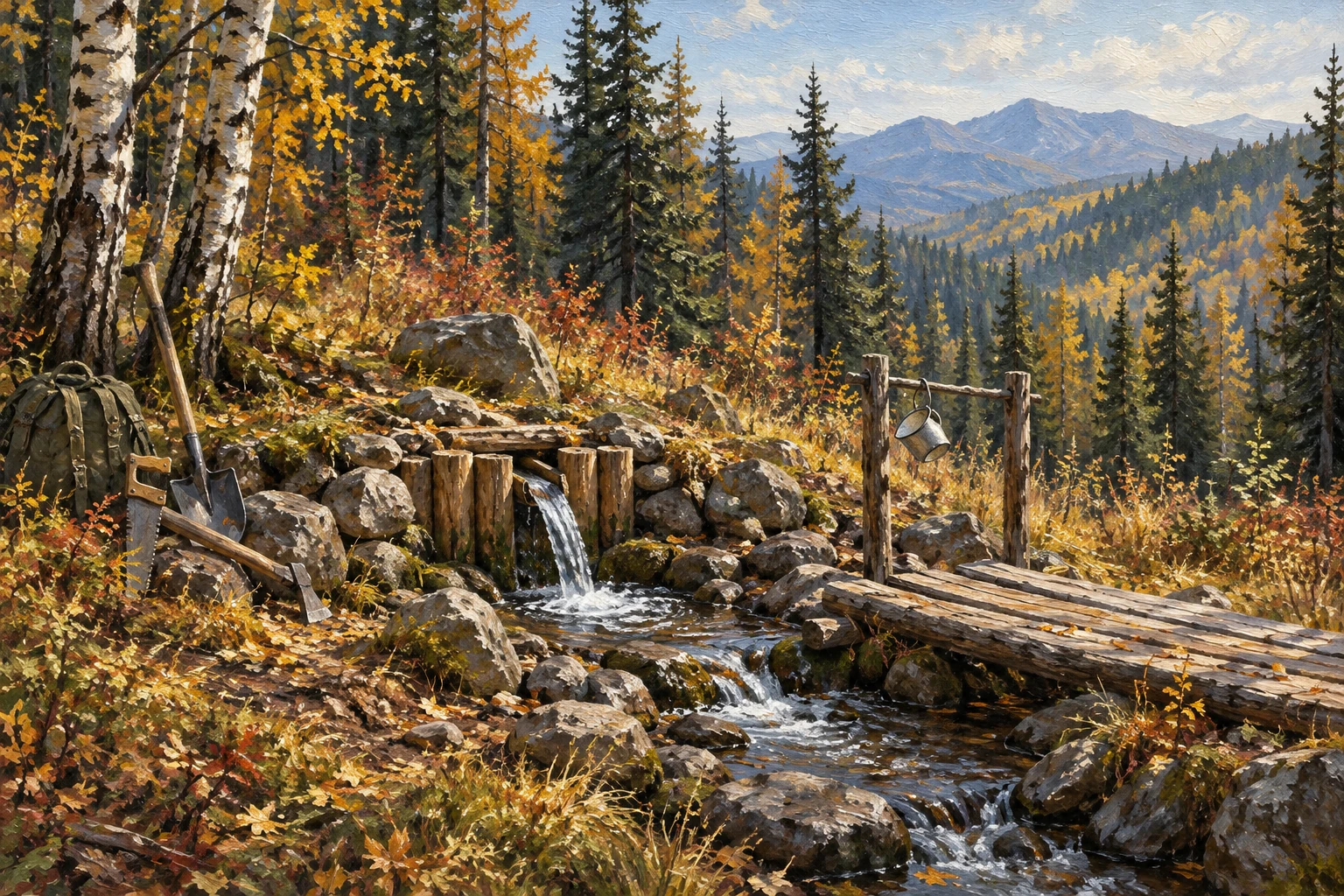
On a wonderful autumn day we found ourselves in the possessions of the Mostovskoye forestry district, 30–35 kilometers from Ulan-Ude. The three of us go, armed with a shovel, saw and axe. Let’s go do a good deed. What kind of thing is this?
Let the lost spring be revived. It existed, perhaps, for hundreds of years, but a couple of years ago, the birch and aspen trees that guarded it were swept away by the treacherous blow of an ax, followed by the tracks of a tractor. On the spot we encountered a terrible picture. But we were not the type to retreat.
We started by clearing the spring bed of dead wood and stones. Then they dug a small well, the walls of which were reinforced with aspen logs. It turned out beautiful and reliable. In addition, we surrounded all this with stones.
Here they made a bridge from poles. A mug was hung nearby. We are confident that the spring will now certainly live, bringing joy to people. At the end of the day, having admired our handiwork, we headed home.
But for a long time the stream did not let us go. I thought that if we don’t save every spring that is in danger of disappearing like this, then we won’t be able to save our sacred Baikal for posterity. Maybe because I did something useful today, or maybe because of the resinous aroma of pine needles, I suddenly remembered the events from Georgy Markov’s book “The Strogovs” I read a long time ago about the villagers’ defense of a public cedar forest. It was from there that I remember the phrase: “The whole world…”.
This principle is relevant, in my opinion, even today. The windows of my apartment overlook the Trans-Siberian Railway, and the railway trains loaded with round timber and going mainly to China have long been an eyesore. The reason is known: we have virtually no deep wood processing. Obviously, for this reason, we see large areas in logging areas that have not been cleared of logging residues, creating a huge fire hazard.
And this is in our time, when society is on the verge of adopting an ecological constitution that provides for humanity’s transition to a “green economy”, where, along with the further development of the forestry industry, mandatory reforestation will also be carried out. Frankly, we can do a lot. I remember the years when a ban on moth rafting on the rivers of Buryatia was adopted. As a result, a gigantic amount of work was done to clear the river beds of driftwood, and the shores of Lake Baikal from driftwood — logs thrown ashore by the surf.
It turns out we can do it when we really need it. With all the current ups and downs, the words of the head of the Republican Forestry Agency Alexey Shchepin, who says that today four projects in the Republic of Buryatia are included in the list of priorities, are certainly encouraging. They will be implemented through private investment. This is a project of the Baikal Forestry Company, which will be completed in December, projects of the companies “Baikal-Nordik”, “Forest Exchange” and “Forestinvest”.
Of course that’s good. But could it turn out that modern enterprises will come into operation that provide deep processing of wood, but this very wood is not available at all in places accessible for logging? I’m sure everything has been pre-calculated. But are there many cases when optimistic calculations turned out to be very far from the actual situation?
Suffice it to recall the Kholboldzhinsky coal mine and the Gusinoozerskaya State District Power Plant, which, according to the technical design, could still operate on Kholboldzhinsky coal, but in reality there is no Kholboldzhinsky coal for a long time, just as there is no enterprise itself — the Kholboldzhinsky open-pit mine. Here, in my opinion, it would be appropriate to return to the idea of using modern airships to transport wood. This would allow logging to be carried out on the steep slopes of the pre-alpine zone, where the use of conventional equipment is impossible, and at the same time to abandon the construction of logging roads. And most importantly, to gradually ensure the transfer of logging capacities outside the water conservation forests of the lake basin.
Baikal to forest-abundant areas of the republic. Perhaps this will make a forestry specialist smile skeptically. But at one time the Zabaikalles trust came very close to this tempting idea. So, go for it, gentlemen from the Republican Forestry Agency.
Good luck to you!
@nevsky_alexander
On Instagram: Dubai beyond the postcard — family, the city, discoveries and life between projects. On Threads: thinking out loud about design and AI. On YouTube: videos that need more room than a story. Follow me wherever you feel at home, and let’s keep in touch