The Cooling Season
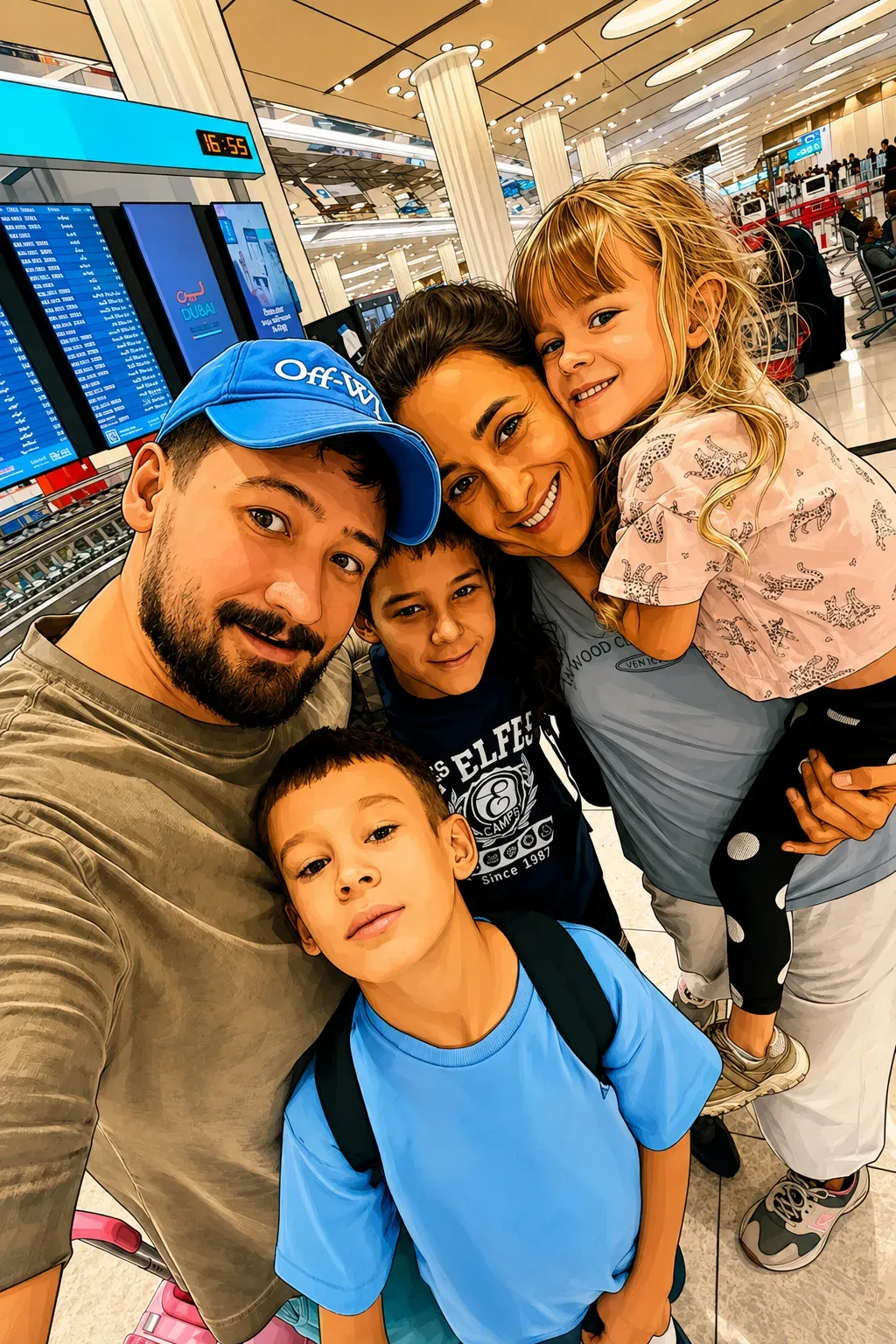
Look at that: the photograph is alive. For four years it lay in my phone among children's faces, dogs' ears, letters from the bank, apartment floor plans and the accidental darknesses shot by a pocket, and now, on the thirty-first of July, it switched itself on again — the silver airport escalator started moving, the rubber handrail began to stream, and there is Ira going down ahead of everyone, and beside her our three children in identical purple backpacks worn like spacesuits, small settlers carrying water bottles, pencils, toy cars and that carefree supply of the future which adults mistakenly take for a modest piece of hand luggage.
That very shot, only in Live mode
I am not in the shot myself. I am standing behind it, behind the camera, the cameraman of my own evacuation, typing into my phone: “We've landed in Dubai, they even let us out.” I added three laughing faces so that nobody would guess that inside the author of that message the unknown was already scratching with a small claw: where to live, how to work, where to send the children, how much money it would take, and why everyone around us held themselves so confidently, as though each of them, along with the residency card, had secretly been handed a manual for operating the future.
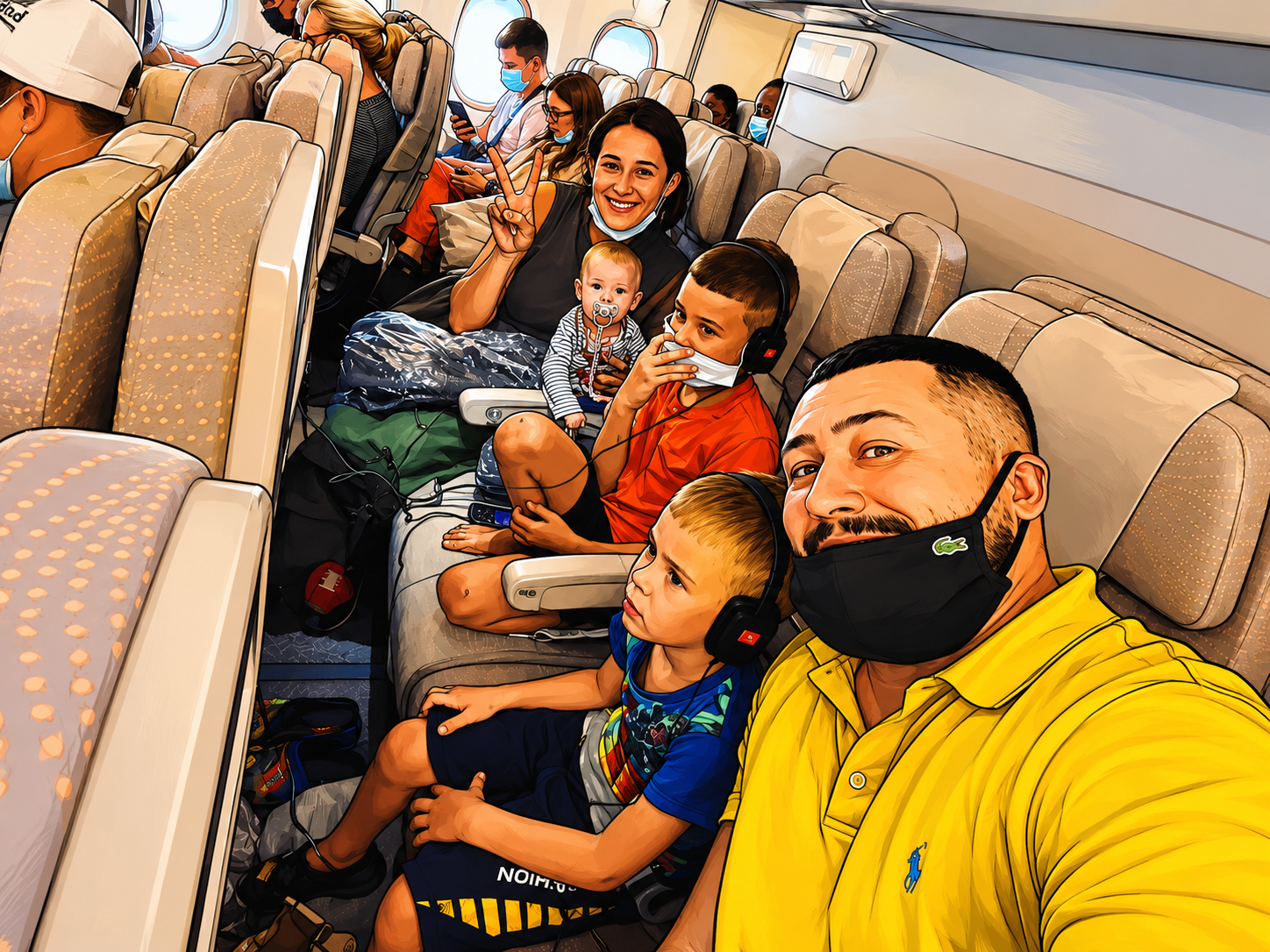
Nobody handed us anything. The border officer looked into our passports, the great glass jaws of the airport parted, and the city let us out — into the July heat-tar, where air is not so much breathed in as put on, damp invisible clothing pulled over the body. My glasses fogged, the children immediately wanted water, the suitcase veered off to one side, taxi drivers scooped up the arrivals and distributed them among the glowing cells of the city, and we stood there, our small expedition, in the middle of the automotive roar, not yet understanding that we had landed in the country of the eternal Cooling Season, where a human being exists only as long as the compressors keep turning, the arteries of cold keep running through the walls, and somewhere in an engineering basement a nameless mechanic labours who could, with a single turn of a rusty valve, separate civilisation from the oven.
The stamp in the passport
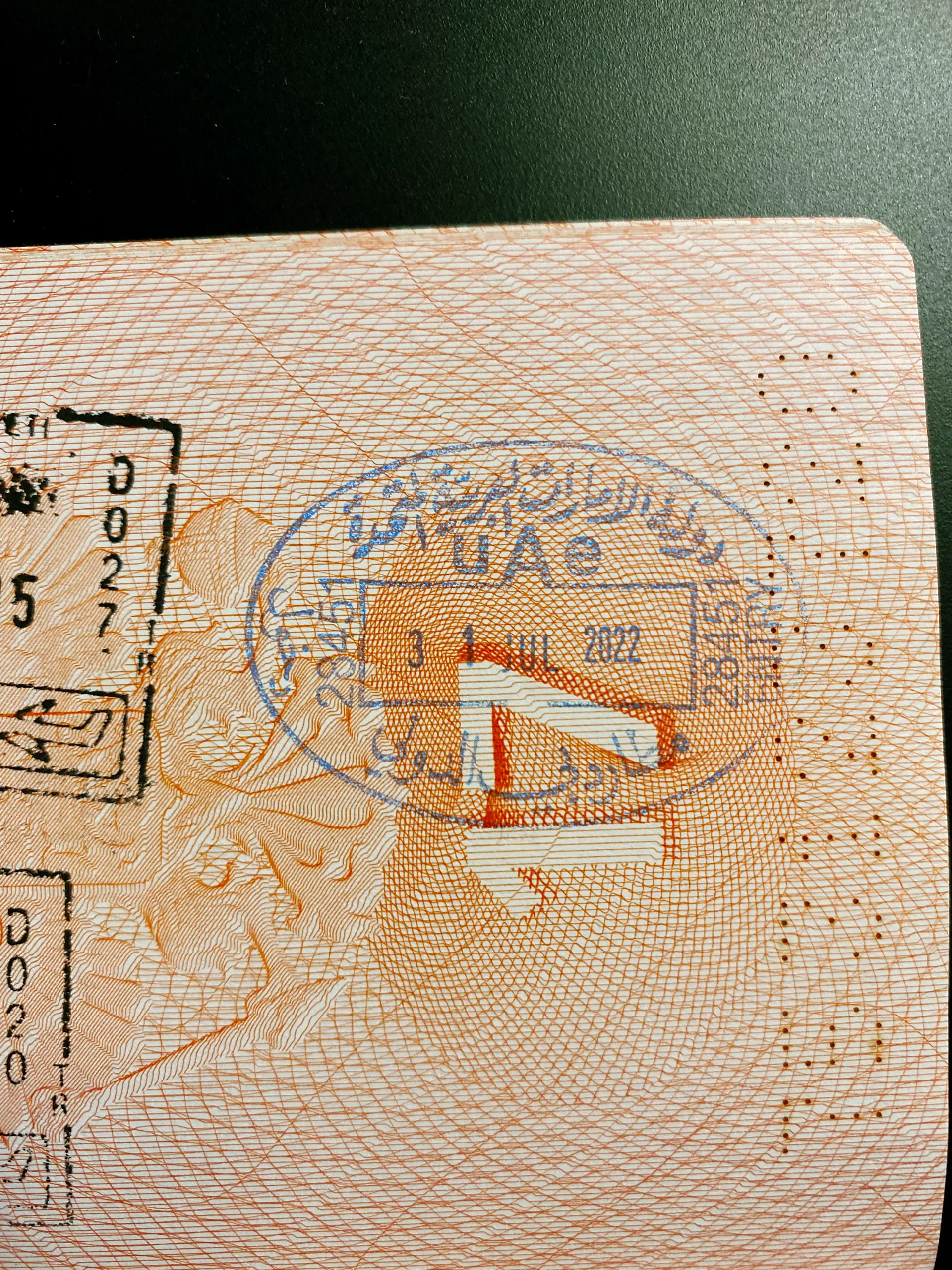
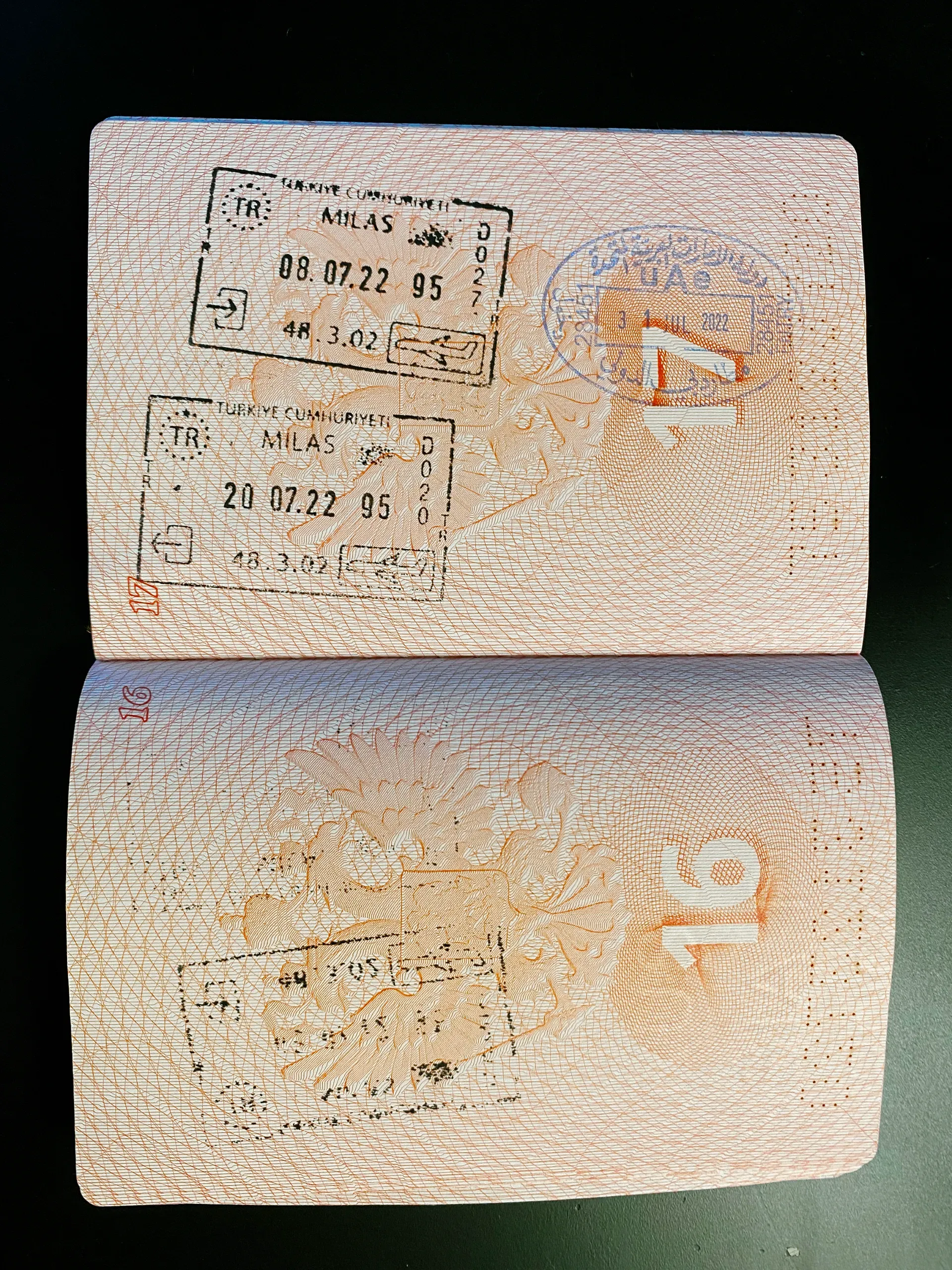
That was the moment the escalator did not stop. It only seemed as if we had stepped off the metal tread, collected our suitcases and carried on under our own power. In fact the mechanism kept moving beneath our feet, hauling us soundlessly through the first apartments, the visas, the schools, the medical insurance, the banking apps and the motorway interchanges laid out across the desert in the pattern of copper microcircuits. We held on to the handrail, sometimes swapped places, sometimes lost our balance, but we kept riding somewhere down and forward, into the lit hall of the next life, while the floors of the previous one closed over our heads.
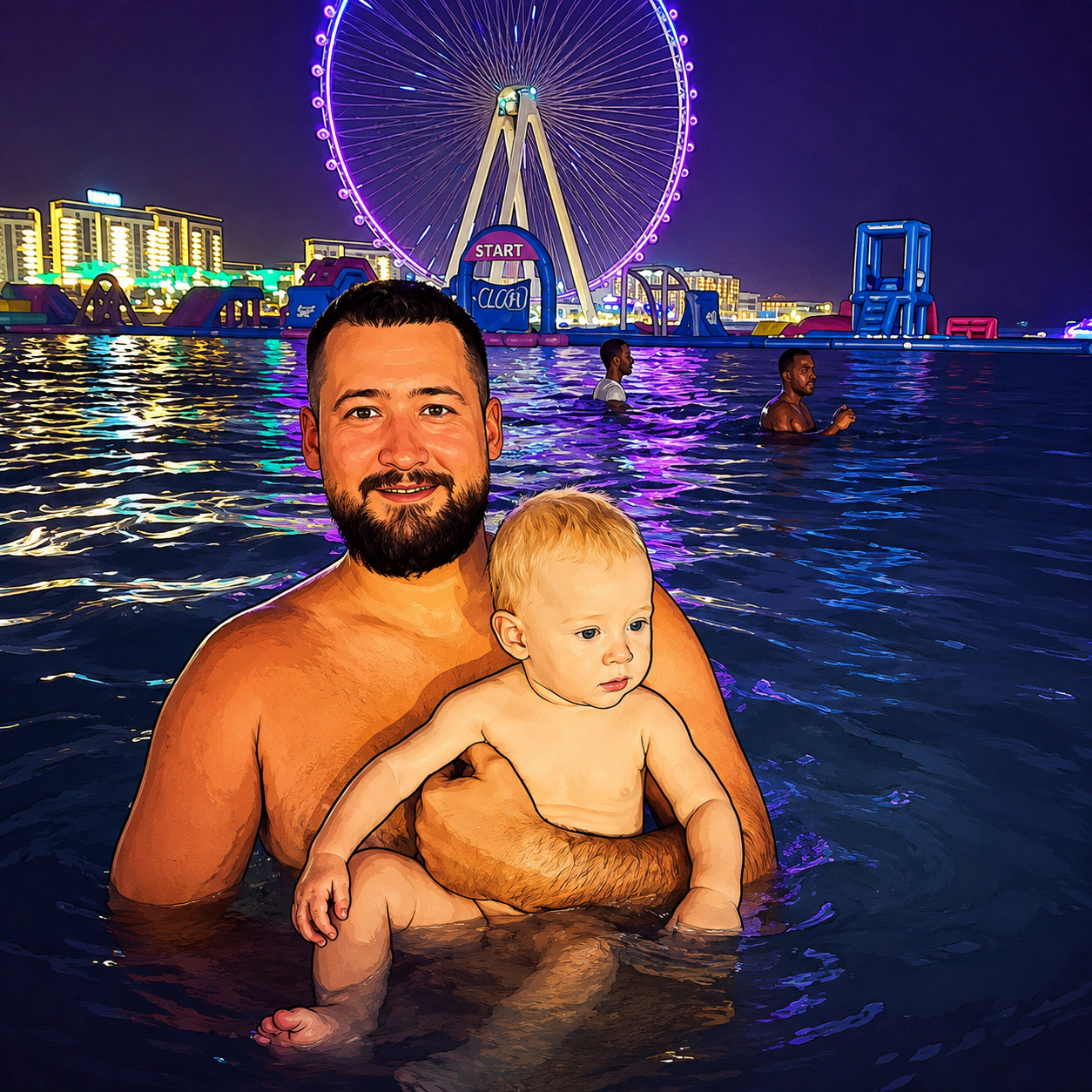
Dubai, on the whole, resembles an enormous digital product pushed into production before the testing was finished. Everything here is beautiful, fast and modern, but behind each shining button lurks a small official of the invisible world, demanding that you upload a document, confirm your face, re-enter the number, contact support, wait for a call and, without fail, update the app that had been working perfectly only yesterday. The city asked us daily who we were, where we lived, on what grounds, whether our card was still valid and whether we agreed to the new terms; we confirmed, signed, attached, paid, and gradually stopped being the people whose documents had once been checked at the airport.
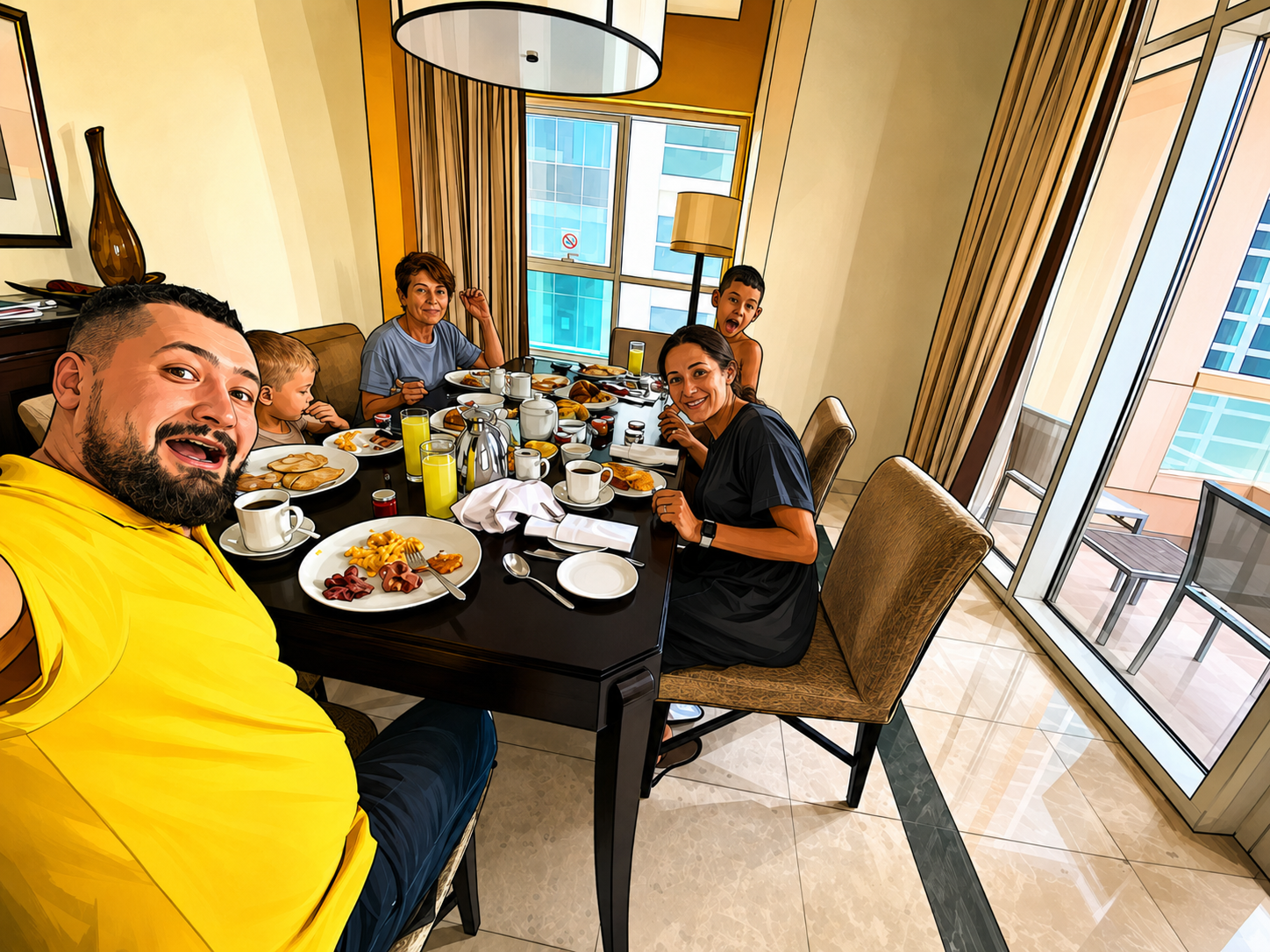
Glass People
I arrived as a designer — that is, as a man professionally convinced that the world can be repaired by the correct arrangement of elements. If a person doesn't understand something, the research was insufficient. If he makes a mistake, the path was badly built. If the system has collapsed, you show a calm message, apologise and offer to try again. Even a catastrophe, inside a good interface, has tidy padding, an icon with an exclamation mark and a button that takes you back to the home screen.
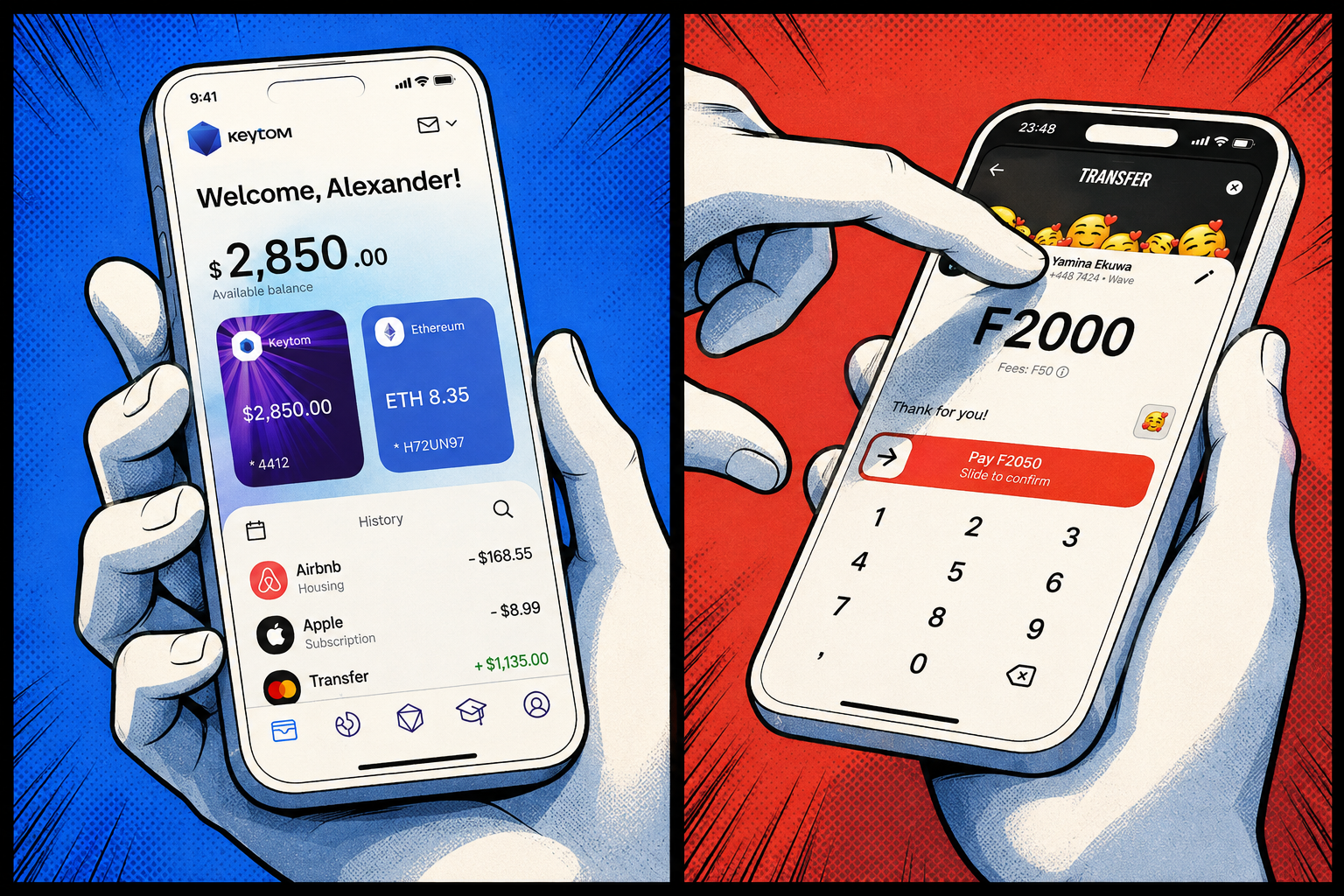
At the Keeta neobank we were building a financial creature not yet born, with currency ventricles, transfer vessels, little card paws and a digital heart that was to beat here, in Dubai, drawing money in from various countries and releasing it again, cleansed of distance. I drew accounts, wallets, exchanges and international transfers, laying out smooth financial corridors along which a person was meant to carry his wellbeing without a single scratch, while our own wellbeing drained away — at a speed astonishing to any designer — into schools, housing, insurance, cars, food, and coffee whose price could serve as a standalone index of Dubai inflation.
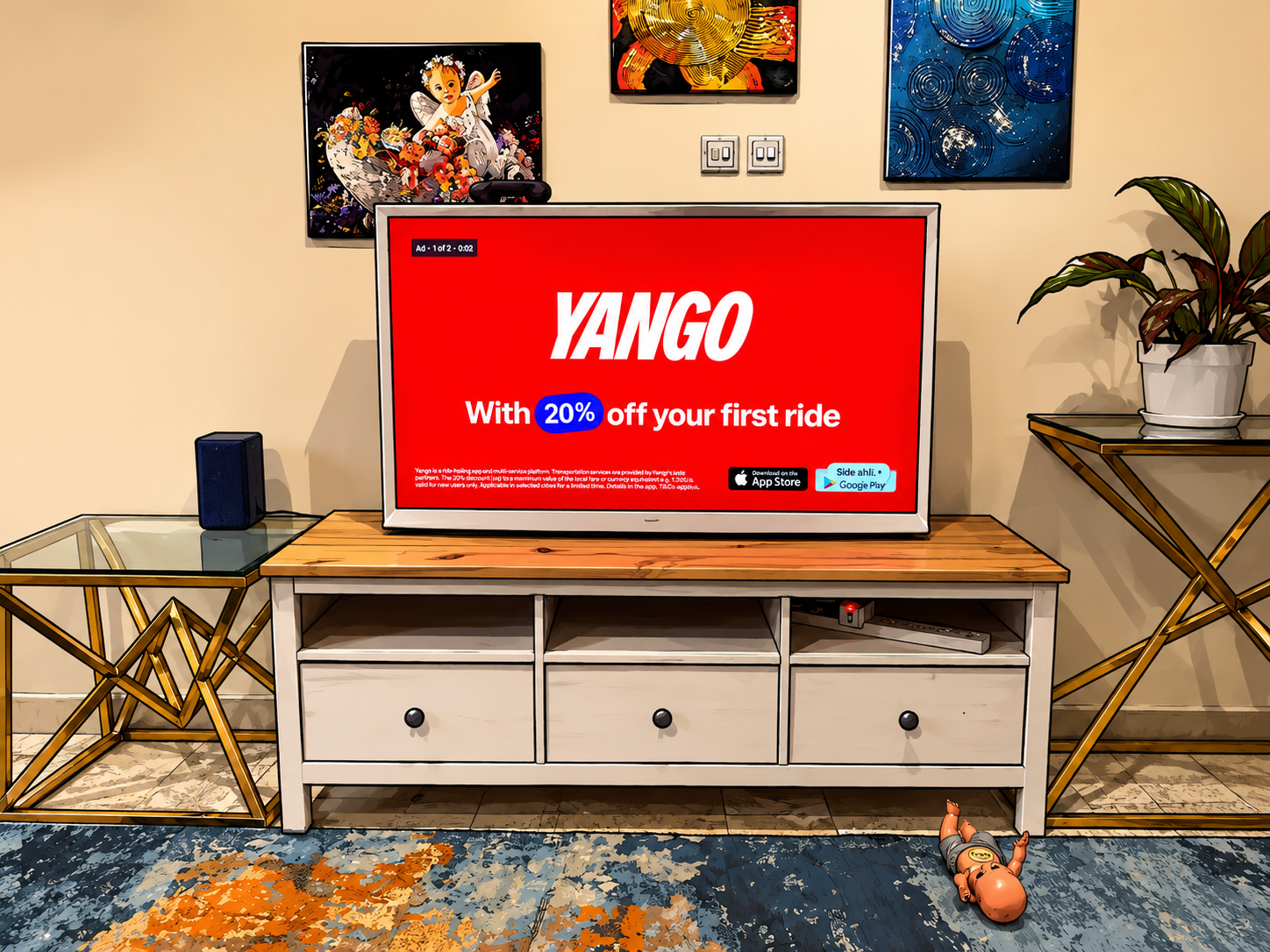
Then along came Yango — the very same Yandex, only in Dubai — and its payment app for the African markets. On my screens people opened wallets, sent each other money, confirmed operations, received error messages and returned to the home screen; we drew happy paths for them, as though marking out safe trails in white paint across an enormous digital continent. In life there were no happy paths. A project could close, a team could change, a budget could float off, a person could vanish from the calendar, and the system displayed no “something went wrong” message, because the system was life itself, and support, by all appearances, had not been provided for.
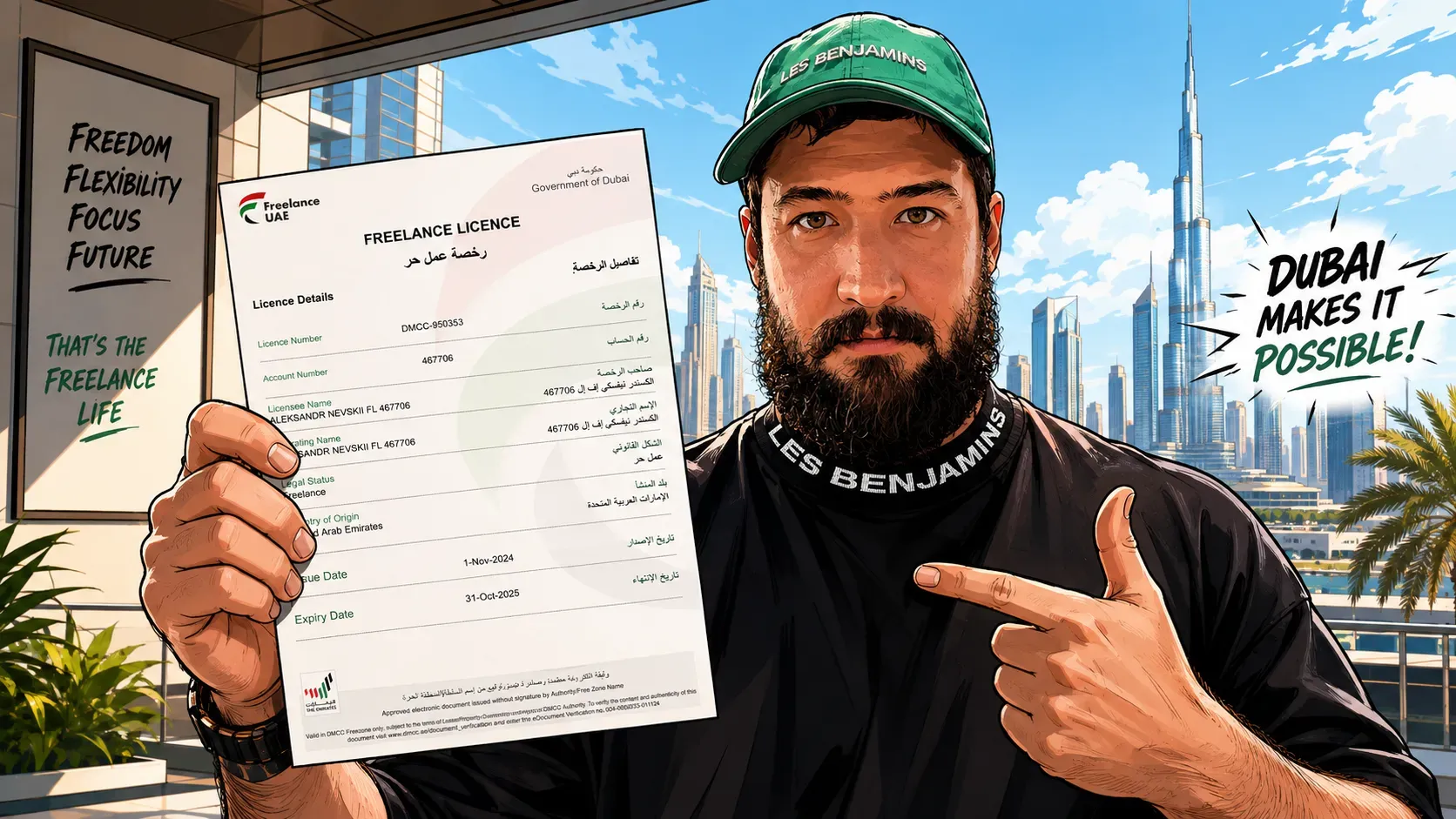
I got my own work visa in DMCC — the plastic seal of a free digital craftsman — and became a company of one man: my own director, designer, salesman, accountant, contractor, HR department and employee, the last of whom was at times deeply dissatisfied with management decisions. In the morning I worked with Dubai, in the afternoon with Europe, at night with America; screens glowed, cursors blinked, clients wrote “Magnificent” and a few minutes later sent through a list of thirty-two clarifications, and I moved pixels around, assembled sites, apps, brands and products, trying not to notice that beyond the window the children were growing older faster than the mockups were gaining new versions.
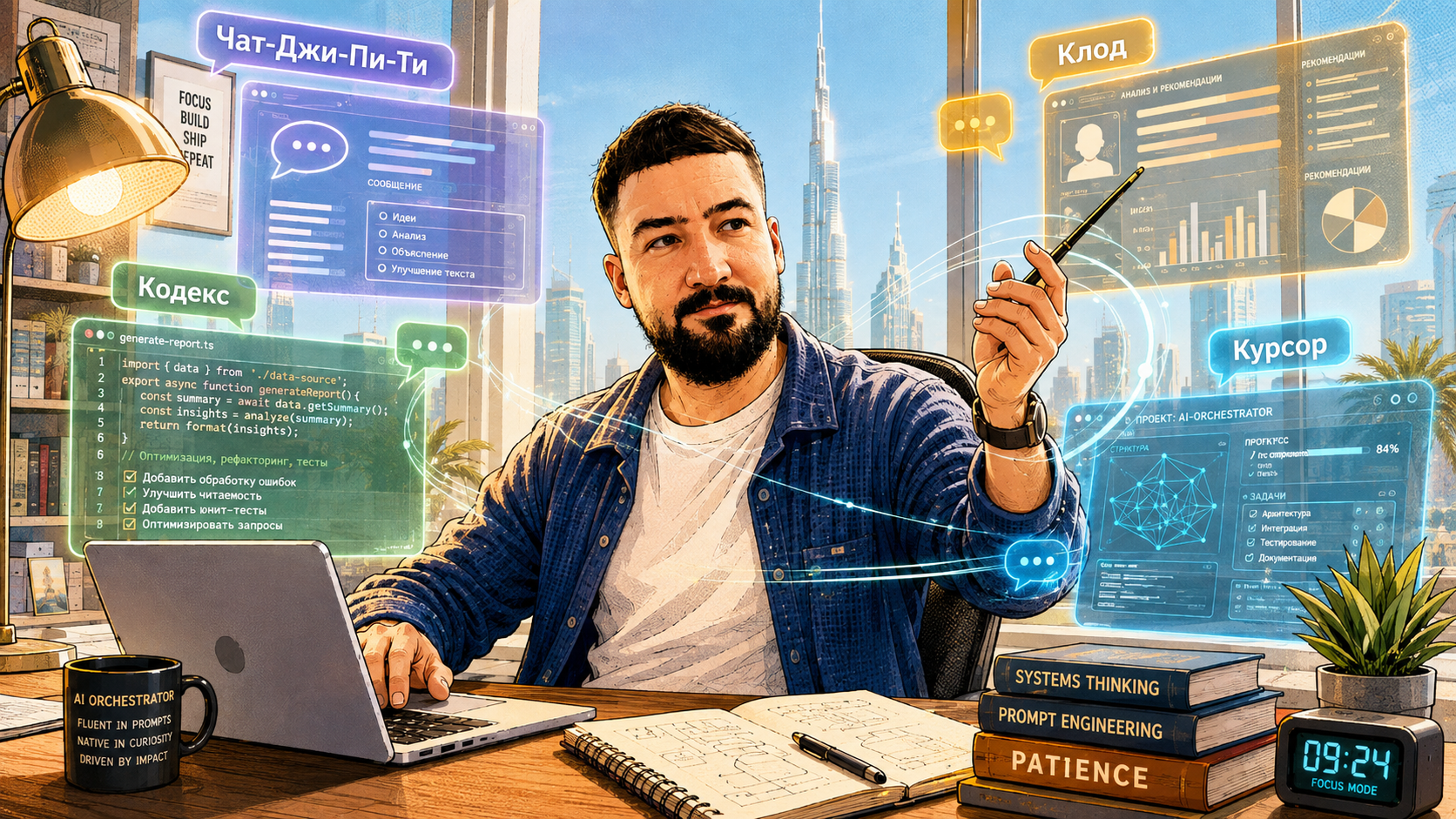
Then the machines arrived. Not the heavy mechanical creatures that carry people along Sheikh Zayed Road, but bodiless interlocutors, forever awake: ChatGPT, Codex, Claude, Cursor and the rest of that electronic guild, which knows neither Sunday, nor fatigue, nor resentment towards a client. I became an orchestrator of artificial intelligence — a luxurious title, musical, almost conductorly, though from the outside the orchestration often looked like this: one exhausted man sitting in front of several tireless minds, explaining to them for the tenth time that “almost right” still means wrong.
I brought the machines a vague intention, scraps of text, structures, images, code and my own impatience; they multiplied the variants, built, rewrote, proposed solutions and handed my thoughts back to me already cleansed of human sweat. Sometimes I could not tell who the author here really was: me, who had given the direction, or the machine, which had laid the road; where my intention ends and its probabilistic sorcery begins; whether I am not myself a temporary interface, through which old books, childhood memories, systems of digital design, conversations with my father and the night-time flicker of server fields assemble into yet another version of a text.
But then Ira's voice would come from the other room, one of the children would be hunting for a charger, water, a uniform, a tablet or justice, and Bekki would scrape at the door with a short paw, demanding immediate access to the material world. And everything became clear again: here is the body, here is the house, here is the pack, here is the duty. A machine can write a thousand lines, but walking the dog still falls to a human being.
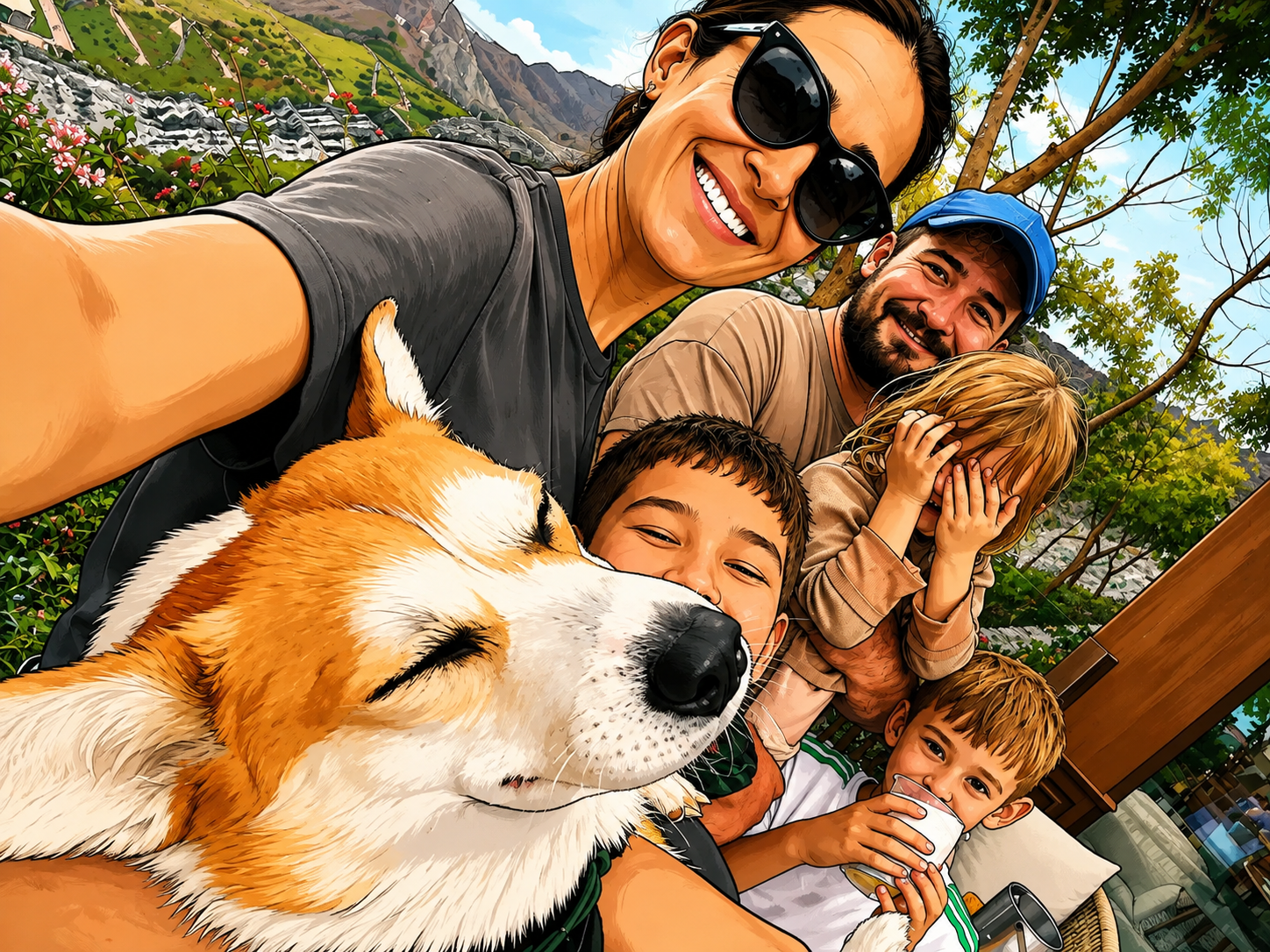
Ira, in the meantime, held our entire Dubai construction the way one holds, in a strong hand, a ring of keys to a great many unconnected rooms. She remembered the dates, the letters, the documents, the school payments, the medical records, the promises, the phone numbers and the exact location of an object officially declared by the rest of the family to have vanished forever. While I changed professions, built products, orchestrated machines and came home with yet another idea for the complete reorganisation of existence, she preserved the continuity of the world — that invisible labour without which people wake up one day surrounded by beautiful projects but with no valid insurance, no paid school fees and no notion of where to take the children tomorrow.
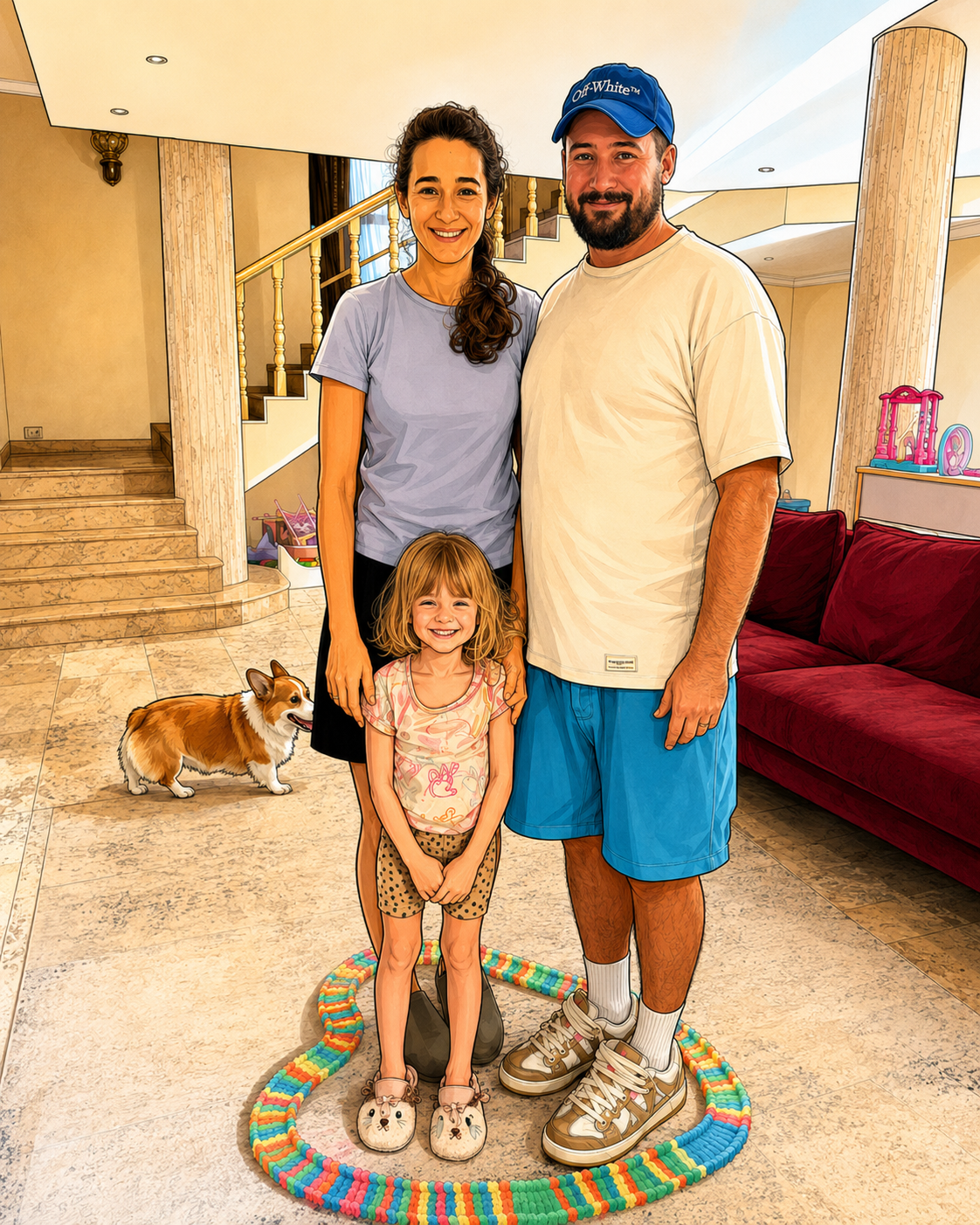
The greater part of our life settled into the villa in Umm Suqeim. At first the house stood empty and foreign, and then it drew us into itself: beds, tables, toys, bicycles, dishes, cables, documents, school backpacks and clothing in every intermediate childhood size. On the staircase a special temporary depot came into being for things intended to be carried upstairs; little by little they lost their itinerary, acquired citizenship and stayed on to live on the steps. Geological strata of past seasons bedded down in the wardrobes, building sets and pencils multiplied in the rooms, and across the floor ran the ginger magnetic field lines of Bekki's fur.
Bekki was the eighth and smallest of the litter, a pedigreed Welsh Corgi Pembroke with a passport, a lineage and the inner dignity of a minor Welsh feudal lord. She appeared after Sasha won a Brazilian jiu-jitsu tournament and, instead of a game console, demanded a dog, having prepared his evidence base well in advance: he drew dogs, spoke about dogs and populated his own house in Minecraft with them. We surrendered before the consistency of the concept. Bekki entered the villa, inspected the corners, ate something forbidden, lay down in the middle of the hallway and from that day became the quiet ginger centre of the family's gravity, a creature with no need to improve itself, change profession, develop a personal brand or search for its purpose. She simply was — and in that she occasionally surpassed all of us.
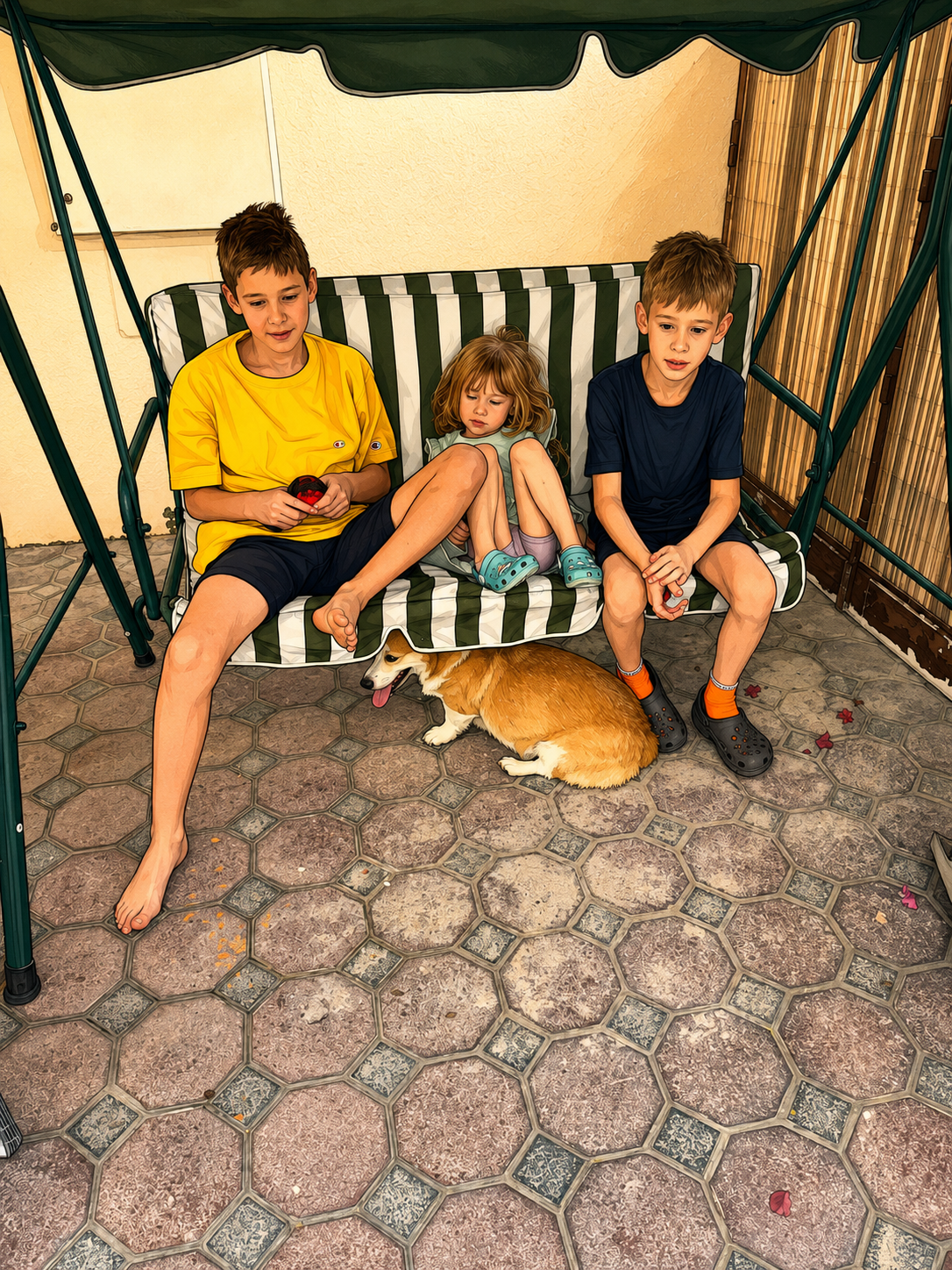
The children weren't doing any relocating either. We, the adults, relocated; they simply grew up inside a new environment. For them Dubai stopped being emigration and became childhood: school corridors, English speech, the sea, the heat, the cold of the air conditioners, wide roads and the natural certainty that any object can be ordered and that shortly a man on a motorcycle will materialise at the door with the necessary thing. Dasha arrived small, passed through her lovely kindergarten world of Forest Oasis and now studies at Raffles World Academy alongside her brothers; the school became our family's heavenly body, around which orbited cars, timetables, water bottles, PE kits, messages from teachers and the hope of one day transferring the boys onto the yellow bus, thereby liberating several earthly hours of parental time.
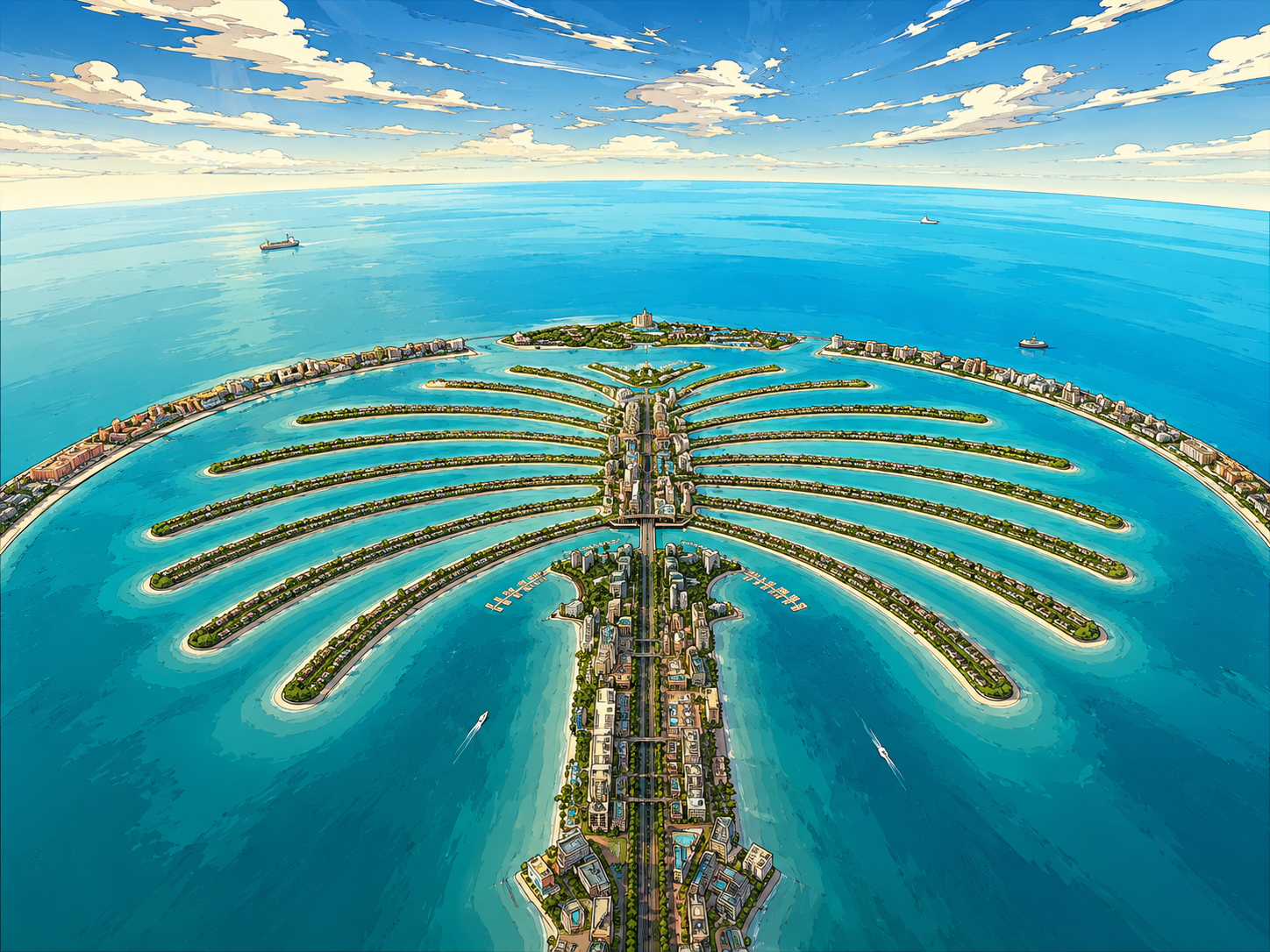
The Palm as a Human Palm
What led me into real estate was exhaustion with the bodiless. For too long I had designed things you cannot touch — bank accounts, digital wallets, user journeys, cloud products, artificial intelligence assistants — and one day I wanted to deal with a wall that either stands or does not; with a window from which you either see the sea or see the neighbour's balcony; with a drive to school that no amount of replanning can shorten, because between a child and a classroom lie thoroughly material kilometres of morning traffic.
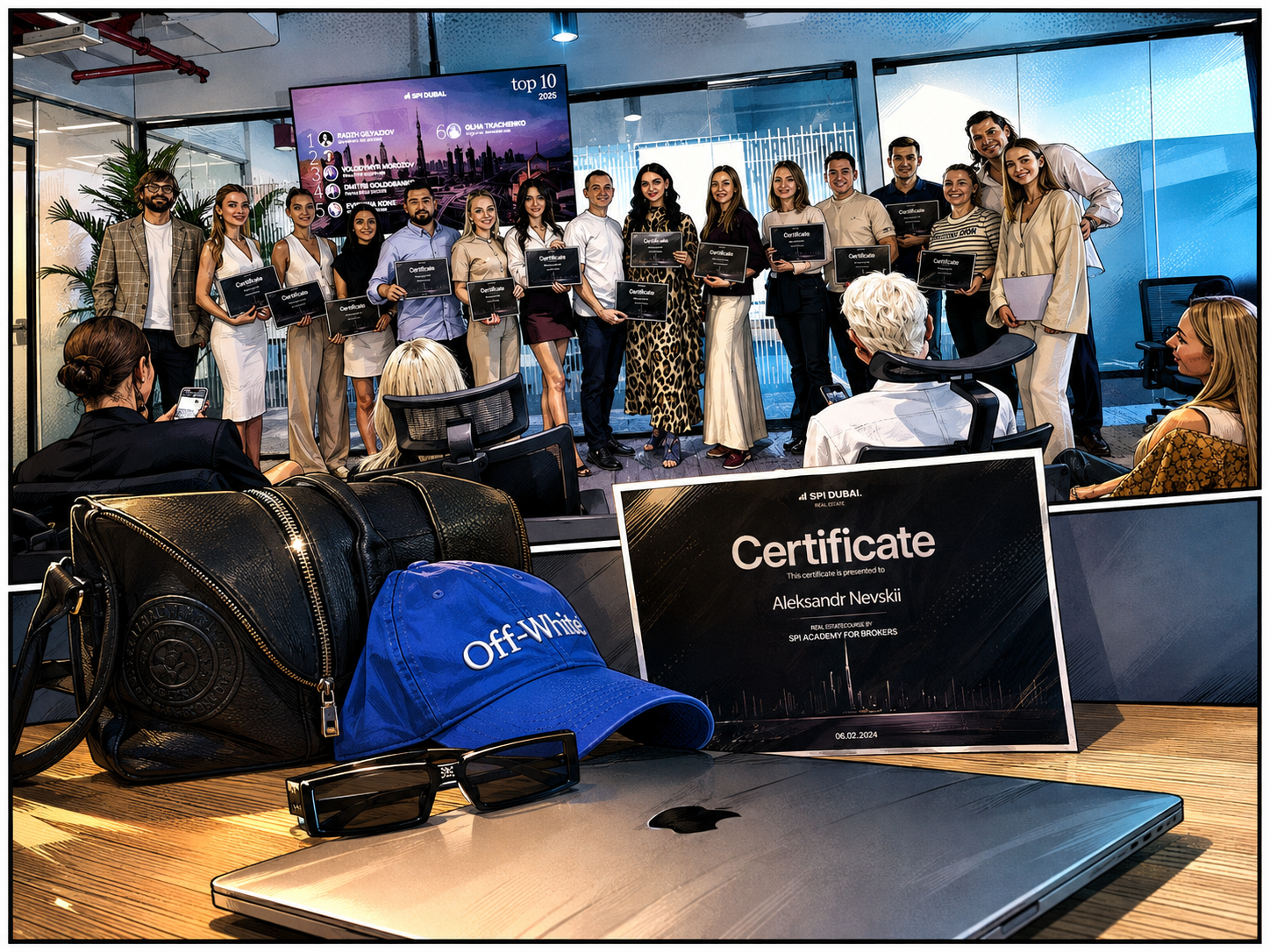
I trained as a broker at SPI and walked out into the city armed with a phone, a knowledge of square feet and the old designer's faith that a person can be understood through his behaviour. It emerged at once that the brokerage market is populated by strange creatures: owners who sell but will not show; owners who show but will not sell; buyers who want the sea, a yield, a large floor area and a price for which the sea is prepared to offer, at best, its reflection in the polished door of a lift. Properties existed in several states at once, like quantum apartments: vacant and occupied, available and already sold, with a final price and with a price the owner might, perhaps, still agree to discuss.
After SPI came Wonderdom, a small boutique agency where I studied neighbourhoods, villas, projects and myself in a new role, still not entirely certain whether brokerage was merely another temporary screen on the endless escalator. Then the road brought me to Nevsky Realty, and here the city dealt with me without any metaphorical delicacy at all: it hung my surname above the door and seemed to say — enough, designer, stop looking for secret signs, here's a sign, in large letters, park.
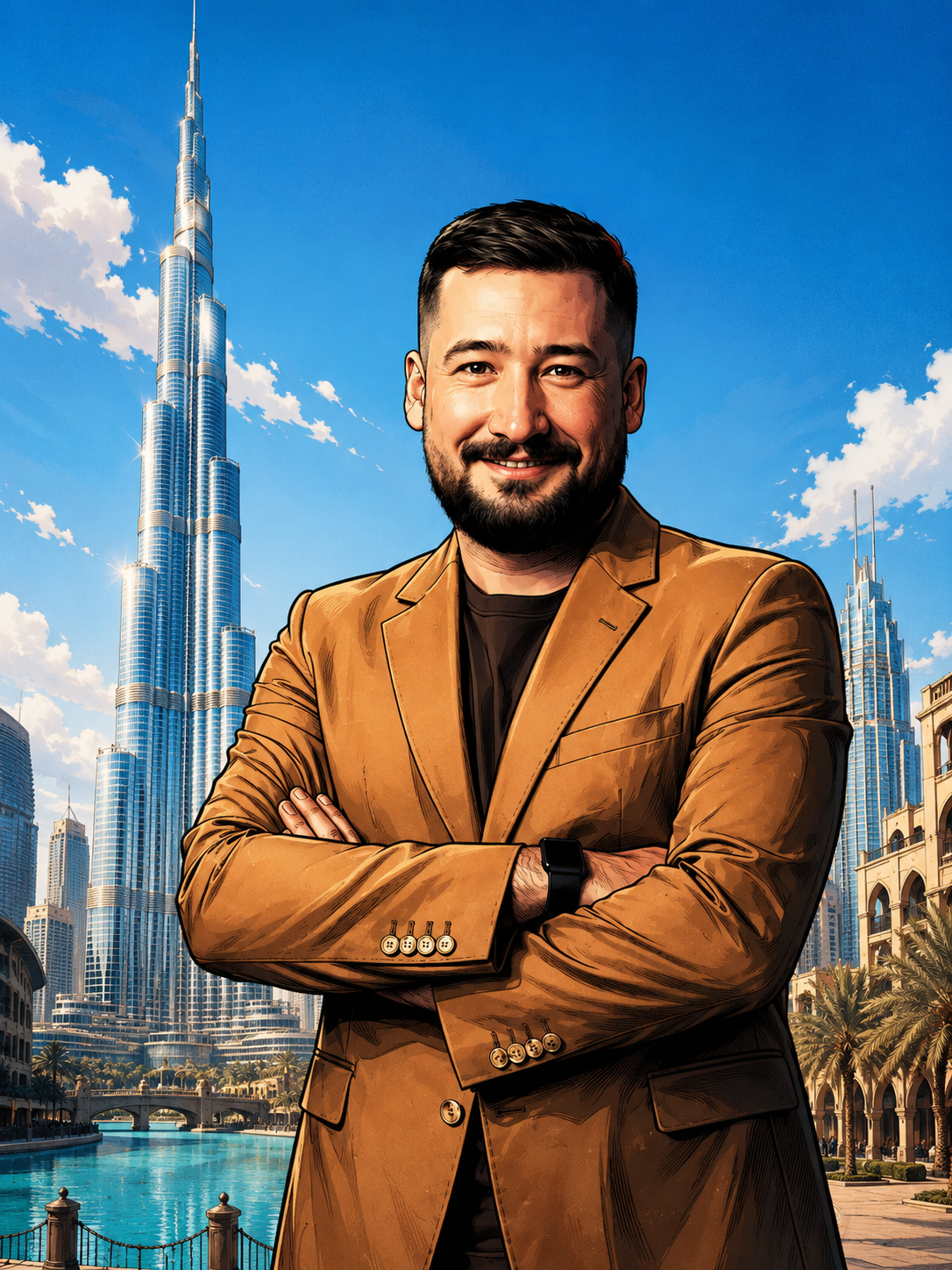
I don't know whether the final home has been found here — final homes, professions and versions of a person, it seems, do not exist. But for the first time my former guises have stopped arguing among themselves. The designer from the Keeta neobank, the man from Yango, the free craftsman with the DMCC visa, the orchestrator of artificial intelligence, the student at SPI and the broker from Wonderdom all gathered in one room and discovered that they had been doing very nearly the same thing the entire time: trying to understand how a human life is arranged, and where one ought to place the button, the door, the school, the window or the house so that a person's days become a little easier.
A family, after all, does not buy square feet — it buys a piece of future time. Morning light in the kitchen, fifteen minutes on the road to school, a place for the bicycle, a quiet wall in the children's room, a supermarket nearby, a walk beside the water and the possibility of coming home in the evening not entirely wrung out. An apartment is a heavy material interface to fate, and its errors are not corrected by the next update. That is why I want to be a family broker: not a man forwarding identical presentations, but a guide for those who will also one day be let out of an airport into the scorching unknown, and who do not yet know that behind the words “choose a neighbourhood” hides the choice of the rhythm of all the life that follows.
A few days before our fourth anniversary we left the villa in Umm Suqeim and moved to Palm Jumeirah. Two large trucks took on the furniture, the beds, the boxes, the bicycles, the children's things and the family remains of former intentions, but the house kept issuing property, and we had to send for a small pickup as well. Thus the legend of our minimalism finally perished. The movers wrapped the furniture, and of the children only Dasha was there: she walked among the boxes, watched the familiar house disappear and from time to time demanded an object already buried in the depths of the packing. Bekki supervised the operation with the short-legged self-importance of a resettlement officer, while the emptying villa slowly shed our years and became foreign again.
Palm Jumeirah turned from a picture seen from an aeroplane into an address. We settled not on one of its fronds fanning out into the sea, but on the central trunk — where the monorail runs above the road, threading stations, hotels and human movements onto its narrow iron filament. We found ourselves on a giant municipal palm, extended into the Persian Gulf either in greeting or for a reading of the lines of human fate. Again we connected electricity, water, cooling, internet and gas, again we assembled beds and shifted tables, again we tried to determine each creature's place. Beyond the windows the sea stirred, the neighbours crossed the courtyard, Bekki explored the new land, and I sat among the boxes, the glowing screens and the fragments of my previous life when the phone suddenly showed me that very photograph.
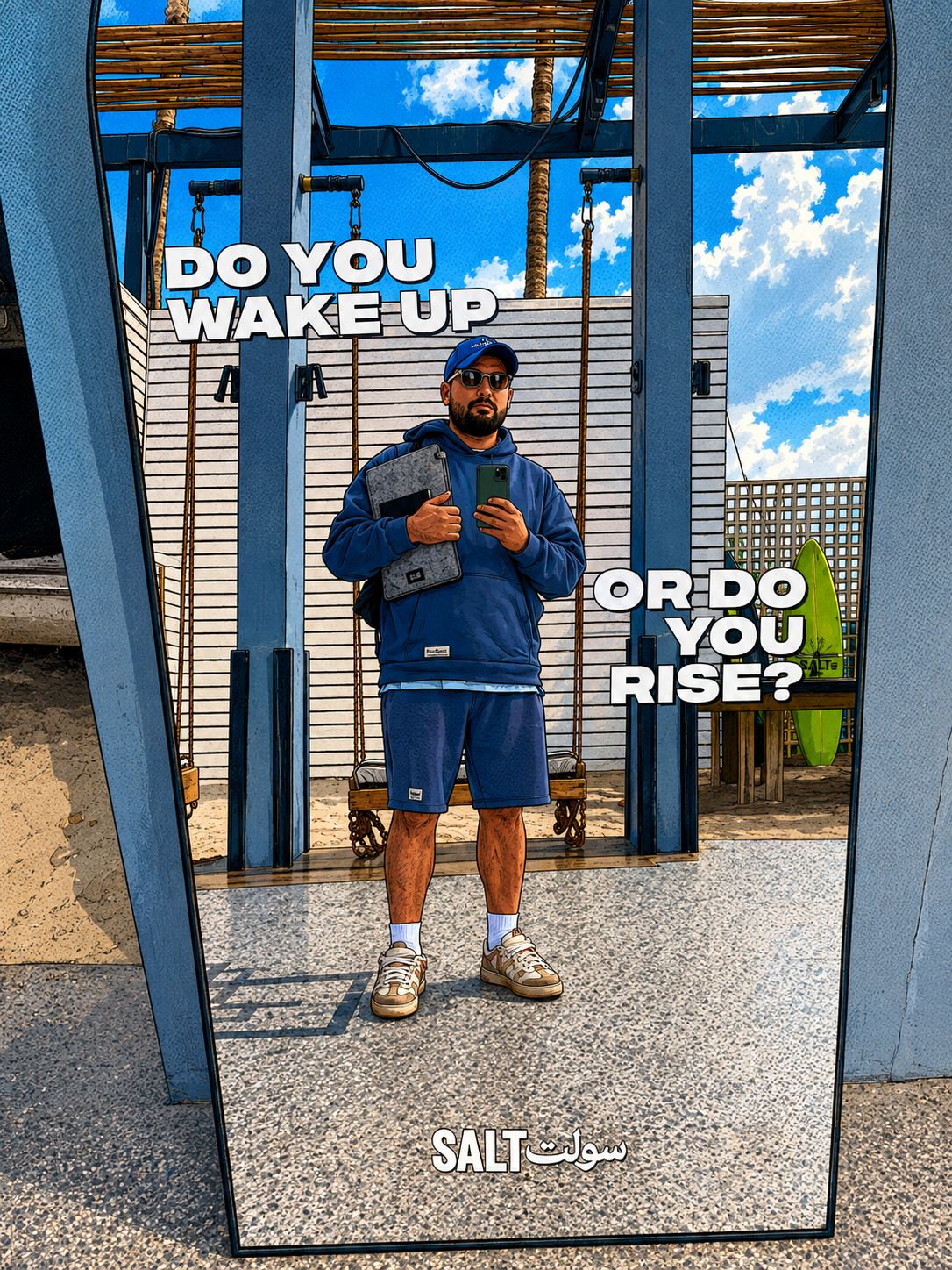
And then I understood: the escalator really had not stopped. All these four years we had gone on standing on its silver treads. The Keeta neobank, Yango, DMCC, SPI, Wonderdom, Nevsky Realty, the villa, the Palm — these were not separate lives but the passing floors of one enormous terminal, where a person never receives his final baggage, because part of it is permanently getting lost, part of it is being found, and several of the suitcases are already being carried by the children.
I look at our former selves almost with tenderness. Ira out in front, the children holding the handrail, me hiding behind the camera and joking as though everything that was coming could be defused with three laughing faces. We do not yet know how much work, fear, money, schools, dogs, apps, moves and attempts to start over there will be. We do not know that the city will take our old ideas apart, grind them in its sandy processor and reassemble the family in a different configuration — heavier, noisier, more tired, and yet somehow still together.
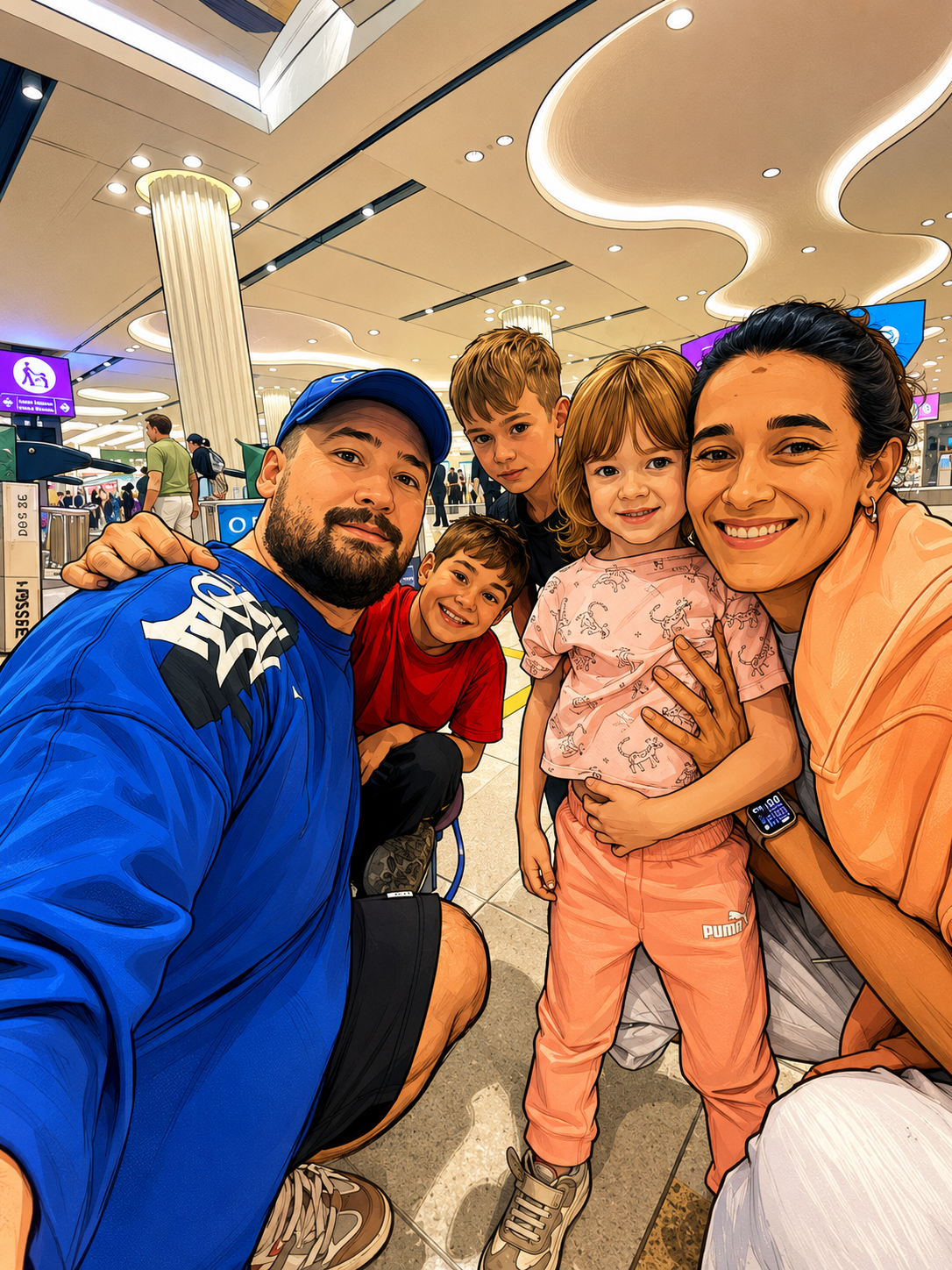
Perhaps that is what my real work actually consists of — not design, not artificial intelligence, not real estate and not even the endless designing of the next version of myself. You simply have to hold the handrail, catch the ones beside you now and then, make sure nobody falls behind, pay the bills, buy the groceries, show the houses, talk to the machines, drive the children to school, walk the dog and keep moving. Because the moment you let go of everything at once, a small imperceptible crack opens in the vast system of the city, and into it begin to drain time, memory, children's voices, our shared mornings and the very reason we once resolved to step down.
Four years ago I wrote: “We've landed in Dubai, they even let us out.”
Now I think: they let us out of rather more than the airport. They let us out of our former houses, professions, fears and definitions of ourselves that had grown too tight. As for where exactly they let us out to — that they still haven't announced.
The escalator is moving. Ira and the children are ahead. I am holding the phone, the handrail and this whole ungainly, expensive, living construction, for as long as my arms hold out.
Well then, on we go.