
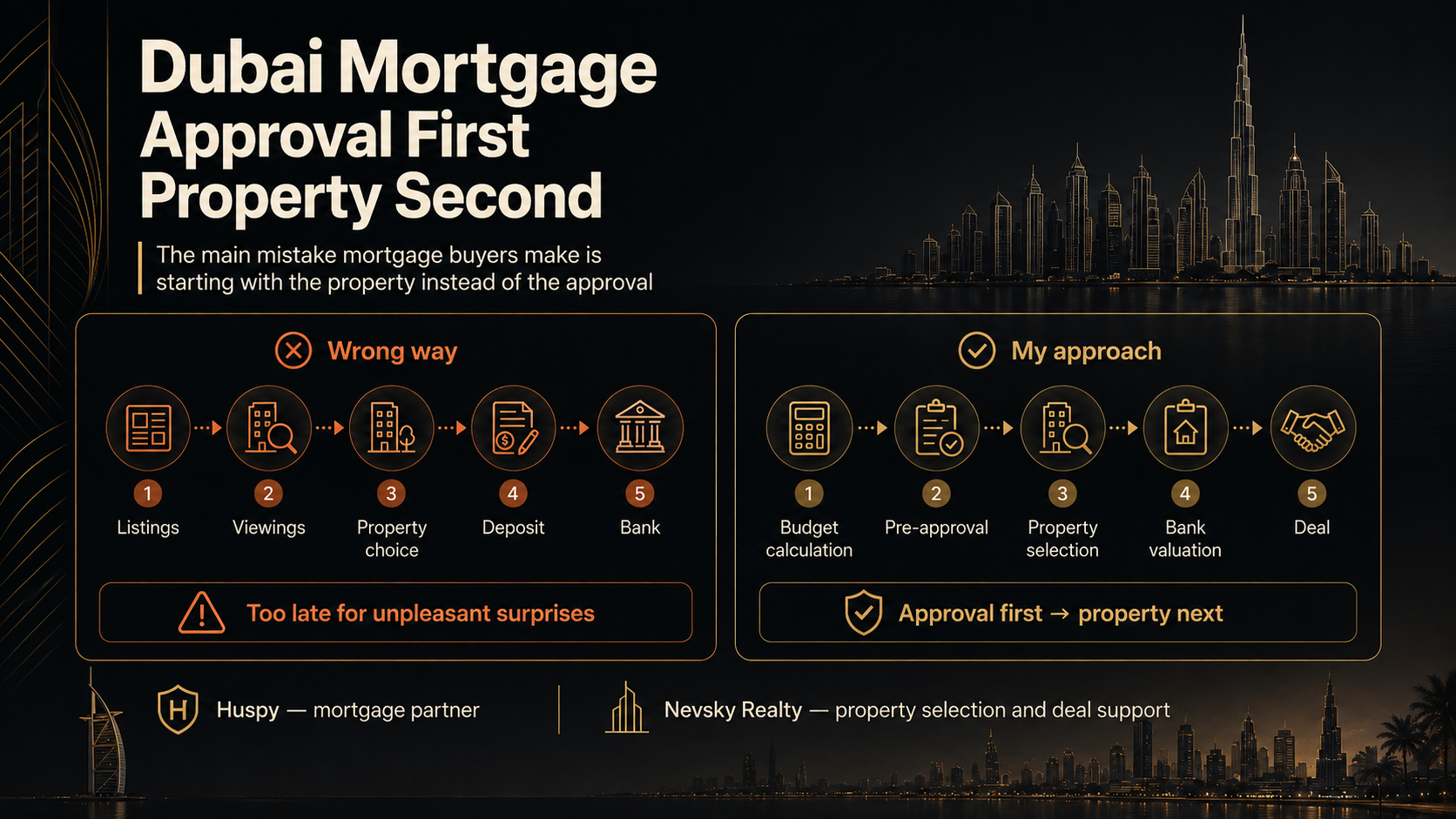
Most buyers start their Dubai property search the same way: open Property Finder or Bayut, save listings they like, compare areas and go on viewings. Eventually they find the right apartment, start negotiating price, prepare the deposit — and only then apply for a mortgage.
In my view, that's the wrong order. If the purchase depends on bank finance, you shouldn't start with the apartment. You start by understanding what you can actually afford. First we establish how much the bank can lend, how much equity you'll need and what monthly payment sits comfortably within your budget. Only then do I start shortlisting property.
I'm a broker at Nevsky Realty, and we handle the mortgage side together with Huspy. The client doesn't have to navigate banks separately, find a mortgage adviser and then try to connect the finance to the property they've already picked.
Why Get Mortgage Pre-Approval
Mortgage pre-approval means the bank has reviewed your financial profile and confirmed it's willing to consider a home loan within a defined range. It's not the final loan disbursement — once you've chosen a property, the bank still needs to assess and value that specific unit separately.
But pre-approval gives you what matters most: a real financial framework. You know your budget upfront, what down payment you'll need and what monthly instalment to plan for.
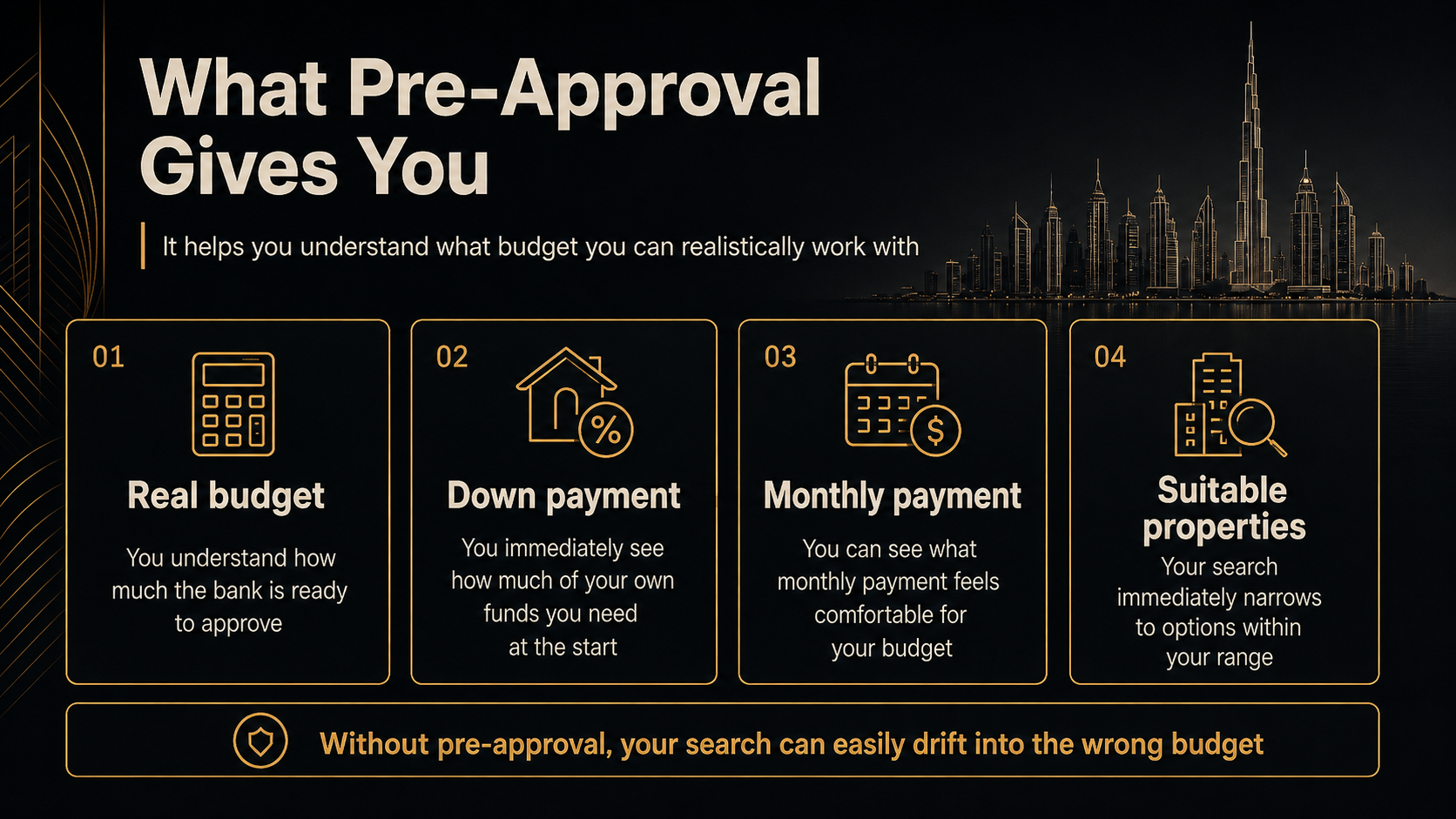
Without this, you can spend weeks viewing AED 3M properties only to learn the bank will finance up to AED 2.3M. Then you're either scrambling to increase your down payment or starting the search from scratch.
That's why I don't see the point in sending a client to dozens of viewings when it's still unclear what purchase they can actually finance.
What the Bank Checks
The bank doesn't just look at salary size. It reviews your full financial picture: income stability, length of employment, employer or business, existing loans, credit cards and payment history.
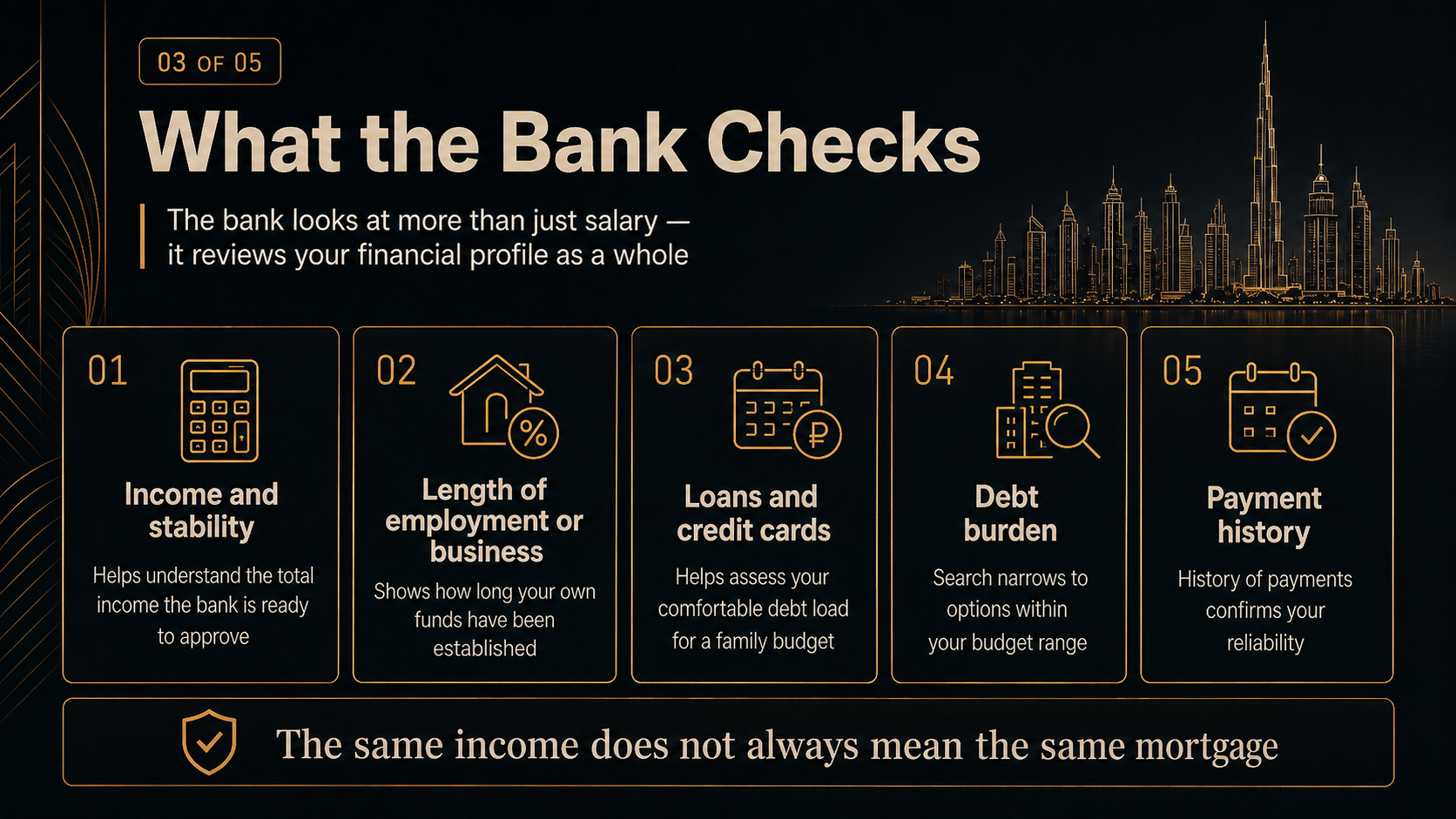
Credit card limits are factored in separately. Even if you don't use the full limit, the limit itself can affect your debt-burden calculation. The bank also considers car loans, personal loans, other mortgages and regular commitments.
For salaried employees, salary, tenure and salary credits matter. For business owners, the bank typically reviews company age, turnover, corporate bank statements and financial statements.
That's why two people with the same monthly income can receive very different offers.
What Mortgage Products Are Available
Mortgage products differ on more than interest rate alone. When comparing offers, you need to look at the fixed-rate period, bank margin, loan term, fees and early settlement terms.
Fixed Rate
With this product, the interest rate is fixed for a set period — often several years. That lets you know your monthly payment in advance and shields you from market rate moves during the fixed term.
Once that period ends, the bank usually moves the mortgage onto a different pricing formula. So it's important to look beyond the attractive rate in the early years and understand what happens next.
Variable Rate
A variable rate is typically linked to a benchmark such as three-month EIBOR, plus the bank's margin. Your payment can move with market rates.
This can work in certain market conditions, but you need to understand how your monthly instalment could change.
Mortgage for Residents
UAE residents can usually access a higher loan-to-value ratio and a wider choice of products.
For expats, the down payment on a first property often starts from around 20% of the purchase price, though exact terms depend on the bank, property value and client profile.
Mortgage for Non-Residents
Non-residents can also buy property in Dubai with a mortgage, but requirements are usually stricter. The bank may ask for a larger down payment, additional income proof and bank statements from your country of residence.
In some cases, equity can reach 50% of the property value. That's not a universal rule for all non-residents, so the specific client profile needs to be checked first.
Mortgage for Business Owners
Mortgages are available to business owners and self-employed clients, but the bank will assess not only personal income but also the company. Corporate bank statements, trade licence, shareholder information, tax documents and financial statements are typically required.
Some banks prefer companies operating for at least two years, though options exist for younger businesses. Bank selection matters here — requirements can vary significantly.
How Much Own Capital You'll Need
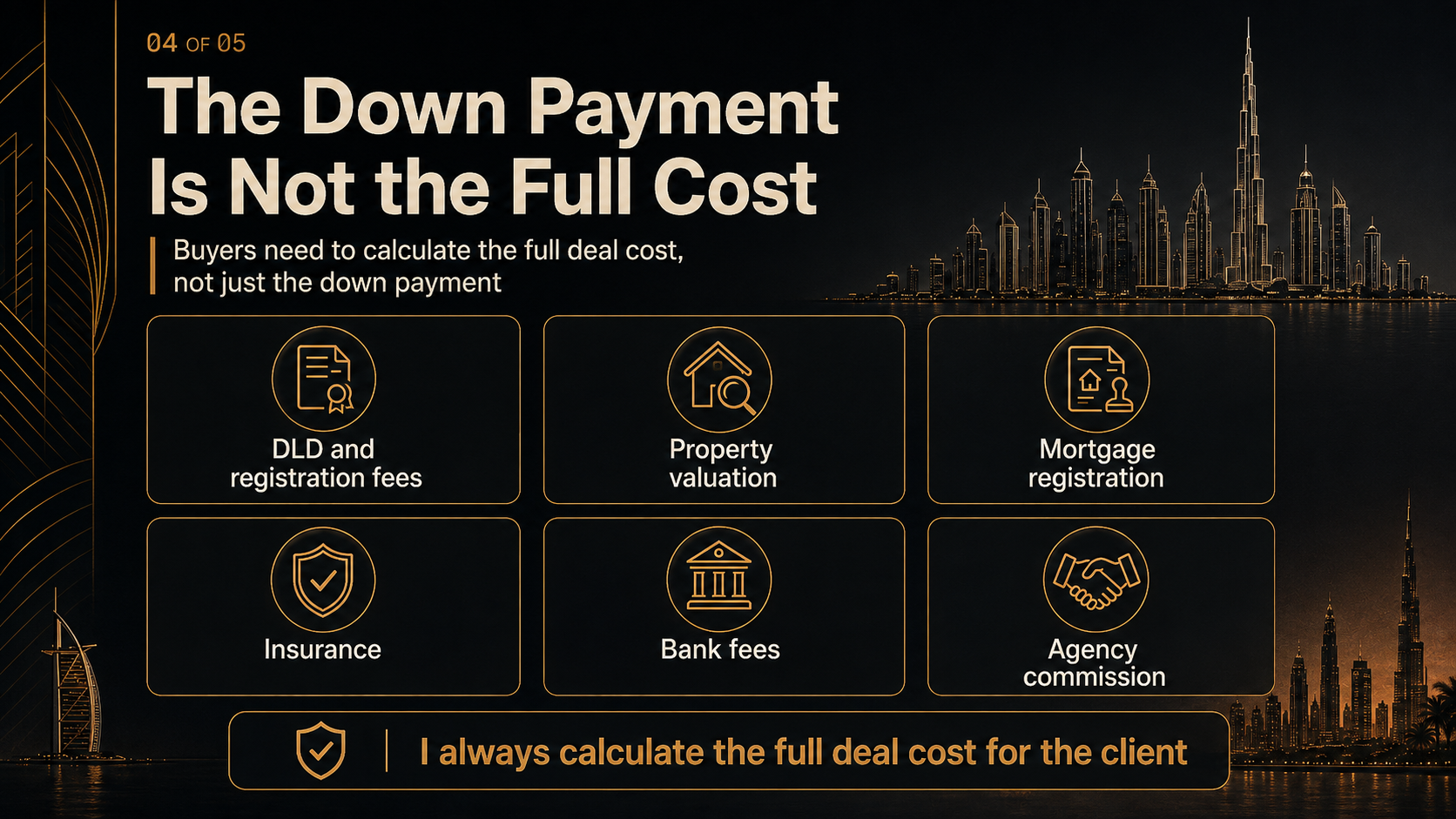
The down payment isn't the only sum you need to prepare. On top of it, buyers should budget for registration fees, agency commission, bank valuation, bank fees, insurance and mortgage registration.
That's why I always calculate not just the minimum down payment but the full cash required to complete the transaction. The buyer should know how much is needed at handover and what buffer remains after purchase.
You also need to factor in valuation risk. For example, the seller agrees to AED 2M, but the bank valuer puts market value at AED 1.85M. The bank will calculate finance based on its own valuation — and the buyer covers the gap.
That's why you can't treat the down payment as a simple percentage of the agreed sale price.
What Documents You'll Need
The exact list depends on the bank and client profile, but a basic pack can usually be prepared in advance.
For Salaried Employees
Typically required:
- passport;
- residence visa;
- Emirates ID;
- salary certificate;
- payslips and bank statements for the last six months.
- The bank may also request credit card statements and proof of address.
Documents should show stable salary credits and a clear spending pattern. Large unexplained transfers or significant income swings can trigger additional questions.
For Business Owners
Beyond personal documents and bank statements, corporate bank statements, trade licence, incorporation documents, VAT records and financial statements are usually required. In some cases the bank asks for audited accounts for recent years.
The sooner the full pack is ready, the faster you can get a bank decision and move to property selection.
For Non-Residents
A non-resident typically needs a passport, proof of address, bank statements and income documents. Salaried employees provide a salary certificate and payslips; business owners provide corporate documents and company statements.
Documents from another country may need additional certification or translation, so it's better to start that process early.
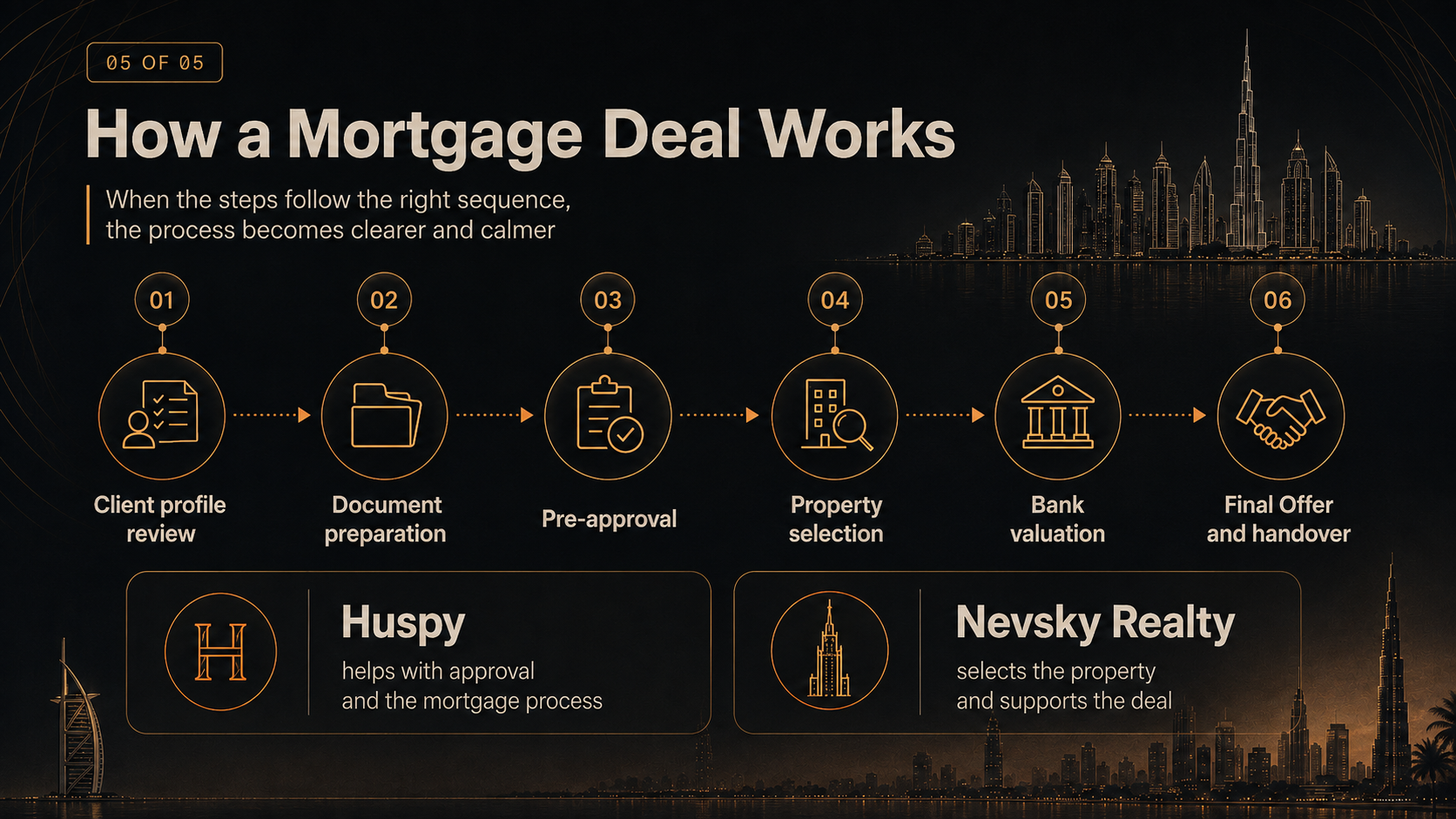
How a Mortgage Transaction Works
The mortgage process has several sequential stages. When they run in the right order, the purchase becomes significantly clearer and calmer.
1. Client Profile Review
We start by discussing budget, income, existing obligations, equity available and the purpose of the purchase. At this stage Huspy assesses basic eligibility and identifies which banks are worth considering.
2. Choosing the Bank Product
Huspy compares available bank offers: rates, fixed periods, fees and client requirements. The goal isn't to find the prettiest advertised rate — it's to match the right product to your situation.
3. Document Preparation
Once the strategy is set, the document pack is assembled. Huspy reviews it before submission to reduce delays and follow-up requests from the bank.
4. Obtaining Pre-Approval
The bank analyses the client's financial profile and issues a preliminary decision. After that, the working purchase budget is clear.
Pre-approval has a limited validity period, so once you have it you can move to active property search.
5. Property Selection
This is where I come in as a Nevsky Realty broker. I shortlist apartments or villas that fit the budget, the client's objective and mortgage transaction requirements.
Selection isn't just about price and photos. We check documents, property status, any existing mortgage on the seller's side, readiness of the unit and potential bank restrictions.
6. Bank Property Valuation
Once a property is agreed, the bank appoints an independent valuer. Their job is to establish market value and confirm the unit is suitable for finance.
If the valuation matches the transaction price or sits within an acceptable range, the process continues. If it's lower, we discuss next steps with the client and seller.
7. Final Bank Offer
After valuation and document checks, the bank issues a Final Offer Letter. It states the loan amount, rate, term, monthly payment and key mortgage conditions.
Review this carefully before signing — especially terms after the fixed period ends and early settlement fees.
8. Property Handover
Once bank requirements are met, handover is scheduled. The bank releases finance, the buyer contributes their equity, and ownership and the mortgage are registered with the Dubai Land Department.
The client then receives the Title Deed and becomes the property owner.
How We Work with Huspy
Each party has a clear remit. Huspy handles the mortgage: profile analysis, bank comparison, document preparation and approval support.
I handle the property and the transaction itself. I define the client's objective, shortlist units, arrange viewings, check market pricing, negotiate with the seller and coordinate the process through to handover.
For the client it feels like one connected process. They don't have to relay information between broker, bank, mortgage adviser, valuer and seller themselves.
Huspy's initial mortgage consultation is free for the client. Bank, registration, valuation and insurance costs remain part of the transaction itself.

Why the Right Sequence Matters More Than Speed
Sometimes a buyer wants to find the apartment first because the mortgage feels like a technical detail that can wait. But that technical detail determines whether the purchase happens at all.
The right sequence is straightforward: first we check mortgage capacity, then obtain pre-approval, then shortlist property, and only then move to transaction.
This approach doesn't remove emotion from the purchase. It simply avoids the situation where someone has chosen their future home, agreed terms with the seller and only then learns the bank sees their budget differently.

Planning to Buy Property in Dubai with a Mortgage?
Message me and tell me what you're looking at, what down payment you have available and what monthly payment you consider comfortable.
Together with Huspy we'll first assess your mortgage options and define a realistic budget. Then I'll shortlist suitable property, negotiate and guide the transaction through Nevsky Realty until you have the keys.
Finance first. Then the right property. Then a transaction without nasty surprises.

If you're interested in a Dubai mortgage and want to discuss your options, message me on Telegram @alexander_nevsky or call/WhatsApp me in Dubai: +971 50 503 1984
Or send me a message at hi@nevsky.ae:


