
The main thing Grok 4.6 is built for is long agentic work: not just writing a function or answering a question, but taking a large goal, finding its way around an unfamiliar project, exploring the codebase, proposing an architecture, making the changes, checking itself, and carrying on across several iterations. Cursor specifically notes that the model has become better at long trajectories, prototyping, and visual interactive projects.
That is why Grok 4.6 interests me less as yet another chatbot, and more as a new working agent inside Cursor.
What the benchmarks show
The most interesting part of the release is Cursor’s comparison table. In it, Grok 4.6 High sits next to Grok 4.5 High, GPT-5.6 Sol Max and Fable 5 Max.
| Benchmark | Grok 4.6 High | Grok 4.5 High | GPT-5.6 Sol Max | Fable 5 Max |
|---|---|---|---|---|
| AA Intelligence Index | 61 | 56 | 61 | 62 |
| GDPVal-AA v2 | 1753 | 1526 | 1728 | 1741 |
| CursorBench v3.2 | 69.9% | 66.7% | 67.2% | 70.5% |
| DeepSWE v1.1 | 65.9% | 54% | 73% | 70% |
| FrontierCode v1.1 Extended | 61.3% | 56.6% | 60.6% | 64.9% |
| APEX-Agents | 57.5% | 47.1% | 56.7% | 59.2% |
| Terminal-Bench v3.0 | 26% | 15.7% | 34.6% | 34.1% |
| APEX-SWE | 56.4% | 53.6% | — | 58.8% |
| AA-Briefcase | 1577 | 1313 | 1502 | 1574 |
| Harvey LAB (Vals) | 15.8% | 12.9% | 2.5% | 11.3% |
On the overall Artificial Analysis Intelligence Index, Grok 4.6 scored 61. That is the same as GPT-5.6 Sol Max, and only one point behind Fable 5 Max at 62. The previous Grok 4.5 had 56. Artificial Analysis separately notes a five-point jump in a single generation.
But it is much more interesting to look past the single headline index and at the actual kinds of work.
GDPVal-AA v2 — 1753. Here Grok 4.6 beats both Fable 5 Max at 1741 and GPT-5.6 Sol Max at 1728. This is a test of agentic work close to real intellectual labour, which is why this number matters to me. Artificial Analysis calls agentic performance one of Grok 4.6’s strongest sides altogether.
On CursorBench v3.2, Grok 4.6 High scores 69.9% against 66.7% for Grok 4.5, 67.2% for GPT-5.6 Sol Max and 70.5% for Fable 5 Max. The gap between Grok and Fable has almost disappeared. The current CursorBench run shows an even higher result for Grok 4.6 Extra High — 70.8% — which now puts it above both Fable 5 Max and Opus 5 Max on this test. CursorBench is built from messy multi-file tasks taken from real Cursor sessions: editing, refactoring, finding bugs, understanding a codebase, and using tools.
There are tests where other models lead. In DeepSWE v1.1, for example, Grok 4.6 scores 65.9%, while GPT-5.6 Sol Max has 73% and Fable 5 Max 70%. On Terminal-Bench v3.0, Grok has 26% against 34.6% for GPT-5.6 and 34.1% for Fable.
But in other categories Grok is again sitting right next to the leaders: 61.3% on FrontierCode, 57.5% on APEX-Agents, 56.4% on APEX-SWE.
And there is one more very telling result — AA-Briefcase: 1577. Fable 5 Max has 1574 here, GPT-5.6 Sol Max 1502, and Grok 4.5 only 1313. Artificial Analysis puts Grok 4.6 in this test at Fable 5-tier, and separately notes how efficient the model is on long agentic tasks: it arrives at a result in substantially fewer steps and input tokens than some more expensive frontier models.
Even on the specialised Harvey LAB, which is tied to legal agentic work, Cursor’s table gives Grok 4.6 15.8% — above Fable 5 Max at 11.3%, Grok 4.5 at 12.9%, and GPT-5.6 Sol Max at 2.5%.
So I would not try to name a single absolute winner here. The picture is more interesting: Grok 4.6 has entered a very small group of models that actually trade places at the top of the table depending on the task.
And now the interesting part — price
The base cost of Grok 4.6 stayed the same as Grok 4.5: $2 per million input tokens and $6 per million output tokens. Cursor also offers a Fast variant at twice the price. Artificial Analysis separately emphasises that at comparable frontier performance, Grok comes in considerably cheaper than several competitors.
And for the first week after launch, Cursor turned on 2× usage for Grok 4.6 inside Cursor and Grok Build. For an active user that is almost equivalent to a 50% drop in the cost of running the model: for the same included usage you can now push through roughly twice as many tasks.
And this is where the situation becomes especially interesting.
A model roughly at Fable 5 level can already be put to work on your own projects — and right now with doubled usage as well.
What happened for me after the release
I use Grok 4.6 directly inside Cursor, so after the launch email arrived I almost immediately threw it at my own repositories and current projects.
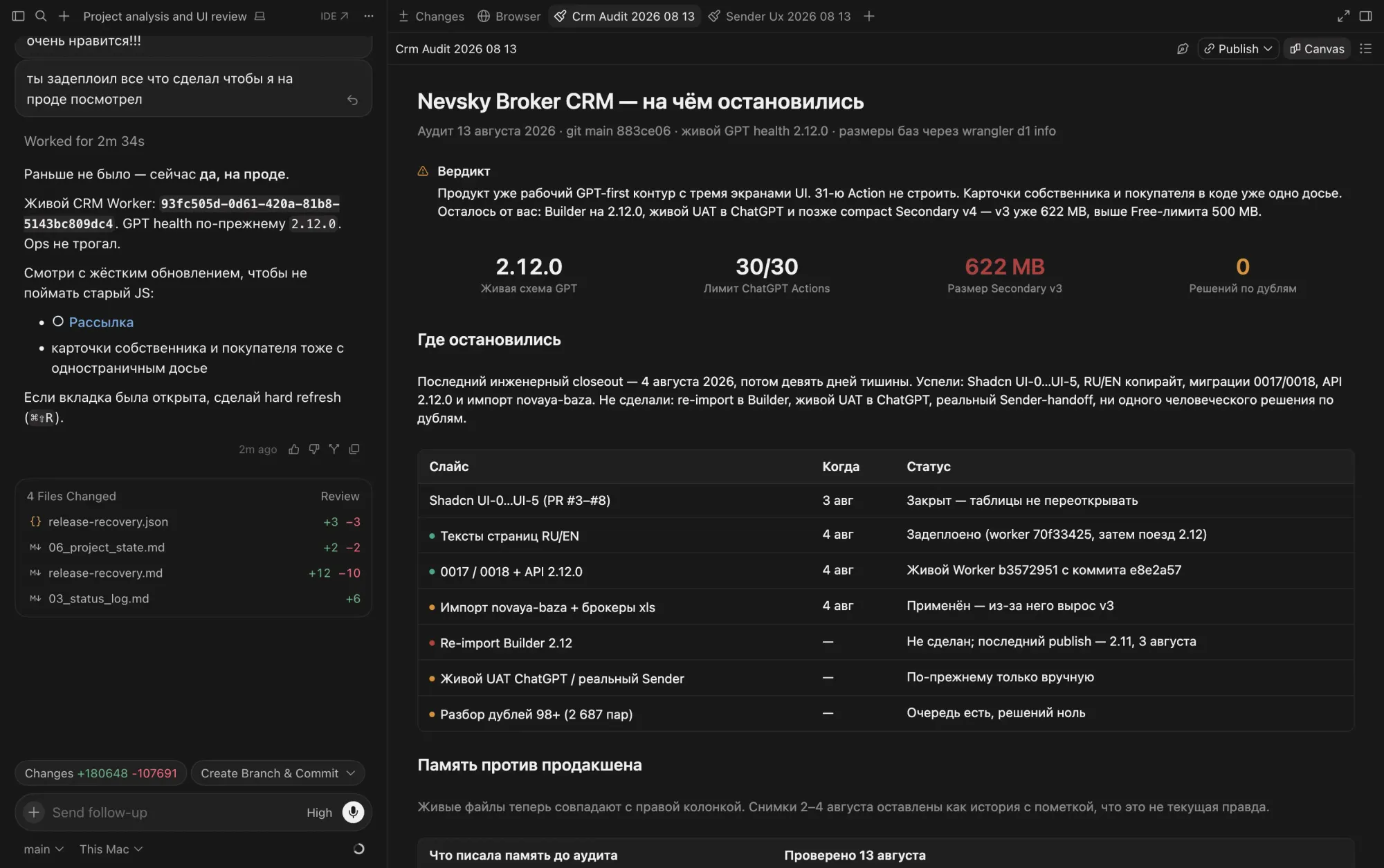
Not at a test Hello World, but at living codebases: working out the structure, looking for weak spots, running an audit, proposing a refactor, looking at the architecture as a whole.
And the first results I like a lot.
The audit mode works especially well right now. The model does not stop at a handful of obvious remarks — it actually starts walking through the project systematically. After exploring the repository it assembles an Audit Canvas — effectively a map of the problems it found and the improvements that might follow — and a surprising amount of useful stuff appears there: architectural simplifications, duplicated logic, old decisions that can already be deleted, room for a proper refactor, component-structure problems, and places you can easily fail to notice for months.
What I like is the character of the work. It first gets fairly deep into the existing project, and only then proposes changes. For large living repositories that is far more valuable than the ability to generate a beautiful piece of code from scratch.
I am still running it through my projects and watching where the real limits of the model sit. So far the impression is very good: Grok 4.6 inside Cursor already feels less like a programmer’s assistant you feed small tasks to, and more like another reasonably strong engineer you can hand an entire line of work.
And that, I think, is what is happening to AI development fastest of all. We talk less and less about which model answers questions better, and more and more about how much of the real work you can hand to an agent entirely — and look in the morning at what it did.


Discussion